How the Arizona Fire Insurance Claim Process Actually Works
A fire claim is a sequence of notices, inspections, sworn documents and deadlines — and almost all of the friction comes from meeting each stage for the first time under pressure.
Short answer: An Arizona homeowners policy pays a fire loss from four separate sections: dwelling, other structures, personal property and loss of use. The claim moves through notice, adjuster inspection, proof of loss, contents inventory and settlement, and Arizona’s claim rule puts clocks on the insurer at the acknowledgement and accept-or-deny stages.
Need a licensed restoration company first?
Call now and we route you to a licensed local company.
📞 Call Now — (612) 886-9863No obligation. We connect you with independent, qualified, licensed local restoration companies — we are a referral service, not a contractor.
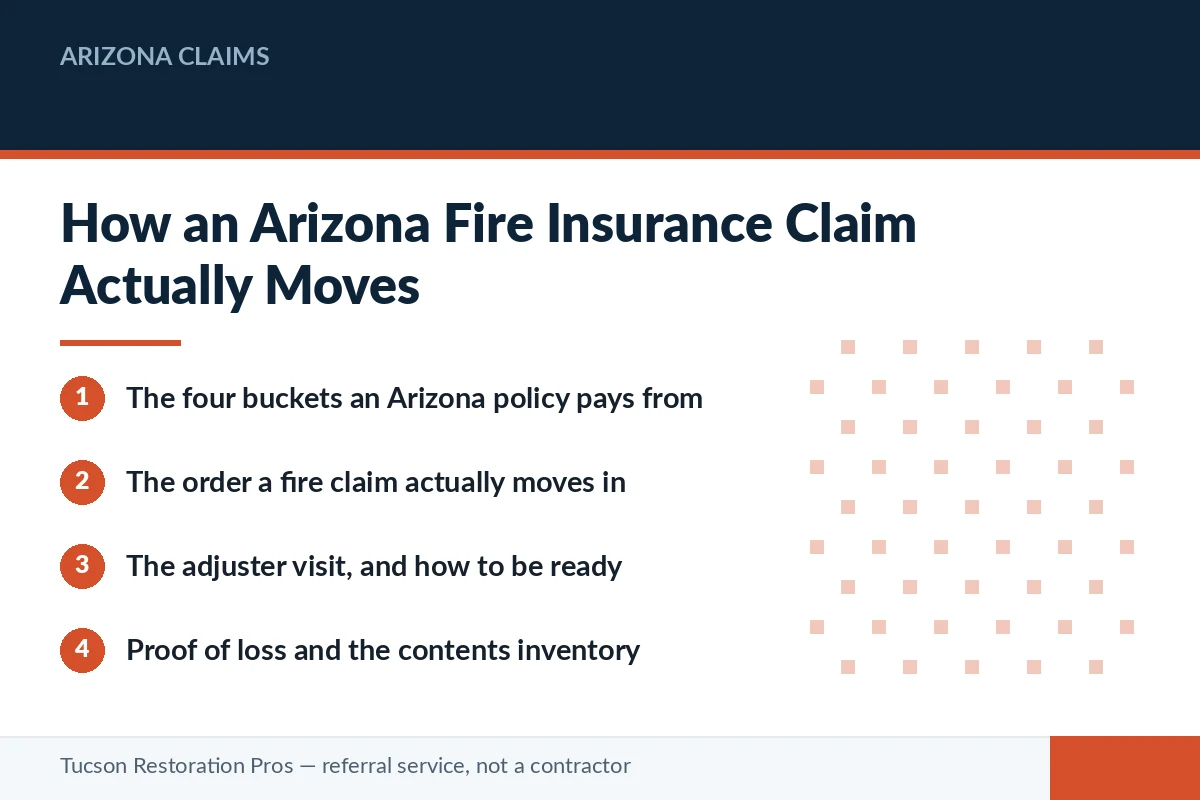
A fire claim is not one decision made by one person. It is a sequence of notices, inspections, sworn documents and deadlines, and almost all of the friction comes from a homeowner meeting each stage for the first time while living out of a suitcase. Knowing the shape of the process in advance is most of the advantage.
This guide is qualitative on purpose. It describes how the Arizona process is structured and what each step is for; it does not quote figures, because coverage, limits and settlement all turn on the wording of your specific policy. Nothing here is legal advice.
The four buckets an Arizona homeowners policy pays from
A standard Arizona homeowners form splits a fire loss across four separate coverage sections, each with its own limit and its own valuation rules. Understanding which bucket a given item falls into explains most of what an adjuster does.
The order a fire claim actually moves in
Notice of loss
You report the fire and get a claim number. Policies impose a duty of prompt notice, so this happens the same day where possible.
Adjuster assigned
Either a staff adjuster or an independent adjuster contracted to cover Pima County for an out-of-state carrier.
Emergency mitigation
Board-up, extraction and drying proceed and are documented. Protecting the property from further damage is a duty under the policy, not a discretionary expense.
Inspection and scope
The adjuster walks the loss and writes a scope of damage, which becomes the estimate the settlement is built from.
Proof of loss and inventory
A sworn statement of what was lost, usually accompanied by a room-by-room contents list.
Payment, supplements and closeout
Initial payment, then supplements as hidden damage surfaces during demolition, then recovery of withheld depreciation once repairs are actually made.
The adjuster visit, and how to be ready for it
The adjuster’s scope is a written opinion about what was damaged and what it takes to put it back. It is not a verdict, and it is routinely revised. The most effective counterweight a homeowner has is documentation produced by the restoration company: moisture maps and daily drying logs, thermal images showing where water travelled, readings that justify equipment placement, and a soot map showing how far residue moved through the ductwork.
Be present for the inspection if you can. Point out what you already photographed, ask for the written estimate rather than a verbal summary, and ask specifically how smoke-affected but unburned areas were scoped — that is where scopes most often come in thin.
Proof of loss and the contents inventory nobody wants to do
A proof of loss is a sworn statement, signed under penalty of perjury, setting out the claim. Policies typically require it on request and within a stated period, so treat a request for one as a hard deadline rather than paperwork. Accuracy matters more than speed — you are attesting to it.
The contents inventory is the part people abandon. Work room by room, photograph as you list, and record description, age, and where each item came from. Garages, sheds and detached casitas hold the items most often forgotten and, in Southern Arizona, often the ones that took heat damage without ever meeting flame.
Actual cash value and replacement cost, as a concept
Two valuation ideas drive most settlement confusion, and neither requires a number to understand.
Actual cash value
What the property was worth in its damaged, used condition at the moment of the loss — replacement cost reduced for age, wear and remaining useful life. A ten-year-old roof is not valued as a new roof.
Replacement cost
What it takes to replace the item with one of like kind and quality today, without the deduction for age. On many policies this is only payable once the repair or replacement has actually been made.
That last condition is why settlements often arrive in more than one instalment: an initial payment on the depreciated basis, and the withheld depreciation released once you show the work was completed or the item was actually replaced. Some depreciation is recoverable in that way and some is not, depending on the policy form. Read which one you have before you assume.
Why your mortgage company’s name is on the loss draft
If there is a loan on the house, the lender is named on the policy as mortgagee and has a financial interest in the structure being repaired. Structural payments are commonly issued jointly and routed through the lender’s loss-draft department, which releases funds in stages as the work progresses and often requires inspections between draws.
This is the single most under-anticipated delay in a fire claim. Contact the loss-draft department as soon as you have a claim number, ask for their packet and their inspection schedule, and build the restoration schedule around it rather than discovering it midway through reconstruction.
Public adjusters, and how Arizona licenses them
Three different people get called an adjuster and they do not work for the same party. A staff adjuster is employed by your insurer. An independent adjuster is contracted by the insurer to handle the file. A public adjuster is retained by the policyholder and represents the policyholder’s interest in valuing and negotiating the claim.
Public adjusters in Arizona are licensed and regulated by the Arizona Department of Insurance and Financial Institutions under Title 20 of the Arizona Revised Statutes, and licensure involves examination, background screening, bonding and continuing education. Before signing anything, confirm the individual holds a current Arizona adjuster license, read the compensation terms and the cancellation terms, and understand that a public adjuster is a negotiator, not a contractor and not an attorney.
The clocks: what Arizona’s claim rule requires
Arizona’s unfair claim settlement practices rule, A.R.S. § 20-461 and its implementing regulation at A.A.C. R20-6-801, puts specific timeframes on insurers handling first-party claims.
| Stage | What the rule requires of the insurer |
|---|---|
| Acknowledgement | Acknowledge receipt of the notice of claim within 10 working days, unless payment is made within that period. |
| Accept or deny | Advise the first-party claimant of acceptance or denial within 15 working days after receiving properly executed proofs of loss. |
| Need more time | If more time is needed to decide, notify the claimant within that same 15-working-day window and give the reasons. |
Your policy imposes deadlines on you too: prompt notice, protecting the property from further damage, cooperating with the investigation, submitting to an examination under oath if requested, and bringing any lawsuit within the contractual suit-limitation period. Those are contract terms, and missing them causes far more denied claims than bad faith does.
If the claim stalls
When a file goes quiet or a denial does not track the policy language, the state regulator is the escalation path. The Arizona Department of Insurance and Financial Institutions takes consumer complaints against licensed insurers, reviews the carrier’s response and determines whether Arizona statutes were violated. A complaint does not replace the appraisal or dispute-resolution clause inside your own policy, but it creates a regulator-level record and often restarts a stalled file.
Documentation discipline beats argument
- One folder, physical or digital, holding the policy, the declarations page, every estimate and every piece of correspondence.
- A dated log of every call: who, when, what was said, what was promised.
- Photographs taken before mitigation, not after, and kept with their original timestamps.
- Every receipt connected to the loss, including the ones you think are too small to matter.
- Written confirmation of anything agreed by phone, sent back by email the same day.
Related reading: Tucson water damage insurance claim help, how to file a water damage claim in Arizona, what water damage Tucson policies typically cover, and the first 24 hours after a house fire.
Working a Fire Claim in Southern Arizona?
Documentation from a licensed restoration company is what a scope gets argued from. Call now and we route the address to an independent, licensed and insured local restoration company. Same-day dispatch is common but not guaranteed.
Arizona fire claim questions
Which parts of an Arizona homeowners policy pay for a fire loss?
How quickly does an Arizona insurer have to respond to a fire claim?
What is a proof of loss and why does it matter?
Why is my mortgage company named on the insurance payment?
What does a public adjuster do in Arizona, and are they licensed?
Is smoke damage handled as a separate claim from the fire?
Claims, coverage & restoration guides
About this guide
Researched and reviewed for Arizona accuracy by the Tucson Restoration Pros team, drawing on A.R.S. § 20-461 and A.A.C. R20-6-801, and on the Arizona Department of Insurance and Financial Institutions. See how we research. We are a referral service, not a licensed restoration contractor, an insurer or a law firm, and nothing here is legal or insurance advice. Coverage is determined by your own policy.
Connect with a Tucson fire restoration company
Call now and we’ll connect you with a qualified, licensed local restoration company near you — 24/7.
📞 Call Now — (612) 886-9863Free, no obligation. We’re a referral service, not a contractor.
Leave a Reply