Water Damage Restoration in Douglas
Douglas has kept more of its original 1901 company-town housing than almost any city in Arizona — a century of brick, adobe, and flat roofs sitting in a basin that drains slowly. We match you with a licensed local restoration pro, 24/7.
Get connected to a Douglas restoration pro
Call now — we route your request to a qualified, licensed local restoration company.
📞 Call Now — (612) 886-9863Free to request. No obligation. We connect you with independent, qualified, licensed local restoration companies — we are a referral service, not a contractor.
Douglas was built all at once and built to last. Laid out in 1901 as the company town for the copper smelter, it holds one of Arizona’s oldest intact housing inventories — street after street of pre-1930 brick and adobe homes, many still carrying their original galvanized supply lines and clay-tile sewer laterals. The town sits at nearly 4,000 feet on the floor of the Sulphur Springs Valley, where Whitewater Draw’s flat basin sheds storm water slowly and monsoon cells rolling off the Chiricahuas and the Mule Mountains have all night to pond against century-old foundations.
How does water damage start in Douglas homes?
Age is the first culprit. Galvanized steel pipe from the smelter era closes up with rust from the inside until pressure finds a seam, and when it lets go it does so inside walls that have been patched, papered, and painted for a hundred years. Clay-tile sewer laterals crack, take on roots, and back up into the lowest fixture in the house. Original gate valves seize open at exactly the moment somebody needs them shut. Every decade of ownership has layered additions onto these homes, and the plumbing splices between eras are where trouble concentrates.
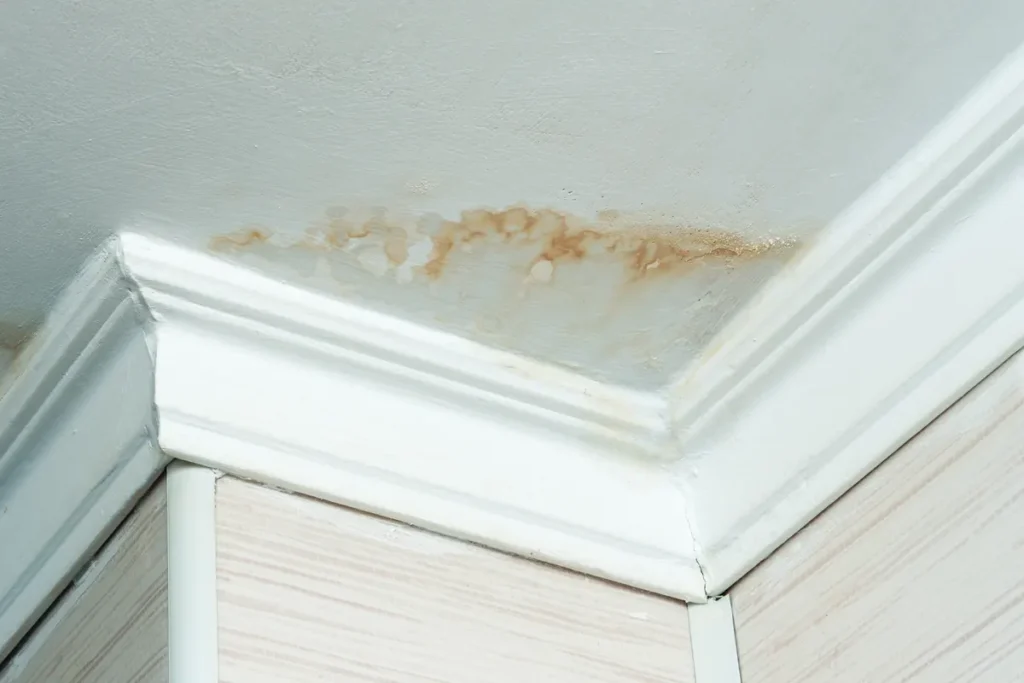
The roofs are the second. Flat and low-slope roofs define the historic blocks, and a flat roof is essentially a shallow pool whose only drains are its scuppers. Leaves, pigeon nests, and mesquite duff plug those scuppers; an August cell drops an inch or two in an hour; and the ponded water works into parapet joints and hairline cracks until a ceiling somewhere lets a stain bloom. Meanwhile the basin floor underneath town drains slowly — 1910 lot grading was never engineered for retention — so storm water stands against foundations for days, wicking up into adobe and rubble-stone footings.
Winter is the third. At 3,990 feet Douglas freezes hard most years, and multi-night cold snaps split uninsulated attic lines, hose bibs, and the supply tubing feeding rooftop coolers that never got drained in October. Homes that sit empty — estate properties, seasonal residences, buildings awaiting renovation — let a February burst run for days before anyone notices the ice on the porch or the meter that never stops turning.
Douglas at a glance
| ZIP codes | 85607 (Pirtleville 85626 adjacent) |
|---|---|
| Jurisdiction | City of Douglas · Cochise County |
| Elevation | 3,990 ft |
| Terrain | Flat Sulphur Springs Valley basin floor at the border |
| Key drainage | Whitewater Draw’s slow-draining basin |
| Housing stock | Pre-1930 brick & adobe company-town core; midcentury additions |
From Douglas we can also connect you for storm & flood cleanup, sewage backup cleanup, and Arizona restoration cost guidance.
What should you do in the first hour?
Stop the source & stay safe
Shut off the water at the fixture or the main (and the power, if it’s safe). Keep people clear of sagging ceilings, contaminated water, and anything electrical that got wet.
Document it
Photograph and video everything before cleanup begins — your insurance claim is built on what you capture in these first minutes.
Get a local crew moving
We connect you with a qualified, licensed Douglas-area restoration company — fast. The EPA’s 24–48 hour window to limit mold starts now, not when the adjuster calls back.
Water, fire or mold damage in Douglas?
Get connected with a qualified, licensed local restoration crew — 24/7 across Douglas and statewide Arizona.
Can Douglas’s century-old homes be dried without ruining them — and who actually responds?
The historic fabric rewards patience. Douglas adobe is typically lime-plastered and painted over generations, which means a wetted wall is a layered system: moisture gets trapped between the plaster skin and the mud brick behind it, where a surface meter reads dry while the wall core stays wet. Good practice here is drill-point or deep-probe readings at the wall base, dehumidification run steadily rather than aggressively, and plaster opened only where readings prove the wall cannot release its moisture on its own. Brick homes carry their own caution — the soft historic mortar between smelter-era bricks erodes if drying turns into pressure-washing enthusiasm. What these buildings need is a crew that treats them as irreplaceable, because they are.
Now the honest part: Douglas is a long way from the mitigation industry’s home bases. Most crews that serve Cochise County dispatch from Sierra Vista, roughly an hour out, or from Tucson, closer to two. Nothing about that changes the 24–48-hour window in which wet materials start growing mold — so the first hours belong to the homeowner. Shut the source, kill power to wet circuits, photograph and video every room before touching anything, move rugs and furniture off wet floors, and start air moving with whatever fans the house owns. A Douglas homeowner who does that has materially changed the outcome before the truck clears Bisbee.
The basin adds a slower kind of loss. Whitewater Draw’s catchment is table-flat, so monsoon water ponds rather than races — against stem walls, into crawl spaces, under additions poured directly on grade. Ponded storm water that enters a structure is still contaminated Category 3, and it is still rising water, which homeowners policies exclude; our Arizona monsoon flood insurance guide walks through the flood-policy side. After any ponding event, the smell test lies — adobe and old wood release moisture for weeks, so verified drying with instruments matters more here than almost anywhere.
And because these homes are old, losses compound: a roof leak finds hundred-year-old wiring, a freeze burst soaks a plaster ceiling that then sags, a small kitchen fire adds smoke to an already-wet wall. The network we connect you with handles water, fire, and mold as one response, and our Arizona restoration cost guide explains how scope — not distance — drives what a loss involves.
What restoration help is available in Douglas?
Emergency Water Removal
Standing water extracted before it soaks another century-old floor — dispatch across the historic district and the newer east-side blocks.
Storm & Flood Cleanup
Basin ponding and mountain-cell runoff are contaminated Category 3 — extraction, tear-out, disinfection, and instrument-verified drying.
Frozen & Burst Pipe Damage
Multi-night hard freezes split attic lines and hose bibs at 4,000 feet — thaw-flood extraction and cavity drying, documented for your carrier.
Sewage Backup Cleanup
Clay-tile laterals from the smelter era crack and root — backups cleaned under containment with disinfection and safe disposal.
Structural Drying & Mold Control
Deep-probe readings and steady dehumidification until lime plaster and adobe verify dry at the core — not just at the surface.
Insurance Claim Help
What to photograph, when to notify, and how Arizona claims move — with the documentation burden a remote town makes heavier.
Douglas restoration FAQs
Which Douglas areas do you cover?
How long will a crew take to reach Douglas?
My flat roof ponded and now the ceiling is stained — which is the emergency?
Is a soaked adobe wall in Douglas a total loss?
About this guide
This page is researched, written, and reviewed for local accuracy by the Tucson Restoration Pros team. It draws on primary and scientific sources — including the IICRC S500/S700 restoration standards, the U.S. EPA and CDC on mold, the WHO guidelines on dampness and mould, NWS Tucson forecasts and monsoon climatology, University of Arizona CLIMAS research, FEMA flood maps, and Cochise County Flood Control District resources. See how we research. Tucson Restoration Pros is a referral service that connects Arizona homeowners with independent, qualified restoration companies; we are not a licensed restoration contractor and do not perform the work ourselves.
Arizona cities we serve
Connect with a Douglas restoration crew
Call now and we’ll connect you with a qualified, licensed local restoration company near you — 24/7.
📞 Call Now — (612) 886-9863Free, no obligation. We’re a referral service, not a contractor.