Tucson Monsoon Flood & Mold Prevention Guide
How monsoon water actually gets into Tucson homes, flash-flood and wash safety, the first-48-hours mold clock, and what to document for insurance — compiled from NWS Tucson, Pima County, and IICRC sources.
What’s in this guide
- How monsoon water gets into Tucson homes
- Flash-flood & wash safety
- The first 24–48 hours (the mold clock)
- Desert-specific mold dynamics
- Drying & documentation for insurance
- When to call a pro
- Monsoon season & Pima County washes
- Frequently asked questions
- Embed this checklist
- Sources & further reading
How monsoon water actually gets into Tucson homes
Arizona’s monsoon delivers roughly half the Southwest’s annual rainfall in a few intense months — and it finds its way in through a handful of predictable paths.
Wind-driven rain & haboobs
A monsoon haboob can push a wall of dust ahead of intense, sideways rain. Wind-driven rain gets forced under exterior doors, around window frames, and through gaps that never see water in an ordinary drizzle.
Flat & low-slope roof ponding
Much of Tucson’s housing stock uses flat or low-slope roofing, common in desert construction. Ponding water during a heavy cell can exceed the roof’s drainage capacity and find a seam, parapet, or scupper that leaks into the ceiling below.
Grading & drainage around the slab
Many Tucson homes sit on slab foundations with minimal surrounding vegetation to slow runoff. Where grading channels water toward the house instead of away from it, even moderate rain can pond against a foundation and seep in at the base.
Flash flooding from washes
Properties near or downstream of a wash can see water arrive fast and from a storm cell that isn’t even overhead locally — runoff from higher elevation can turn a dry wash into a moving hazard within minutes.
Flash-flood & wash safety
Pima County’s wash system is designed to move storm water — which means it can move a lot of water, fast, with very little warning.
A few practical rules for monsoon season: check Pima County Regional Flood Control District alerts before driving during or right after a storm cell, avoid parking or camping in or near a wash channel, and treat a dry wash as a “not currently flowing” condition, not a “safe” one — conditions upstream can change in minutes.
The first 24–48 hours: the mold clock
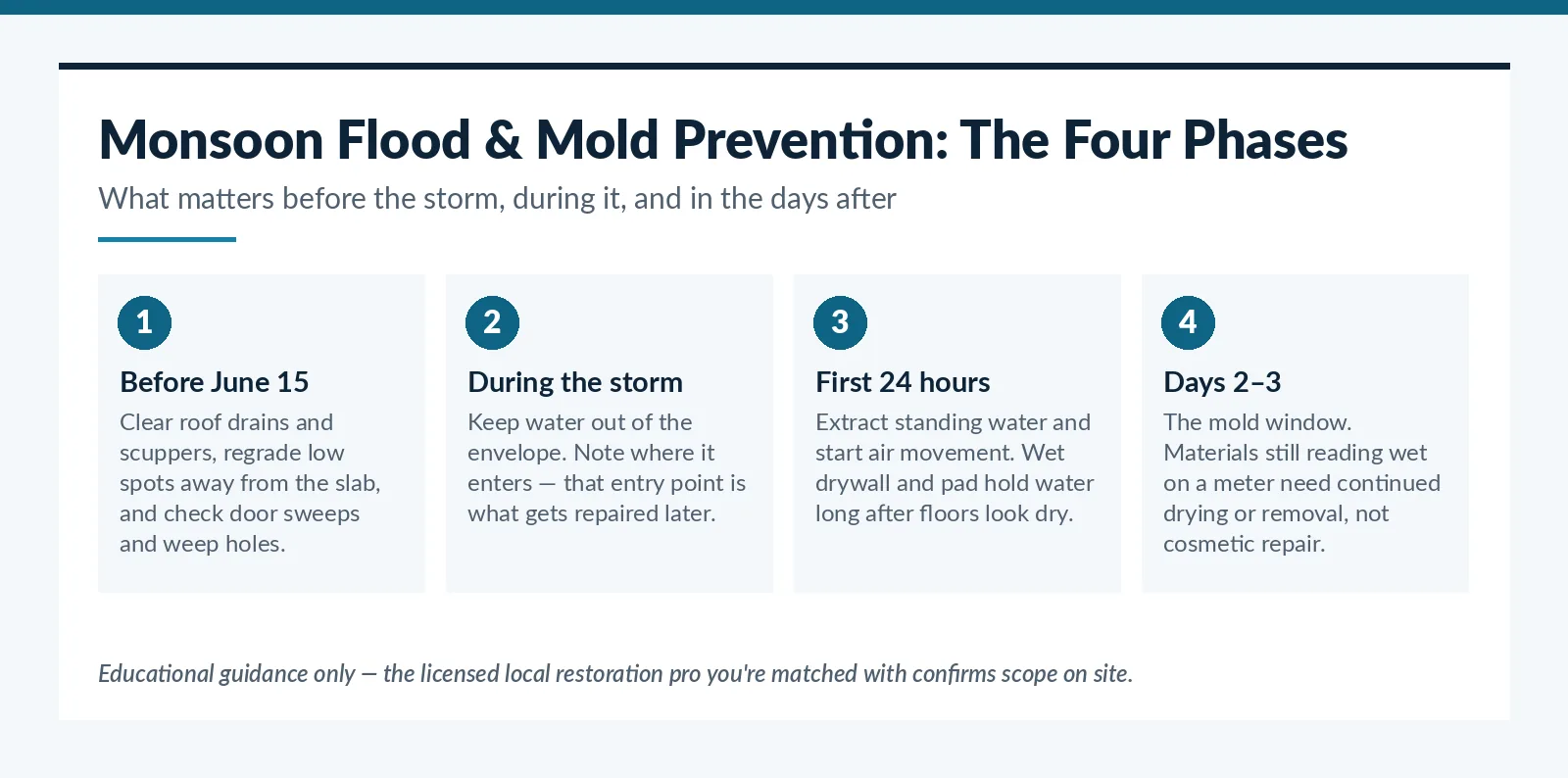
This is the highest-leverage window of the entire event. What you do here determines whether this is a same-week dry-out or a much bigger remediation job.
Confirm safety before re-entering
Never step into standing water near outlets or a breaker panel until power to that area is confirmed off. Watch for sagging ceilings or buckled flooring before walking in.
Stop the source if it’s safely reachable
Roof leak, plumbing failure, open window — address what you can safely reach. Don’t attempt to block active flash-flood water from outside during the storm itself.
Photograph everything before you move anything
Standing water, affected walls and flooring, and the visible source, before cleanup starts. This is what insurers ask for most often.
Remove standing water immediately
Wet-vac, mop, or pump it out. The mold clock starts when material gets wet, not when you get around to cleaning it up.
Pull out saturated soft materials
Rugs, cushions, and soaked cardboard hold moisture long after visible water is gone, and are frequently where mold establishes first.
Increase airflow, reduce humidity
Open windows if outdoor humidity allows, run fans, add a dehumidifier if you have one. Getting materials under roughly 60% relative humidity meaningfully slows mold growth.
Re-inspect at 24 hours, then 48 hours
Materials still wet at the 48-hour mark carry meaningfully higher mold risk and may need commercial drying equipment.
Call a pro if drying isn’t keeping pace
Still damp at 48 hours, water reached a wall cavity or subfloor, or you notice a musty smell — time to bring in a licensed local restoration company.
Desert-specific mold dynamics
The “it’s too dry here” myth
Mold needs moisture and time, not a humid climate as a baseline. A monsoon intrusion, a swamp cooler leak, or an AC condensate line backup can create a locally wet, humid pocket inside a wall cavity or attic for days — even while the outdoor climate stays bone dry.
Swamp coolers add a second pathway
Evaporative (“swamp”) coolers are common on Tucson roofs and add their own leak risk independent of weather — a slipped float valve or clogged pad can drip into a ceiling for days before anyone notices, creating the same mold-clock conditions as a storm.
24–48 hours is the real number
Under normal indoor conditions, visible mold growth can begin on wet drywall paper, wood, or carpet padding within roughly one to two days of sustained moisture — regardless of how arid the region is overall.
Where it hides
Behind baseboards, under carpet padding, inside wall cavities behind an exterior wall that took wind-driven rain, and in attic insulation below a roof leak — all places a quick visual check can miss.
Drying & documentation for insurance
Visually dry is not the same as moisture-meter dry — and insurers care about the difference.
| Do this | Why it matters |
|---|---|
| Photograph/video before touching anything | Establishes the sudden, storm-related nature of the intrusion |
| Note the date, approximate time, and apparent source | Insurers ask for a timeline, not just photos |
| Log every drying step taken (fans on/off, dehumidifier hours, materials removed) | Shows a reasonable, documented mitigation effort |
| Keep receipts for any fans, dehumidifiers, or disposed materials | Supportable as mitigation costs in many claims |
| Get a moisture-meter reading before closing up drywall or flooring | Confirms actual dryness, not just surface appearance |
When to call a pro
Water reached a wall cavity, subfloor, or ceiling
These spaces trap moisture longer than an open floor and are hard to verify dry without a moisture meter.
Drying isn’t visibly working by 48 hours
Fans and open windows can only do so much — commercial air movers and dehumidifiers close the gap fast.
The water was contaminated
Sewage backup or flood water from outside the home carries a different risk category and calls for professional handling, not DIY.
You notice a musty odor anywhere nearby
Smell often shows up before visible growth does — treat it as a signal to check, not something to ignore.
Free to check availability. A qualified, licensed local restoration company handles the work and gives any estimate directly.
Monsoon season & Pima County washes
For historical flood events, exact wash-overflow timing, and dust-storm frequency data behind these patterns, see our sourced Tucson Monsoon Season Data & Home Flood-Risk Reference.
Official monsoon season
The National Weather Service’s official Arizona monsoon runs June 15 through September 30, with the heaviest activity typically in July and August. Storm cells are often highly localized — one neighborhood can flood while another a few miles away stays dry.
Pima County’s wash network
Washes cut through much of the metro area, including neighborhoods like Rita Ranch, Vail, and parts of the Catalina foothills. Pima County Regional Flood Control District maintains flood-control infrastructure and public flood-stage information for many of these channels.
Neighborhood variety
From dense in-town lots near Sam Hughes and Barrio neighborhoods to newer growth corridors in Marana, Sahuarita, Green Valley, and Dove Mountain, drainage patterns and roof types vary enough that “how water gets into a house” looks a little different block to block — the mechanisms above are the ones to check first regardless of neighborhood.
Frequently asked questions
How does monsoon water actually get into a Tucson home?
Is it true that flash floods in Tucson can happen even without rain overhead?
Why does mold matter in a desert climate like Tucson?
What is the mold clock and why do the first 48 hours matter so much?
What should I document for an insurance claim after monsoon water damage?
Does homeowners insurance cover monsoon flood damage in Arizona?
How long does drying actually take after water intrusion?
When should I call a professional instead of handling it myself?
Embed this free checklist on your site
HOAs, neighborhood sites, and local blogs are welcome to embed this checklist free — just copy the code below onto your page. Attribution back to this guide is built in.
Sources & further reading
- National Weather Service Tucson — Monsoon — official monsoon season dates and local forecasting
- NWS — Turn Around, Don’t Drown — flash-flood and wash safety guidance
- Pima County Regional Flood Control District — local flood infrastructure and alerts
- IICRC S500/S700 Standards — professional water & mold restoration standards
- U.S. EPA — A Brief Guide to Mold, Moisture and Your Home
- CDC — Mold and Health
- Ready.gov — Floods
- University of Arizona CLIMAS — Southwest monsoon climate research
This guide is an independent reference compiled by the Tucson Restoration Pros team from the public sources above. See how we research. It is provided free, with no sign-up, as a resource for Tucson-area homeowners. Tucson Restoration Pros is a referral service that connects homeowners with independent, qualified restoration companies; we are not a licensed restoration contractor and do not perform the work ourselves.
Dealing with monsoon water damage right now?
Call now and we’ll check availability with a qualified, licensed local restoration crew.
Related reading
- End-of-Monsoon Mold Checklist for Tucson Homes — A room-by-room walkthrough of the five places Tucson homes hide mold, before the June 15–September 30 season closes out.
- Musty Smell but No Visible Mold in Your Tucson Home? — Why that odor means more in desert air than in a humid city, and how to track it back to a wall cavity, cooler, or slow cabinet leak.
- How Fast Does Mold Grow After Water Damage? Timeline and Prevention — The hour-by-hour growth timeline once water gets in, and which building materials colonise first.
- Central AC & Monsoon Humidity: Tucson Mold Risk — Monsoon dew points sharply increase central-AC condensate; a clogged drain line or failed overflow switch backs that water into the house.
- Why Tucson’s Evaporative Cooler Ducts Are a Hidden Mold Risk — Where moisture collects inside swamp-cooler ductwork during a humid monsoon stretch, and why it usually goes unnoticed.
- How to Dry Out a Flooded Room in the Desert — Why “it feels dry” is misleading, and the setup that actually pulls water back out of materials rather than the air around them.