Fire Damage Restoration in Tucson, AZ
A structure fire leaves three problems at once: what burned, what the suppression water soaked, and what the smoke touched. Call now and we connect you with a licensed, insured local company.
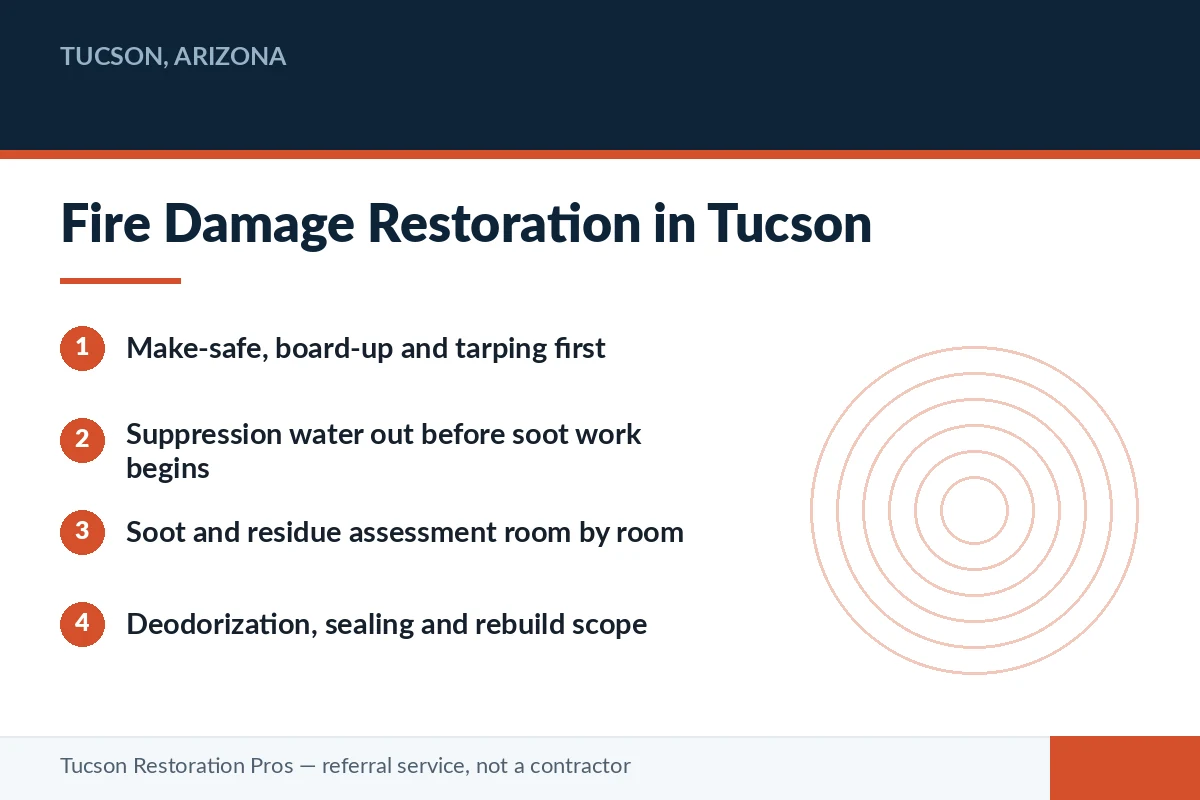
Quick answer: Fire restoration in Tucson starts with board-up and utility shutoff, then suppression-water extraction, structural drying, soot cleaning, deodorization and rebuild. Because that water sits in a house still holding desert heat, the mold clock starts within 24 to 48 hours.
Get connected to a Tucson fire pro
Call now to reach a licensed local company.
📞 Call Now — (612) 886-9863Free to request. No obligation. We connect you with independent, qualified, licensed local restoration companies — we are a referral service, not a contractor.
Three things line up in Pima County that do not line up elsewhere: the desert cures to tinder by late May, the grid runs flat out through weeks of 110°F-plus afternoons, and the monsoon that breaks the heat brings some of the country’s most frequent cloud-to-ground lightning. When a structure fire follows, char is only part of the loss — the water used to knock it down is now in the walls of a house still over 100°F.
Why Tucson structure fires behave differently
Most fire-restoration guidance assumes a pitched-roof house in a humid climate. Much of Tucson is slab-on-grade with low-slope roofs and attic-mounted equipment. A low-slope roof pools suppression water instead of shedding it, and an attic fire above a slab home drains down wall cavities onto a floor that cannot drain.
The property line matters too: along the wildland-urban interface in the Catalina Foothills, Tanque Verde, the Redington Pass fringe and the Tortolita foothills above Marana and Dove Mountain, drought-cured brush runs to the wall.
Tucson fire damage at a glance
| Ignition sources | Lightning, electrical overload, aging wiring, attic equipment, brush |
|---|---|
| Peak risk | Late May – September |
| Risk assemblies | Attics, low-slope decks, panels, AC closets, soffit vents |
| Secondary clock | 24–48 hours to mold |
| Standards | IICRC S700, S500 |
This page covers structure fire restoration. For soot and odor with no burn, see smoke damage restoration.
Six ignition patterns that repeat here
Monsoon lightning
Mid-June into September, strikes tracked by NWS Tucson ignite roof decking and attic framing as rain falls on the opening.
Summer electrical overload
Weeks above 110°F punish condensers and older panels; failed compressor windings recur in Rita Ranch, Civano and Midvale Park.
Aging mid-century wiring
Sam Hughes, Midtown, Flowing Wells and Drexel Heights homes still carry aluminum branch wiring and knob-era retrofits that arc.
Brush at the structure
On the WUI edge above Marana, Oro Valley and the Foothills, palo verde and mesquite litter carries flame to the eave.
Attic-mounted equipment
Package units, evaporative coolers and their wiring bake in attic spaces all summer; a fault there burns unseen until it breaks the ceiling.
Historic adobe
In Barrio Viejo and Armory Park, adobe walls hold suppression water in ways frame construction does not, so drying is slower.
The first 24 hours after a house fire
What happens between the last hose line and the first drying equipment decides how much of the house survives. USFA After a Fire and the Red Cross cover general safety; below is the Tucson sequence.
Do not re-enter until the structure is released
Tucson Fire Department or your district has to clear it — fires reignite in wall cavities. Confirm gas and power are off; leave breakers alone until the utility checks them.
Get the building boarded up and tarped
Open walls and a breached roof invite monsoon rain, dust and theft.
Photograph before anything is moved
Wide shots of every room, close shots of contents, plus roof and exterior — captured before cleanup, not reconstructed later.
Do not wipe, sweep, or run the HVAC
Dry-wiping grinds soot into paint; the air handler pushes it into rooms that never saw fire.
Get a licensed restoration company on site
Drying starts while the building is still being secured. Call now and we route your job to a licensed local company.
The fire-plus-water double hit
Putting out a house fire takes a great deal of water, and none of it leaves on its own. On a slab-on-grade Tucson home there is no basement to drain into — it pools on the slab, wicks up drywall and saturates pad, insulation and toe-kicks. In a house still radiating summer heat, the mold window is 24 to 48 hours.
Three overlapping damage layers
Layer two is its own loss, so most Tucson fire jobs run a parallel drying scope: water damage restoration, cleanup, mold remediation, monsoon flood cleanup.
What fire restoration actually involves
The licensed local company you are matched with works to ANSI/IICRC S700 for fire and smoke and S500 for water. Sequence matters: cleaning before the structure is dry gets redone.
Structure fire or smoke-only damage?
Fire insurance claims in Arizona
Damage from a sudden, accidental fire is typically covered under the dwelling coverage of a standard Arizona homeowners policy; belongings fall under personal property, and hotel costs while the home is uninhabitable fall under loss of use, often labelled additional living expenses. Smoke and soot are usually part of the same claim.
Points that recur on Tucson fire claims: document before you clean, keep receipts, do not discard damaged contents before the adjuster inventories them, and treat board-up as protecting the property rather than an optional cost. If scope is disputed, a licensed Arizona public adjuster works for you. See our claim help and how to file in Arizona guides.
Neighborhoods and ZIP codes
Catalina Foothills, Oro Valley, Marana, Dove Mountain, Casas Adobes, Flowing Wells, Sam Hughes, Midtown, Downtown, South Tucson, Drexel Heights, Midvale Park, Tanque Verde, Civano, Rita Ranch, Vail, Corona de Tucson, Sahuarita, Green Valley.
Fire Damage at Your Tucson Home?
Call now and we connect you with a licensed, insured local company, 24/7 across Pima County. Same-day dispatch is common but not guaranteed.
Tucson fire damage restoration FAQs
What should I do in the first hour after a house fire in Tucson?
Is fire damage covered by homeowners insurance in Arizona?
Does the water the fire department used cause its own damage?
How is this different from smoke damage restoration?
Why are Tucson house fires tied to the monsoon and the summer heat?
Do I have to move out during fire damage restoration?
How long does fire damage restoration take in the Tucson area?
Related fire, smoke & water guides
About this guide
Researched and reviewed for local accuracy by the Tucson Restoration Pros team, drawing on ANSI/IICRC S700, S500, USFA After a Fire, Red Cross and NWS Tucson data. See how we research. We are a referral service, not a licensed restoration contractor.
Related reading
- Fire vs Smoke Damage: What’s the Difference and How to Recover — Why smoke contamination normally reaches much further than the flames did, and how insurance treats the two differently.
Connect with a Tucson fire restoration company
Call now and we’ll connect you with a qualified, licensed local restoration company near you — 24/7.
📞 Call Now — (612) 886-9863Free, no obligation. We’re a referral service, not a contractor.