Mold Remediation in Dallas–Fort Worth, TX
Gulf humidity, oversized AC systems and slow slab and roof leaks make DFW attics and HVAC closets prime mold ground. Enter your ZIP and we connect you with a Texas-licensed local mold company.
Quick answer: Mold remediation in Dallas–Fort Worth means finding and fixing the moisture source first, then containing the area, removing affected material under negative air, and verifying the work. Texas is one of the few states that licenses this: under TDLR rules, a mold project affecting 25 or more contiguous square feet must be handled by a licensed mold remediation contractor, with assessment done by a separate licensed assessor.
Get connected to a DFW mold pro
Enter your ZIP to reach a Texas-licensed local company.
Free to request. No obligation. We connect you with independent, qualified, licensed local restoration companies — we are a referral service, not a contractor.
Mold is a moisture problem before it’s a mold problem, and Dallas–Fort Worth supplies the moisture: a long humid cooling season, tight modern construction, oversized AC that cools without dehumidifying, and slow slab and roof leaks. Texas is also one of the few states that licenses this work, which changes how a real remediation job is run here.
How Dallas–Fort Worth homes take this damage
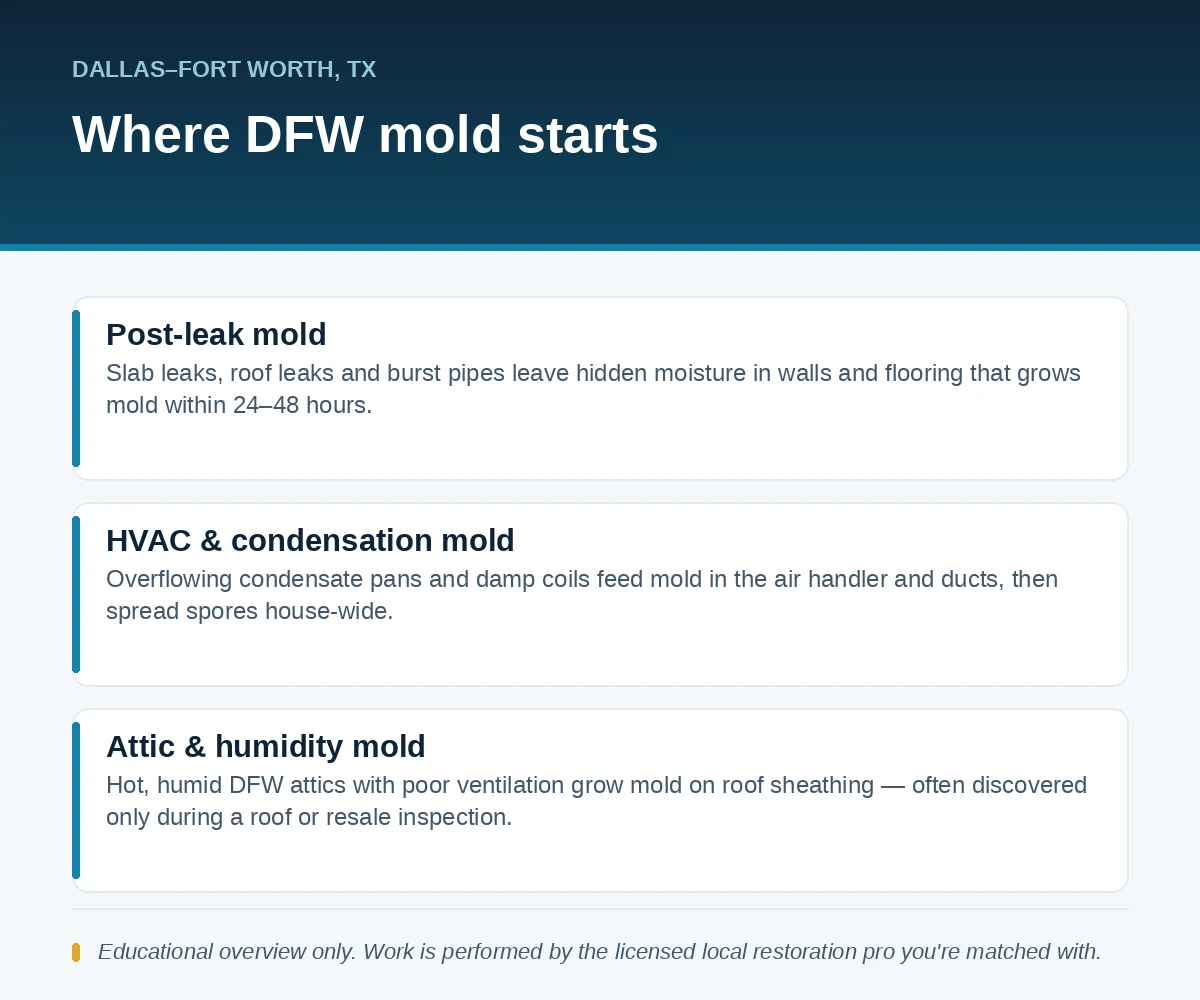
Post-leak mold
Slab leaks, roof leaks and burst pipes leave hidden moisture in walls and flooring that grows mold within 24–48 hours.HVAC & condensation mold
Overflowing condensate pans and damp coils feed mold in the air handler and ducts, then spread spores house-wide.Attic & humidity mold
Hot, humid DFW attics with poor ventilation grow mold on roof sheathing — often discovered only during a roof or resale inspection.How mold remediation works in Texas
Find & fix the moisture source
Remediation that skips the leak or humidity source fails. The source — slab leak, roof leak, condensate overflow — is found and corrected first.
Containment & negative air
The area is sealed under negative air pressure with HEPA filtration so spores don’t spread during removal.
Remove & HEPA-clean
Affected porous materials are removed, and surfaces are HEPA-vacuumed and wiped per IICRC S520.
Verify & clear
For larger Texas jobs a licensed assessor’s clearance test confirms the work before rebuild.
DFW ZIP codes we cover
The dispatch line routes across the full Dallas–Fort Worth metroplex — Dallas, Fort Worth and the suburbs below. Enter your ZIP and it connects you to a licensed local company that works your area.
Mold insurance claims in Texas
Texas policies vary on mold. Mold from a sudden covered water loss may be covered up to policy limits, while mold from long-term humidity or a neglected leak is usually excluded. Document the moisture source and check your specific policy; for larger jobs Texas requires separate licensed assessment and remediation, which keeps the scope honest.
Mold in your DFW home?
Enter your ZIP and we connect you, 24/7, with a licensed local restoration company that works your part of the metroplex. Free to request, no obligation — the company you are matched with handles the inspection, the pricing and the work.
Dallas–Fort Worth mold FAQs
Does Texas require a license for mold remediation?
Why is mold so common in DFW homes?
Where does mold usually hide in a DFW house?
Should I test for mold before remediation?
Is mold covered by homeowners insurance in Texas?
Can’t I just use bleach on it?
Does it cost anything to call?
Related DFW restoration guides
About this guide
Researched and reviewed for Dallas–Fort Worth accuracy by the Tucson Restoration Pros team, drawing on ANSI/IICRC S520 mold standards, EPA mold guidance and Texas’ own TDLR mold licensing rules. We connect you with independent, licensed local companies — we are a referral service, not a contractor.
Connect with a DFW restoration company
Enter your ZIP and we’ll connect you with a qualified, licensed local restoration company near you — 24/7.
Free, no obligation. We’re a referral service, not a contractor.