Free live match · ROC-licensed pros 📞 (866) 695-5058
Dealing with Mold Testing and Inspection in Tucson, AZ in metro Tucson or Pima County, AZ (ZIPs 85701–85755)? Whether your loss involves a roof-mounted evaporative cooler leak, a slab-on-grade pipe burst over caliche clay, or post-monsoon mold behind drywall, wet materials cross the U.S. EPA’s 24–48 hour mold threshold rapidly. Call (866) 695-5058 24/7 to get matched live with an independent, licensed local Tucson restoration company.
Need a Licensed Crew in Tucson & Pima County, AZ?
Before you call — have ready: (1) Your 5-digit ZIP code, (2) What got wet or damaged, and (3) When it started.
Free live match · ROC-licensed pros 📞 (866) 695-5058
Mold Testing & Infrared Moisture Inspection in Tucson, AZ
Not sure if that musty smell or ceiling stain is actually mold — or how much of it? Call now and we’ll connect you with a local mold testing and inspection crew, 24/7.
Quick answer: Mold testing and inspection determines whether a musty smell or ceiling stain is actually mold, what species it is, and how far it’s spread — through visual inspection, moisture mapping, and often lab-based air or surface sampling. Guessing wrong wastes money on the wrong fix. We connect you with a local inspector for an independent assessment, 24/7.
Get Connected in Minutes
Call now and tell us code and we’ll connect you with a local, independent mold testing and inspection company serving Tucson.
📞 Call Now — (866) 695-5058No cost to use this service. We connect you — independent local companies perform the work.
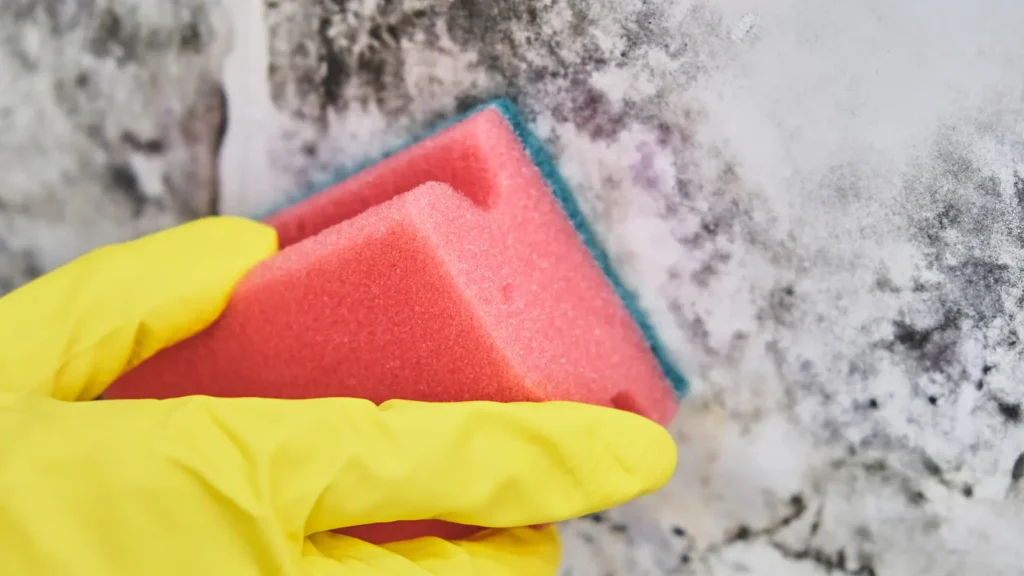
When Tucson Homeowners Actually Need Mold Testing
Tucson Restoration Pros is a dispatch and referral service. We connect Tucson homeowners with independent, licensed local mold testing and remediation companies that carry their own insurance and perform the actual inspection or work — we are not a contractor and do not do the work ourselves. Testing and remediation are two different services, and Tucson’s dry climate makes the distinction more important here than in humid regions, since visible mold doesn’t always behave the way people expect.
If mold is already visibly growing on a wall, ceiling, or in a crawlspace, most remediation professionals will tell you testing isn’t strictly necessary — you can see the problem, so the next step is remediation, not a lab report confirming what’s already obvious. Testing earns its value in a different set of situations: a musty smell with no visible growth, a home inspection ahead of a Tucson real estate purchase, post-remediation clearance testing to confirm a remediation job actually worked, or air-quality concerns in a home with unexplained respiratory symptoms. Tucson’s aggressive monsoon-to-dry-season humidity swings mean moisture can get trapped behind drywall, under flooring, or inside a swamp cooler-fed ceiling cavity without ever producing a visible stain on the surface. If you need help, see our page on commercial mold remediation.
Visual inspection vs. lab-based testing
A visual inspection — checking known moisture-risk areas like attic decking, crawlspaces, under-sink cabinets, and swamp cooler ceiling penetrations — is the first step most independent inspectors take. Lab-based testing, which can include air sampling, surface swabs, or tape lifts sent to a third-party laboratory, adds objective data when the visual inspection alone can’t answer the question, such as identifying mold species or confirming air quality has returned to baseline after remediation work is finished. If this sounds familiar, our piece on mold remediation vs. mold removal is worth a read.
Situations Where Testing Makes Sense
- Buying or selling a Tucson home and want documentation of current conditions
- A musty odor with no visible mold growth anywhere accessible
- Confirming a remediation job is complete before reoccupying a space (clearance testing)
- Unexplained allergy or respiratory symptoms that improve when away from the home
- A recent water event (swamp cooler leak, monsoon flooding, slab leak) where you want to rule out hidden growth behind drywall or under flooring
- Landlord/tenant disputes needing third-party documentation
What Happens After You Get Connected
Call now and tell us & the concern
A quick form — no phone tag, no hold music. Let us know what prompted the concern, whether it’s a smell, a stain, or a recent water event.
Get matched locally
We connect you with an independent, licensed mold testing or remediation company already working in the Tucson area.
Inspection & sampling
The local inspector assesses moisture-risk areas and, if warranted, collects samples for third-party lab analysis, then walks you through the results.
Smell mold but can’t find the source?
Call now and get connected with a local mold inspection crew today.
What Homeowners Typically Encounter
A basic visual inspection is generally the most affordable option, while lab-based air or surface sampling adds cost for the analysis itself, and clearance testing after a completed remediation project is often priced separately from the initial inspection. Industry data generally places a standalone Tucson-area mold inspection somewhere in the low hundreds of dollars, with lab sample fees added on a per-sample basis; a combined inspection-plus-remediation project scales up from there based on square footage and materials affected. This range reflects the broader industry, not a quote from Tucson Restoration Pros or any company we connect you with — your local inspector will scope your specific situation.
Hiring a mold inspector in Tucson: what to ask
A mold inspection in Tucson should tell you three things: where the moisture is coming from, how far the growth goes, and whether the area needs professional remediation. Arizona doesn’t issue a separate state license for mold inspectors, so credentials come from training bodies such as the IICRC or ACAC. Ask which certification the inspector holds and what the inspection includes before you book.
What a Tucson mold inspection usually includes
- A visual walk-through of the rooms you’re worried about, plus the usual Tucson trouble spots: under swamp-cooler vents and around the roof curb, ceilings under flat roofs, around water heaters, and walls next to AC condensate lines.
- Moisture mapping with a moisture meter, often with a thermal camera, to find wet drywall or subfloor you can’t see. Finding the moisture matters more than finding the spores.
- Air or surface samples, if they’re useful. Air samples are compared with an outdoor sample taken the same day. Tucson’s outdoor spore levels change with the seasons and rise during monsoon humidity, so a sample without an outdoor comparison doesn’t tell you much.
- A written report that names the source, the affected area, and whether the job is small enough to handle yourself.
When you can skip testing
If you can already see mold growth, sampling usually isn’t needed. The EPA says so directly: the money is better spent fixing the moisture and removing the growth. Testing earns its cost when you smell mold but can’t find it, when you need documentation for a landlord, buyer or insurer, and for clearance testing after remediation to confirm the space is back to normal.
Should the same company test and remediate?
It’s allowed, but many homeowners prefer an inspector who doesn’t also sell the cleanup. That way the report isn’t tied to the size of the job. At minimum, ask for the moisture readings and lab results in writing so you can get a second opinion.
How the call works, and how to check the company before you sign
- You call (866) 695-5058. The line is answered 24/7 and connects you to an independent restoration company that covers your ZIP code. Tucson Restoration Pros is a referral service. We don’t send crews and we don’t do the work.
- You deal with that company directly. They tell you their arrival time, scope and price. Any contract is between you and them, and you’re free to say no.
- Check them before work starts. It takes about two minutes:
- Ask for their Arizona ROC license number and look it up on the Arizona Registrar of Contractors license search. Check that the license is active and that its class covers the work.
- Arizona requires an ROC-licensed contractor for any job over $1,000 in labor and materials, or any job that needs a building permit (A.R.S. § 32-1121). Drying plus rebuild after a leak is almost always over that line.
- Ask whether their technicians are IICRC-certified (Water Restoration Technician, or Applied Microbial Remediation Technician for mold). You can confirm a firm on the IICRC Global Locator.
- Get the scope in writing before you sign. The ROC’s own before-you-hire checklist also says never to pay in cash and to make checks payable only to the company named in the contract.
More questions
Do mold inspectors need a license in Arizona?
How long do mold test results take?
Is a mold inspection worth it if I can see the mold?
Frequently Asked Questions
Do I need testing if I can already see mold?
What is clearance testing?
Can testing find mold hidden behind drywall or under flooring?
Is mold testing useful when buying a Tucson home?
How long does a mold inspection take?
Do you send an inspector to my house?
Frequently Asked Questions About Tucson, AZ Water & Mold Restoration
Does homeowners insurance cover water damage from a swamp cooler or pipe leak in Tucson, AZ?
Yes, standard Arizona HO-3 homeowners insurance policies typically cover sudden and accidental water damage in Tucson—including burst supply pipes, water heater ruptures, and sudden evaporative (swamp) cooler line breaks. You generally pay only your policy deductible ($500–$1,000) when professional IICRC S500 extraction starts within 24–48 hours.
How much does water damage restoration cost in Tucson, AZ (85701–85755)?
In Tucson, AZ (85701–85755), professional water mitigation and structural drying typically range from $1,200 to $3,800 for a single-room Category 1 clean-water leak, and $4,000 to $9,500+ for multi-room Category 2 or Category 3 sewage or monsoon flood losses built in Xactimate.
How fast does mold grow after a water leak in a Tucson home?
Per the U.S. EPA, mold can begin colonizing damp drywall, baseboards, and insulation within 24 to 48 hours of water exposure in a Tucson home. Because desert air dries only the surface while wall cavities stay humid, professional dehumidification and moisture mapping are essential.
How do I verify a restoration contractor's license in Tucson and Pima County?
Every restoration contractor performing structural work in Tucson and Pima County must hold an active license with the Arizona Registrar of Contractors (ROC). Before signing a work authorization, verify the company's license number online at roc.az.gov and confirm active general liability insurance.
Have an active leak or mold question in Tucson? Call (866) 695-5058 24/7 for a free live connection to a licensed local restoration specialist.
Local Hydrological, Psychrometric & Restoration Benchmarks: Tucson, AZ
| Local Engineering / Restoration Factor | Tucson, AZ (Metro Pima County) Field Specification |
|---|---|
| Primary Watershed & Wash Corridor | Rillito River, Pantano Wash, Santa Cruz River & Canada del Oro Corridors |
| Dominant Wall & Foundation Assembly | Sonoran slab-on-grade over caliche, burnt/mud adobe, slump block & 2-story stucco over dense Sonoran caliche hardpan |
| Leading Local Water / Mold Triggers | Rooftop swamp cooler overflows, under-slab copper pinhole leaks & monsoon flash runoff |
| Local Water Hardness & Pipe Scale Factor | 210–350 ppm CaCO₃ (12–20 gpg) — accelerates water heater tank & copper valve failure |
| IICRC S500 / S520 Target Dry Standard | < 16% Wood Moisture Equivalent (WME) & < 35 GPP indoor humidity within 24–48 hrs |
| Typical Pima County Xactimate Range | $1,400–$3,800 (Cat 1 Clean Extraction) | $3,500–$8,500+ (Cat 2/3 Flood, Sewage or Mold) — Call (866) 695-5058 |
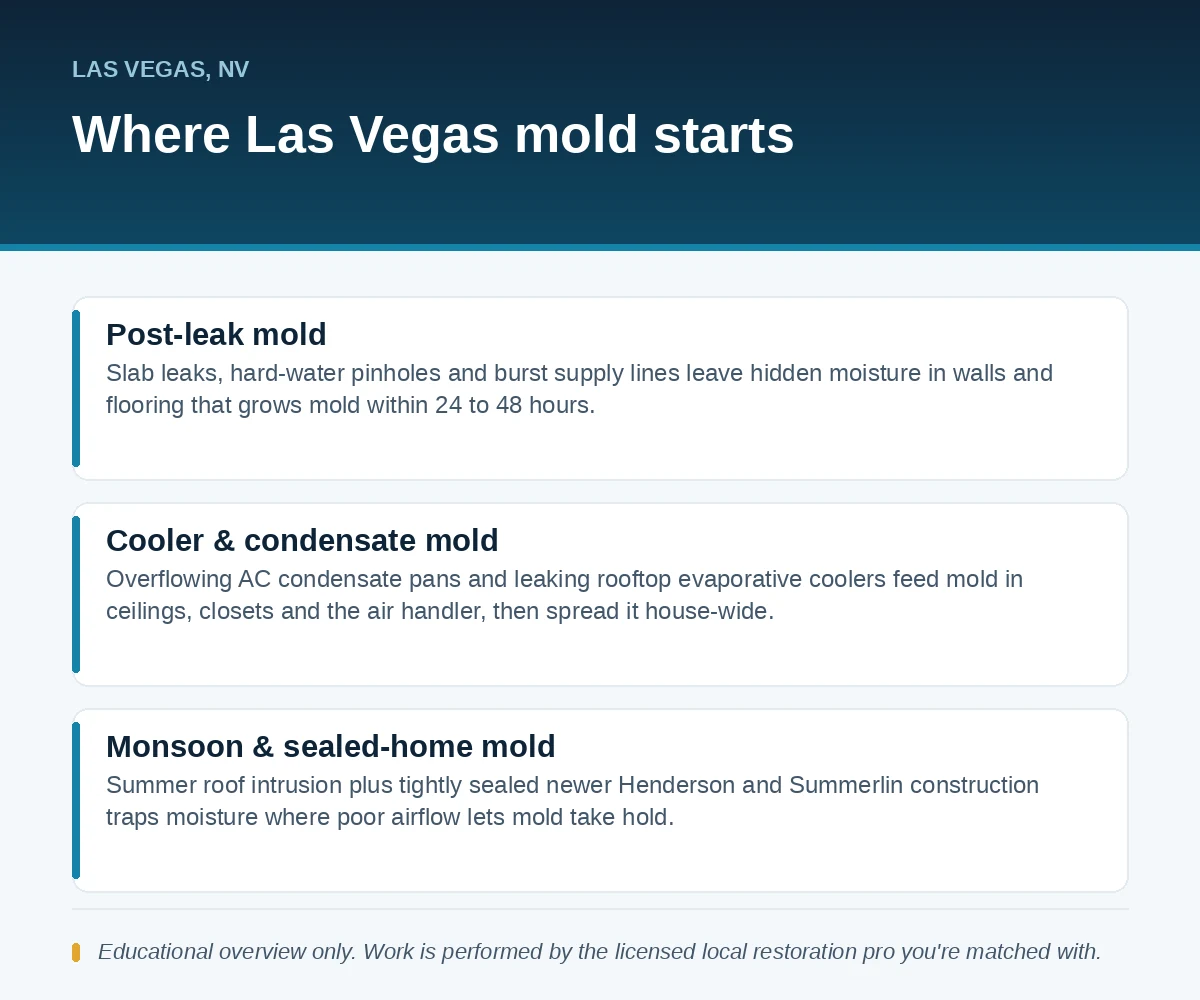
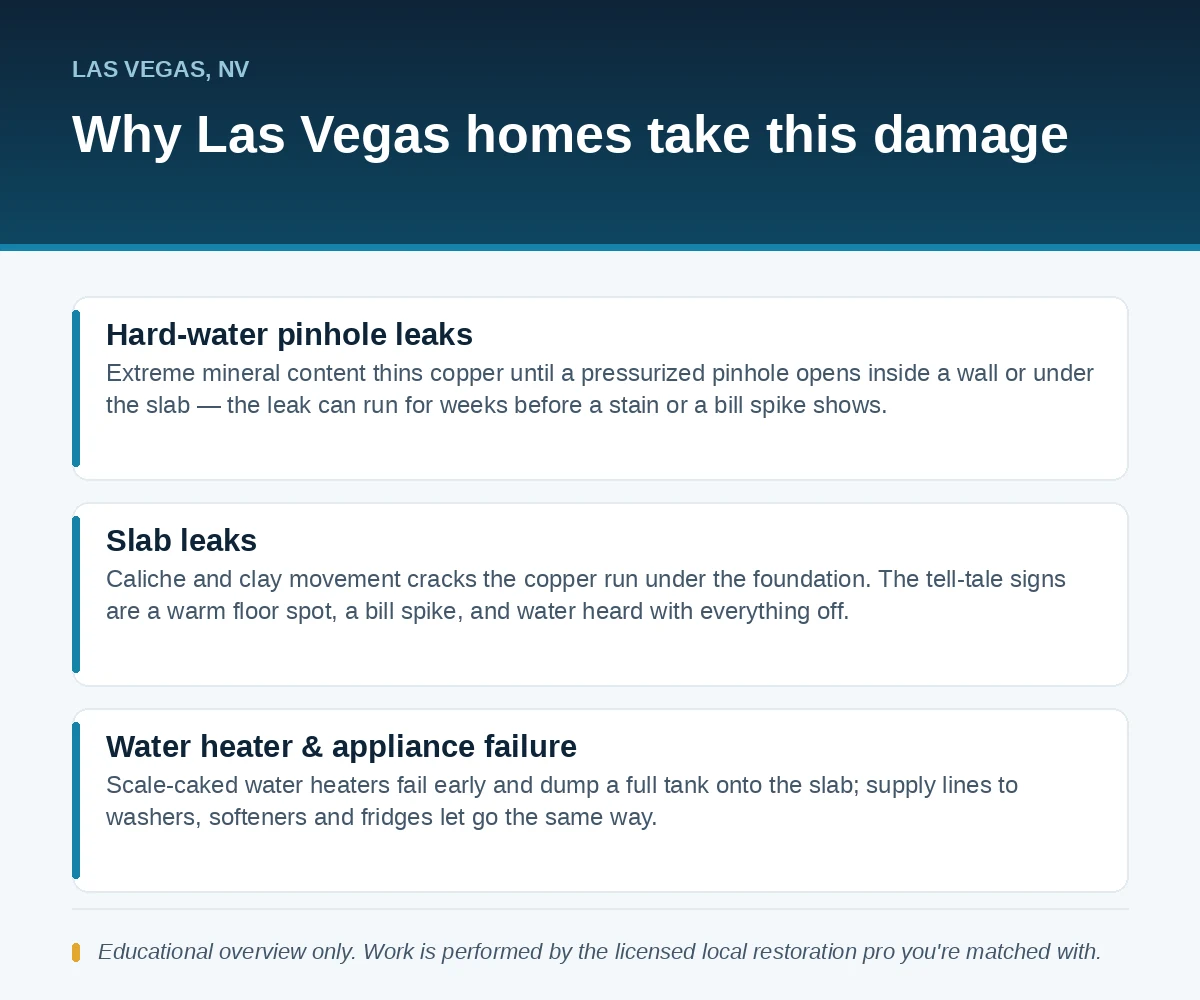
How much does water damage restoration cost in Tucson?
Professional water damage restoration in Tucson, AZ typically costs between $1,400 and $3,800 for Category 1 clean pipe or supply leaks, while Category 2 appliance overflows and Category 3 monsoon flood or sewage cleanups range from $3,500 to $8,500+. Most sudden water losses are covered by Arizona homeowners insurance minus your policy deductible.
Does insurance cover swamp cooler leaks in Tucson?
Yes, standard Arizona HO-3 homeowners insurance policies generally cover sudden and accidental water damage from a ruptured rooftop swamp cooler supply line or float valve failure in Tucson, AZ. Policies exclude gradual rust neglect, so documenting the sudden overflow with immediate thermal moisture logs and Xactimate photos within 24 hours protects your claim.
How fast does mold grow after a water leak in Tucson, AZ?
Per U.S. EPA and IICRC S520 standards, mold spores begin colonizing damp drywall, baseboards, and insulation within 24 to 48 hours after a leak in Tucson, AZ. Because warm desert temperatures accelerate microbial amplification inside closed wall cavities, starting commercial LGR dehumidification on day one prevents costly mold demolition.
Priority Tucson Water Damage & Mold Remediation Dispatch Hubs
Need immediate on-site extraction, thermal moisture mapping, or containment? Connect directly with our two main service hubs for water damage restoration in Tucson, AZ and mold remediation in Tucson, AZ, or compare coverage in our Tucson State Farm, USAA & Allstate insurance claim hub.
Our 60-minute response trucks cover all nearby communities, including water damage restoration in Catalina Foothills, water damage restoration in Oro Valley, water damage restoration in Sam Hughes, and water damage restoration in Marana.
Frequently Asked Questions: Mold Testing & Infrared Moisture Inspection in Tucson, AZ
Does homeowners insurance cover mold testing & infrared moisture inspection from a swamp cooler or burst pipe in Tucson, AZ?
Most Arizona homeowners insurance policies cover sudden and accidental water damage in Tucson, AZ, including ruptured supply lines, water heater bursts, under-slab copper leaks, and sudden rooftop swamp cooler overflows. Gradual seepage or overland surface wash flooding typically requires separate flood coverage. Our technicians provide Xactimate estimates and infrared moisture photos directly to your adjuster.
What should I do in the first 30 minutes after discovering water damage in Tucson, AZ?
First, shut off your main residential water valve at the street meter or exterior hose bib to stop active flooding. Second, turn off circuit breakers serving wet rooms and elevate wood furniture onto foil pads. Third, call our 24/7 dispatch line at (866) 695-5058 with your Tucson, AZ address ready for immediate crew routing.
How fast can an emergency restoration crew arrive in Tucson, AZ?
Our live operator routes the nearest available IICRC-certified extraction truck in Tucson, AZ within minutes of your call. Typical on-site arrival near Rillito River and Pantano Wash and surrounding Pima County neighborhoods is 45 to 60 minutes, 24 hours a day, including weekends, holidays, and severe summer monsoon thunderstorm surges.
How much does professional mold testing & infrared moisture inspection cost in Tucson, AZ?
In Tucson, standard Category 1 clean-water extraction and structural drying typically ranges between $1,400 and $3,800 depending on affected square footage. Category 2 greywater or Category 3 sewage and monsoon silt remediation ranges from $3,500 to $8,500+. When covered by homeowners insurance, you generally pay only your standard policy deductible.
Why is the 24 to 48 hour drying window critical for homes in Tucson, AZ?
According to EPA and IICRC S500 guidelines, indoor mold spores begin colonizing damp drywall, baseboards, and adobe or wood framing within 24 to 48 hours. In Tucson's warm climate, hidden moisture trapped under tile or inside stucco walls rapidly triggers microbial growth and odors unless commercial LGR dehumidifiers extract it immediately.