Water Damage Restoration in Fountain Hills
Fountain Hills was master-planned onto hillsides — 1970s–90s custom homes whose original copper is now pinholing behind walls, washes that drop off the McDowells at speed, and a condo core where one unit’s leak becomes three units’ claim. We match you with a licensed local restoration pro, 24/7.
Get connected to a Fountain Hills restoration pro
Call now — we route your request to a qualified, licensed local restoration company.
📞 Call Now — (612) 886-9863Free to request. No obligation. We connect you with independent, qualified, licensed local restoration companies — we are a referral service, not a contractor.
Fountain Hills is what happened when Robert McCulloch — the developer who conjured Lake Havasu City — turned the same planning ambition onto the granite slopes east of the McDowells in 1970. The result is a town unlike flat-Valley suburbia: custom homes from the 1970s through the ’90s stepped down hillsides, streets that follow terrain instead of a grid, washes that move mountain runoff through neighborhoods at grade-assisted speed, and a condo-and-townhome core gathered around the fountain and its lake. Each of those signatures comes with its own way of getting wet.
How does water damage start in Fountain Hills homes?
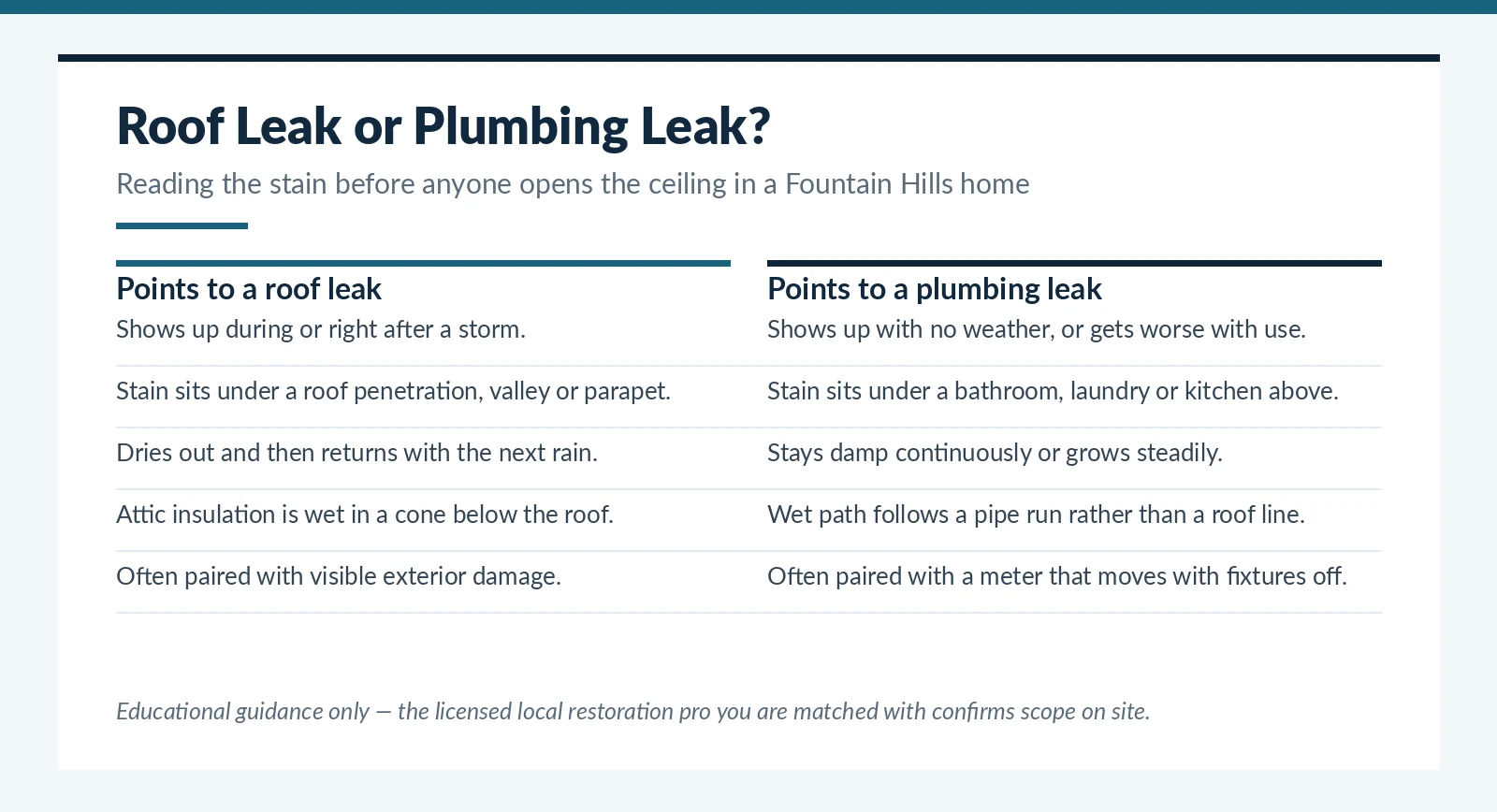
Behind the walls, mostly — and on age. The town’s first three decades of housing ran copper supply lines that are now forty and fifty years old, and pinhole corrosion is their retirement plan: a spray thinner than a pencil lead soaking a wall cavity for weeks before a stain, a smell, or a warm spot on a floor gives it away. The same era loved flat and low-slope foam roofs on its contemporary designs, and those roofs shed water through a handful of drains and edge openings that mesquite litter and dust storms plug — after which the roof holds its own private lake over the living room.
The terrain adds physics that flat suburbs never deal with. Hillside lots concentrate storm runoff against uphill foundation walls, where it finds stem-wall cracks and door thresholds; a single strong cell over the McDowells sends water down the washes that lace the town — moving fast because the grades are real — toward the Verde. Summer heat does the rest: 110-degree stretches cook flex connectors, supply hoses, and water-heater tanks in garages, and air-conditioning systems running flat-out all season back up condensate lines that drip through ceilings drop by drop.
Then there’s how the town is occupied. Fountain Hills runs heavily to winter residents and lock-and-leave owners, so summer leaks in empty houses get weeks of head start, and a January discovery often dates to Thanksgiving. In the condo core, one aging washing-machine hose on a third floor can write claims for three units and the association — with the who-pays question landing squarely on HOA governing documents.
Fountain Hills at a glance
| ZIP codes | 85268 |
|---|---|
| Jurisdiction | Town of Fountain Hills · Maricopa County |
| Elevation | ~1,520 ft |
| Terrain | Granite hillsides east of the McDowell Mountains |
| Key drainage | McDowell-fed washes falling toward the Verde River |
| Housing stock | 1970s–90s hillside customs; condo & townhome core near the fountain; newer FireRock & Eagle Mountain builds |
From Fountain Hills we can also connect you for storm & flood cleanup, sewage backup cleanup, and Arizona restoration cost guidance.
What should you do in the first hour?
Stop the source & stay safe
Shut off the water at the fixture or the main (and the power, if it’s safe). Keep people clear of sagging ceilings, contaminated water, and anything electrical that got wet.
Document it
Photograph and video everything before cleanup begins — your insurance claim is built on what you capture in these first minutes.
Get a local crew moving
We connect you with a qualified, licensed Fountain Hills-area restoration company — fast. The EPA’s 24–48 hour window to limit mold starts now, not when the adjuster calls back.
Water, fire or mold damage in Fountain Hills?
Get connected with a qualified, licensed local restoration crew — 24/7 across Fountain Hills and statewide Arizona.
Who pays when water crosses a Fountain Hills party wall?
It depends on documents most owners haven’t read since closing. In the condo and townhome buildings around the fountain, a single failed supply line can wet the unit it started in, the neighbor through the party wall, and the unit below — and Arizona associations typically split responsibility between the HOA’s master policy (structure, common elements) and each owner’s HO-6 policy (interior finishes, contents), along the lines the CC&Rs draw. The practical playbook: stop the water, notify the association the same hour, photograph everything in every affected unit, and get mitigation moving without waiting for the coverage question to resolve — delay grows the loss for everyone, and adjusters sort out allocation afterward. Owners without an HO-6 policy discover the gap at the worst possible moment.
Hillside houses fight a different battle: gravity. Lots cut into slopes take runoff against their uphill walls every monsoon, and a scupper’s worth of roof water dumped beside a stem wall will eventually find its way inside — as efflorescence, damp baseboards, or a musty storage room that never quite dries. Grading that moves water around the house, extended downspouts, and clean roof drains are the cheap fixes; drying a saturated wall assembly after years of intrusion is the expensive one. When a McDowell cell sends real flow down the washes, remember the water is Category 3 by the time it enters a home, and homeowners policies exclude rising surface water — our Arizona flood insurance guide explains the gap for wash-adjacent lots.
The copper question eventually visits every original-era home here. Pinholes cluster: the conditions that corroded one spot are working on the whole run, so a second and third leak tend to follow the first within a couple of years. After any pinhole repair, have the surrounding cavity moisture-mapped — slow sprays wet far more than they stain — and price a repipe against the cost of opening walls on the leak’s schedule instead of yours. Summer vacancies raise the stakes; a pinhole that starts in June in a locked house meets its owner in October.
And don’t discount the humble condensate line. An AC system running around the clock through a Fountain Hills summer moves gallons of water a day through a drain line the width of a garden hose; when algae plugs it and the safety switch fails, the overflow pan drips through the ceiling below week after week. A ceiling stain under an air handler in August is condensate until proven otherwise.
What restoration help is available in Fountain Hills?
Emergency Water Removal
Standing water extracted same-day — hillside home or third-floor condo, with equipment staged for shared-wall losses. 24/7 dispatch.
Storm & Flood Cleanup
Wash flow off the McDowells is contaminated Category 3 water — cleanup means extraction, tear-out, disinfection, and verified drying.
Burst Pipe & Pinhole Leak Damage
Fountain Hills’ signature loss — aging copper sprays inside wall cavities for weeks. Moisture-mapping, extraction, and carrier-ready documentation.
Sewage Backup Cleanup
Backups in homes and stacked condo drains cleaned under containment with disinfection and safe disposal — critical where units share risers.
Structural Drying & Mold Control
Air movers, dehumidifiers, and daily logged readings until the structure verifies dry — across every unit a shared-wall loss touched.
Insurance Claim Help
What to photograph, when to notify, and how Arizona claims move — including HOA master-policy versus HO-6 questions condo owners face here.
Fountain Hills restoration FAQs
Which Fountain Hills areas do you cover?
Water came through our condo ceiling from the unit above — who pays?
How do I know if my copper pipes are pinholing?
We’re gone all summer — what should we shut off?
About this guide
This page is researched, written, and reviewed for local accuracy by the Tucson Restoration Pros team. It draws on primary and scientific sources — including the IICRC S500/S700 restoration standards, the U.S. EPA and CDC on mold, the WHO guidelines on dampness and mould, NWS Phoenix forecasts and monsoon climatology, University of Arizona CLIMAS research, FEMA flood maps, and Flood Control District of Maricopa County resources. See how we research. Tucson Restoration Pros is a referral service that connects Arizona homeowners with independent, qualified restoration companies; we are not a licensed restoration contractor and do not perform the work ourselves.
Arizona cities we serve
Connect with a Fountain Hills restoration crew
Call now and we’ll connect you with a qualified, licensed local restoration company near you — 24/7.
📞 Call Now — (612) 886-9863Free, no obligation. We’re a referral service, not a contractor.