Water Damage Restoration in Prescott Valley
Prescott Valley grew up in a single generation — mile-high production neighborhoods built from the mid-1990s to 2010 whose plumbing is now aging out in lockstep, in a climate that freezes hard and floods fast. We match you with a licensed local restoration pro, 24/7.
Get connected to a Prescott Valley restoration pro
Call now — we route your request to a qualified, licensed local restoration company.
📞 Call Now — (612) 886-9863Free to request. No obligation. We connect you with independent, qualified, licensed local restoration companies — we are a referral service, not a contractor.
Prescott Valley is the young half of the quad-cities: incorporated in 1978 and built out in earnest between the mid-1990s and 2010, when subdivision after subdivision rose on what had been Fain Ranch pasture. That makes its water-damage profile the mirror image of its historic neighbor’s — not century-old plaster, but tens of thousands of slab-on-grade production homes whose water heaters, supply lines, and angle stops were installed within a few years of each other and are now wearing out on the same schedule, at 5,100 feet, where winter works on every one of them.
How does water damage start in Prescott Valley homes?
Mostly on schedule. The town’s build-out came in one long wave — Fain Ranch pasture turning into StoneRidge, Quailwood, Granville, Viewpoint, Pronghorn Ranch, and the neighborhoods around the Civic Center between the mid-1990s and 2010 — which means the water heaters, polymer supply lines, angle stops, and washing-machine valves that went in with those houses share a birthday. Builder-grade tanks are engineered for roughly a decade of service; many of Prescott Valley’s originals are past two. When one lets go on a street, its twins up and down the block are running on the same clock. And because nearly all of this stock is slab-on-grade, a failed heater or a slab leak doesn’t drip into a basement — it sheets across tile and laminate toward every wall it can reach.
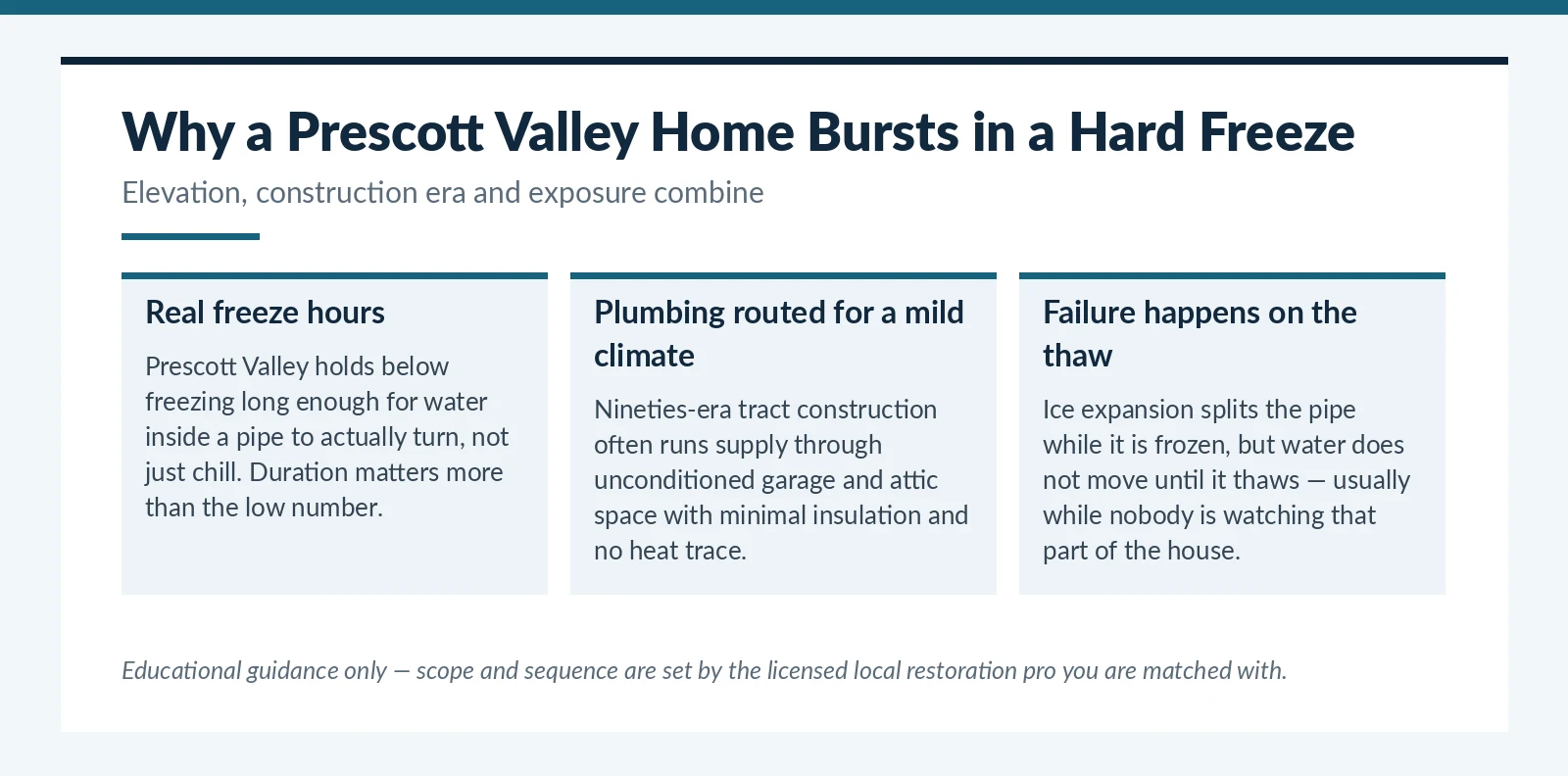
Winter sharpens everything. At roughly 5,100 feet, Prescott Valley takes real multi-night hard freezes, and the production-home era put plumbing where cold can find it: hose bibs on uninsulated exterior walls, garage lines feeding utility sinks and softener loops, and — the signature local failure — supply runs of PEX and copper routed through unheated attic space. As long as the furnace runs, attic lines survive. Let the heat fail during a January cold snap, or set the thermostat too low before a trip, and a split line thaws into a ceiling collapse that rains through two stories of drywall.
Summer brings the other half. Prescott Valley sits in the headwaters country of the Agua Fria River, with Lynx Creek working the town’s south side and Glassford Hill shedding runoff across the neighborhoods at its base. Monsoon cells building over Mingus Mountain and the Bradshaws drop water onto high grassland that doesn’t absorb it fast, so the flats along the Civic Center corridor and the older section-line roads pond and flow. It isn’t canyon drama — it’s broad, shallow, silt-heavy water that finds garage slabs and low-set door thresholds.
Prescott Valley at a glance
| ZIP codes | 86314–86315 |
|---|---|
| Jurisdiction | Town of Prescott Valley · Yavapai County |
| Elevation | ~5,100 ft |
| Terrain | High grassland basin between Glassford Hill and Mingus Mountain |
| Key drainage | Agua Fria River headwaters & Lynx Creek |
| Housing stock | 1990s–2010s slab-on-grade production subdivisions; manufactured homes toward Coyote Springs |
From Prescott Valley we can also connect you for storm & flood cleanup, sewage backup cleanup, and Arizona restoration cost guidance.
What should you do in the first hour?
Stop the source & stay safe
Shut off the water at the fixture or the main (and the power, if it’s safe). Keep people clear of sagging ceilings, contaminated water, and anything electrical that got wet.
Document it
Photograph and video everything before cleanup begins — your insurance claim is built on what you capture in these first minutes.
Get a local crew moving
We connect you with a qualified, licensed Prescott Valley-area restoration company — fast. The EPA’s 24–48 hour window to limit mold starts now, not when the adjuster calls back.
Water, fire or mold damage in Prescott Valley?
Get connected with a qualified, licensed local restoration crew — 24/7 across Prescott Valley and statewide Arizona.
Why does a 1990s Prescott Valley house flood in a hard freeze?
Because that era’s construction put water where winter can reach it. Production framing crews ran supply lines through attics and exterior walls because it was fast, and at Valley-of-the-Sun elevations that shortcut costs nothing. At 5,100 feet it’s a standing bet on the furnace. A multi-night freeze plus an ailing heater, a tripped breaker, or a thermostat set to 50 for a vacation will freeze an attic run solid — and the burst usually announces itself the afternoon it thaws. Homes with crawl-space perimeters north of town and manufactured homes with skirted underbellies carry the same exposure at floor level. If you leave in winter: keep the heat on and honest, shut the main, and have someone local walk the house. The difference between a wet closet and a gutted ceiling is almost always discovery time.
The cohort problem deserves respect on its own. Neighboring Prescott’s losses come out of Victorian-era plaster and generations-old galvanized lines — a different world, covered on our Prescott water damage page. Prescott Valley’s losses come off an assembly line: the same builders, the same suppliers, the same handful of years. There’s an upside to that. Mitigation crews who work PV know exactly where a StoneRidge-era plumbing chase runs, what a twenty-year-old builder-grade tank looks like the week before it fails, and how far water travels across a Quailwood slab. Homeowners can play the same card in reverse: replace the heater, angle stops, and pressure-regulating valve on your schedule instead of the plumbing’s, and you skip the 2 a.m. version of this page entirely.
Monsoon water plays by different rules. Lynx Creek drains old placer-mining country into Fain Lake before crossing town toward the Agua Fria, and a strong cell over Mingus Mountain can put fast, muddy flow across roads and lot lines in under an hour. Storm water that enters a home is Category 3 — sediment-laden and contaminated — which means extraction, controlled tear-out, disinfection, and verified drying rather than a shop-vac and a fan. And because homeowners policies exclude rising surface water, flood coverage is a conversation worth having before July; our Arizona flood insurance guide walks through it.
One more high-desert wrinkle: the dry air that makes Prescott Valley pleasant doesn’t dry a wet wall cavity. Heated interiors hold enough moisture for mold to establish on soaked drywall and insulation within a day or two, so a proper dry-out here still means air movers, dehumidifiers, and daily moisture readings until the structure verifies dry — with documentation your insurance carrier will actually accept.
What restoration help is available in Prescott Valley?
Emergency Water Removal
Standing water off a slab-on-grade floor plan fast — before it wicks up every wall in an open-concept Prescott Valley home. 24/7 dispatch.
Storm & Flood Cleanup
Silt-heavy runoff off Glassford Hill or Lynx Creek is contaminated Category 3 water — cleanup means extraction, tear-out, disinfection, and verified drying.
Frozen & Burst Pipe Damage
Attic-line splits and thaw floods are Prescott Valley’s signature winter loss — extraction, cavity drying, and carrier-ready documentation, fast.
Sewage Backup Cleanup
Backed-up drains cleaned under containment with disinfection and safe disposal — keep family and pets clear until the crew arrives.
Structural Drying & Mold Control
Air movers, dehumidifiers, and daily moisture readings until the structure verifies dry — what keeps a PV water loss from becoming a mold claim.
Insurance Claim Help
What to photograph, when to notify, and how Arizona claims actually move — plus the moisture logs your adjuster will ask for.
Prescott Valley restoration FAQs
Which Prescott Valley areas do you cover?
My house was built in 2003 and never had a leak — why would it start now?
Does Prescott Valley actually flood during monsoon storms?
A pipe burst in our attic while we were away — what should we do first?
About this guide
This page is researched, written, and reviewed for local accuracy by the Tucson Restoration Pros team. It draws on primary and scientific sources — including the IICRC S500/S700 restoration standards, the U.S. EPA and CDC on mold, the WHO guidelines on dampness and mould, NWS Flagstaff forecasts and monsoon climatology, University of Arizona CLIMAS research, FEMA flood maps, and Yavapai County Flood Control District resources. See how we research. Tucson Restoration Pros is a referral service that connects Arizona homeowners with independent, qualified restoration companies; we are not a licensed restoration contractor and do not perform the work ourselves.
Arizona cities we serve
Connect with a Prescott Valley restoration crew
Call now and we’ll connect you with a qualified, licensed local restoration company near you — 24/7.
📞 Call Now — (612) 886-9863Free, no obligation. We’re a referral service, not a contractor.