Fire Restoration Timeline: What Actually Happens, Week by Week
Restoration is not one job with one duration. It is eight overlapping phases, and only the first three run on anything resembling a fixed clock.
Short answer: Stabilization happens in hours. Extraction and structural drying run days. Soot cleaning and deodorization run one to three weeks. Reconstruction is the long tail, and around Tucson it is gated by claim settlement and by which office issues your permit rather than by how fast anyone can swing a hammer.
Start the clock on stabilization
Call now to reach a licensed local company.
📞 Call Now — (612) 886-9863No obligation. We connect you with independent, qualified, licensed local restoration companies — we are a referral service, not a contractor.
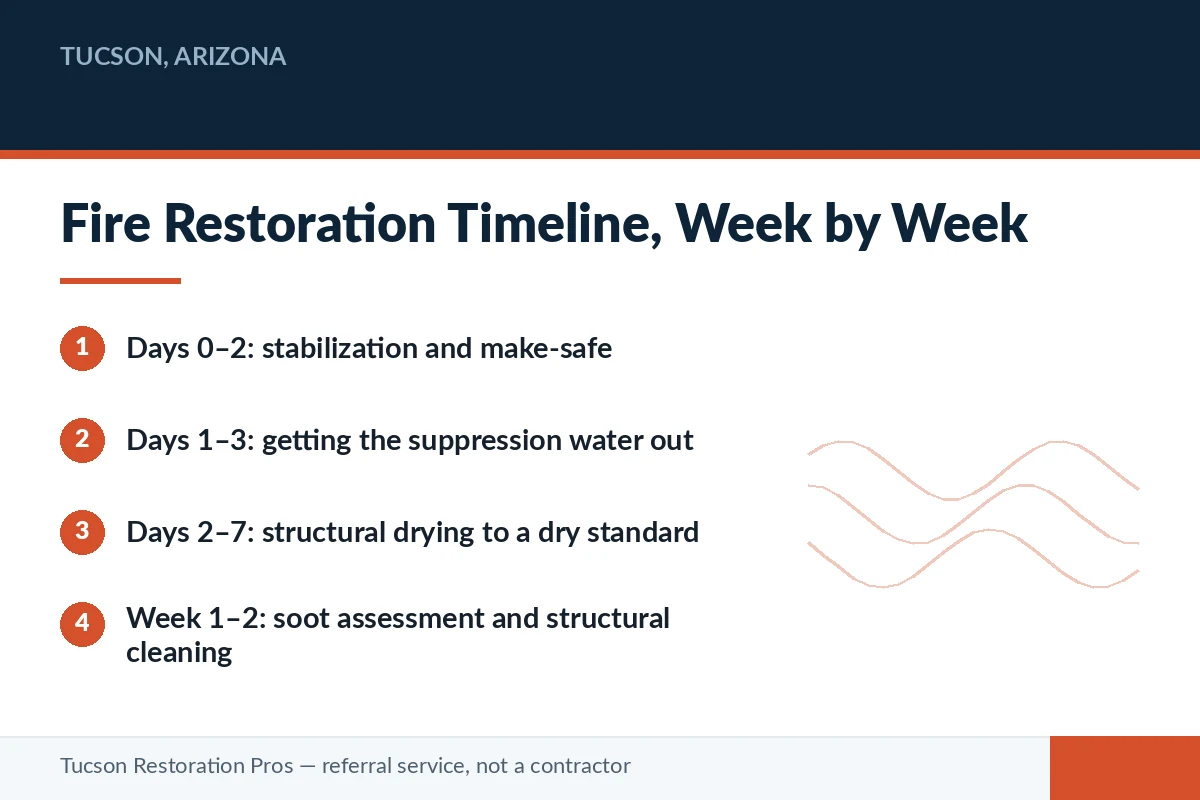
Everyone asks the same question on day two: how long will this take. The honest answer is that fire restoration is not one job with one duration. It is eight phases that overlap, and only the first three run on anything like a fixed clock. The rest are governed by scope, by claim approvals and, in the Tucson area, by which jurisdiction issues your permit.
The phases below assume a structure fire with suppression water, which is the normal case. A smoke-only loss skips phases two and three entirely and finishes far sooner — that scope is covered under smoke damage restoration in Tucson.
Phase 1 — Days 0 to 2: stabilization
Board-up of doors, windows and forced openings; tarping or shrink-wrapping the roof over ventilation cuts and burn-through; shoring where framing was compromised; a safety walk for structural, electrical and, in older homes, potential asbestos or lead-containing materials. Nothing else in the schedule can start reliably until the building stops taking on new damage. In monsoon season this phase is genuinely urgent rather than procedural: an unsecured opening plus one afternoon cell resets the drying schedule from zero, and every day the structure stands open adds dust infiltration and security exposure that were not part of the original loss.
Phase 2 — Days 1 to 3: getting the suppression water out
Knocking down a structure fire takes a great deal of water and none of it leaves on its own. On slab-on-grade construction, which is most of Tucson, there is no basement for it to drain into: it pools on the slab, wicks up drywall, and saturates carpet pad, insulation, toe-kicks and the bottom plate. Extraction is a race, because a warm house plus standing water starts a biological clock in roughly a day or two. The parallel scope here is ordinary water damage restoration.
Phase 3 — Days 2 to 7: structural drying to a dry standard
Drying finishes when materials reach a documented dry standard, not when three days have passed. Air movers, dehumidification and daily moisture readings continue until the numbers say the assembly is dry. Two Tucson factors pull in opposite directions: outdoor air is genuinely dry for most of the year, which helps, but the region’s heavy assemblies do not. Burnt-adobe and slump-block walls, plaster over masonry, and concrete slabs release moisture slowly, and an attic that hits extreme temperatures can drive moisture back down into the ceiling assembly it was just pulled from.
Phase 4 — Week 1: soot and smoke assessment
Before anything gets cleaned, the residue has to be identified and its travel mapped: which rooms, which surfaces, how far it moved through supply and return ductwork, and whether it reached the attic or wall cavities. The residue type dictates the chemistry, and getting it wrong sets the damage permanently — see dry smoke, wet smoke and protein residue compared.
Phase 5 — Weeks 1 to 2: structural cleaning
HEPA vacuuming first, then dry-sponge work on dry residues, then wet cleaning with residue-appropriate agents where the substrate allows it. Charred framing is either abrasively cleaned or removed. Ductwork is cleaned or replaced. Anything porous that cannot be brought back — insulation, carpet pad, some ceiling assemblies — is removed at this stage rather than cleaned around.
Phase 6 — Weeks 2 to 3: deodorization
Odor work only makes sense after the source material has been removed or cleaned. Sealing of framing and decking, thermal fogging or hydroxyl treatment depending on occupancy and material, and duct treatment. If odor keeps returning after this phase, something was left untreated — the reservoirs and the reasons are covered in why smoke odor keeps coming back.
Phase 7 — running in parallel: contents pack-out and processing
Contents are inventoried, photographed and moved off site for cleaning and storage, often while drying is still running. Textiles, electronics, hard goods and documents each follow different processes, and some items are treated in a controlled off-site chamber that would never be appropriate inside an occupied home. In Southern Arizona this phase starts early for a practical reason: an unpowered house in summer is itself damaging contents. Expect an itemised inventory with photographs, a salvage-versus-loss determination on each category, and storage that runs until the rebuild is far enough along to receive belongings back — which is why contents and reconstruction are usually discussed as one budget line rather than two.
Phase 8 — Weeks 3 and beyond: reconstruction and permits
Rebuild is where the schedule stops being technical and starts being administrative. Which office issues the permit depends entirely on the address:
- Inside City of Tucson limits — City of Tucson Planning and Development Services.
- Unincorporated Pima County — much of the Catalina Foothills, Tanque Verde, Vail, Corona de Tucson and Drexel Heights fall here, and go through Pima County development services.
- Separately incorporated towns — Oro Valley, Marana, Sahuarita and South Tucson each run their own permitting.
- Historic districts — Barrio Viejo, Armory Park and El Presidio add design review, which lengthens approval and constrains materials.
Structural, electrical, mechanical and plumbing work generally each need their own permit and inspection, and inspections have to be sequenced, so rebuild time is driven as much by the inspection calendar as by labour.
What stretches the schedule, and what shortens it
Stretches it
Scope still in dispute with the carrier. A large contents volume. Adobe, historic or custom assemblies. Asbestos or lead testing in older homes. Long-lead finishes such as matching saltillo tile or custom cabinetry. Monsoon re-wetting of an unsealed building. Lender draw inspections between stages.
Shortens it
Same-day stabilization. Photographs taken before anything moved. One company coordinating mitigation and rebuild instead of two handing off. Fast carrier approvals on supplements. A homeowner who answers the phone and makes finish selections quickly.
The standards behind the schedule
The licensed local restoration company you are matched with works to ANSI/IICRC S700, the standard for professional fire and smoke damage restoration, and to ANSI/IICRC S500 for the water portion. A standard does not dictate a calendar; it defines the principles, the inspection and documentation expected, and the criteria for calling a phase complete. That is precisely why a defensible drying log matters more than a promised end date.
Start here if the fire was recent: the first 24 hours after a house fire, then how the Arizona fire insurance claim process works.
Get the First Phase Moving Today
Board-up, extraction and drying are the phases that cannot wait. Call now and we route the address to an independent, licensed and insured local restoration company. Same-day dispatch is common but not guaranteed.
Fire restoration timeline questions
How long does fire restoration take from start to finish?
Why does structural drying take days rather than hours in Tucson?
When does reconstruction actually start?
Do I need a permit to rebuild after a fire in the Tucson area?
What is a contents pack-out and when does it happen?
Which standards does the restoration company work to?
More from the fire & smoke cluster
About this guide
Researched and reviewed for local accuracy by the Tucson Restoration Pros team, drawing on ANSI/IICRC S700, S500, USFA After a Fire, the American Red Cross and NWS Tucson. See how we research. We are a referral service, not a licensed restoration contractor, and nothing here is legal or insurance advice.
Connect with a Tucson fire restoration company
Call now and we’ll connect you with a qualified, licensed local restoration company near you — 24/7.
📞 Call Now — (612) 886-9863Free, no obligation. We’re a referral service, not a contractor.
Leave a Reply