The First 24 Hours After a House Fire in Tucson
A house fire ends twice — once when the hose lines shut off, and again a day later when what was left wet, hot and open has either been stabilised or has quietly gotten worse.
Short answer: Do not re-enter until the responding fire agency releases the structure. Then, in order: confirm gas and power are off, board up and tarp before the next monsoon cell, photograph everything before it moves, leave the HVAC and the swamp cooler switched off, and get a licensed local restoration company routed to the address the same day.
Get connected to a Tucson fire pro
Call now to reach a licensed local company.
📞 Call Now — (612) 886-9863No obligation. We connect you with independent, qualified, licensed local restoration companies — we are a referral service, not a contractor.
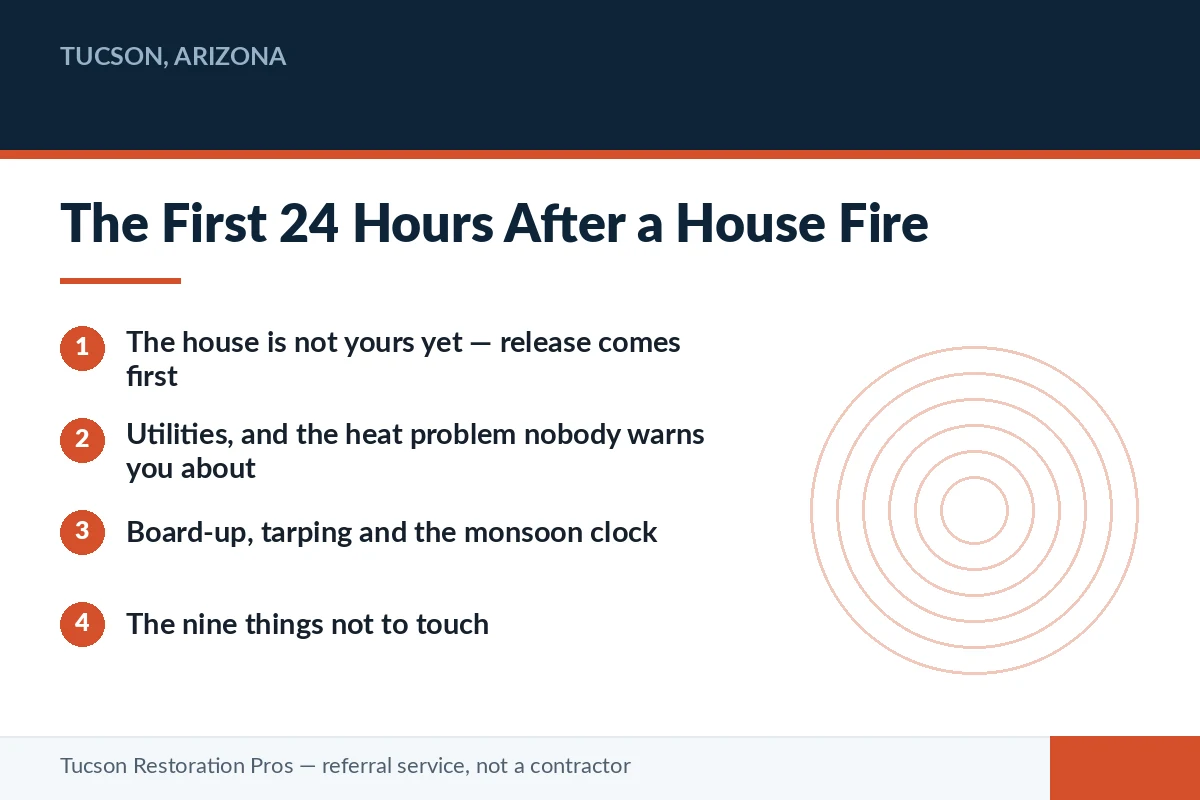
The 24-hour short version
- Stay out until the responding fire agency formally releases the structure.
- Leave the air off. The air handler and the evaporative cooler both spread soot.
- Secure the building before the next monsoon cell, dust event or overnight.
- Photograph before you move anything, and throw nothing away.
- Start the claim and the drying the same day — both clocks are already running.
A house fire in Tucson ends twice: when the hose lines shut down, and again a day later, when whatever was left wet, hot and open has either been stabilised or has quietly gotten worse. In a climate that can hold a scorched, unpowered house above 100°F all afternoon and then drop a monsoon cell on the hole in the roof by evening, that gap is where most of the recoverable loss is won or lost.
This is the order things actually happen in. For the full scope of the work that follows, see fire damage restoration in Tucson.
Hours 0–2: the house is not yours yet
Fire crews do not leave when the flames stop. Overhaul — pulling ceilings, opening wall cavities, chasing heat with thermal imagers — is what keeps a knocked-down fire from reigniting in the framing an hour later. Until the incident commander releases the structure, going back in for a laptop or a pet carrier is not a small favour to ask; it is the thing that gets people hurt after the fire is out.
Before the last engine leaves, get three answers and write them down: has the structure been released, has the gas been shut at the meter, and was the electrical service pulled or the panel killed. Get the incident or report number too — every carrier asks for it, and it is far easier to collect on scene than to chase later.
One Tucson wrinkle: the agency on your driveway may not be the City. Northwest Fire District covers much of Marana and the Casas Adobes side, Golder Ranch runs Catalina and the SaddleBrooke corridor, Rural Metro and district departments cover unincorporated pockets around Vail, Corona de Tucson and Drexel Heights. Record which agency responded, because the report you will eventually request lives with them, not with Tucson Fire.
Hours 1–4: utilities, and the heat problem nobody warns you about
If the gas was shut at the meter, the utility relights it — not you and not a helpful neighbour. If the electric meter was pulled or the service damaged, the utility and a licensed electrician have to clear it before power returns. Resetting a breaker in a panel that just fed a fire is how a second fire starts.
Hours 2–6: board-up, tarping and the monsoon clock
The openings are not only the ones the fire made. Crews cut ventilation holes in the roof, take out windows and force doors, and every one of those is now an inlet. Three things go through them in Tucson, usually in this order.
- Rain. From mid-June through September a cell can build over the Catalinas and be over your street within the hour. Water landing inside a burned structure turns a fire loss into a fire-plus-water loss, and on slab-on-grade construction it has nowhere to drain.
- Dust. A blowing-dust event drives fine particulate into surfaces already coated in soot. It is not just dirt on top of dirt; it makes the residue harder to lift cleanly later.
- People. An obviously damaged, obviously empty house on a Tucson street attracts attention overnight. Board-up and a locked perimeter are theft prevention as much as weather protection.
Board-up and tarping are also a policy obligation. Standard homeowners policies require you to take reasonable steps to protect the property from further damage, and the cost of doing so is normally part of the claim rather than money you eat. The Arizona fire insurance claim process guide covers how that gets documented.
The nine things not to touch
Nearly every irreversible mistake in the first day is a well-meant one. Soot is acidic and abrasive; the residue keeps etching finishes while it sits, and it also fractures and drives deeper the moment you rub it.
Which residue you are looking at changes the cleaning method entirely. See dry smoke, wet smoke and protein residue explained.
Hours 3–10: document the loss the way an adjuster reads it
Photographs taken before cleanup are worth far more than photographs reconstructed after it. Work wide to tight, and be boring about it.
Shoot every room, including the clean ones
Undamaged rooms establish the baseline that proves what smoke later reached. Skipping them is a common and expensive omission.
Get ceilings, corners and the roof
Soot deposits on cooler surfaces and in corners. Photograph ceilings, the underside of the roof deck where accessible, and the exterior from all four sides.
Capture serial and model plates
Appliances, the air handler, the water heater, tools and electronics. A legible data plate settles a contents line item without argument.
Record a narrated walk-through
One slow video with you naming rooms and items out loud captures context that stills miss.
Start a dated log
Every call, name, claim number and promise, with the time. Keep receipts for tarps, hotels, meals and anything bought because you cannot live at home.
Hours 4–12: where you sleep tonight
Call the carrier the same night. Claim intake lines run after hours, and the sooner a claim number exists, the sooner temporary housing is authorised. Standard homeowners policies include loss-of-use coverage, sometimes labelled additional living expenses, which is the section that contemplates hotel and interim living costs while the home is uninhabitable. Coverage and limits are set by your own policy, so ask what your policy allows before booking anything long-term.
Practical Tucson notes: summer heat makes sleeping in a car genuinely dangerous, pets need somewhere cooled, and prescriptions left in a hot house may need reissuing. The American Red Cross responds to residential fires locally, and USFA After a Fire covers replacing documents and valuables.
Hours 6–24: get a licensed restoration company routed to the address
Mitigation does not wait for the adjuster. Suppression water sitting in a warm slab house starts growing something within roughly a day or two, so drying should begin while the building is still being secured. The licensed local restoration company you are matched with covers board-up, extraction, structural drying, soot assessment and deodorization under one scope and documents all of it for the claim. Call now; same-day dispatch is common but not guaranteed.
Your first-24-hours checklist
| Window | Do this | Why it matters |
|---|---|---|
| 0–2 hrs | Wait for release; get incident number, agency name, utility status | Reignition risk; the claim needs the report |
| 1–4 hrs | Leave gas and power alone; note heat-sensitive contents | Utility relight rules; desert heat damage |
| 2–6 hrs | Board-up and tarp every opening | Monsoon rain, blowing dust, theft |
| 3–10 hrs | Photograph and video everything, discard nothing | Scope and contents both get argued from this record |
| 4–12 hrs | Open the claim; arrange somewhere cool to sleep | Loss-of-use authorisation starts with a claim number |
| 6–24 hrs | Get extraction and drying started | Mold begins in roughly 24 to 48 hours in a warm structure |
What happens after day one is laid out in the week-by-week fire restoration timeline, and the parallel water scope is covered in Tucson water damage restoration.
Fire Damage at Your Tucson Home?
Call now and we route the address to an independent, licensed and insured local restoration company, 24/7 across Pima County. Same-day dispatch is common but not guaranteed.
First-24-hours questions Tucson homeowners ask
Can I go back into my house right after the fire is out?
Should I turn the air conditioning back on to cool the house down?
Do I need to board the house up if the fire was small?
What should I photograph before anything is moved?
Can I start wiping soot off the walls myself?
Where do people stay the first night after a house fire in Tucson?
Keep reading in the fire & smoke cluster
About this guide
Researched and reviewed for local accuracy by the Tucson Restoration Pros team, drawing on ANSI/IICRC S700, S500, USFA After a Fire, the American Red Cross and NWS Tucson. See how we research. We are a referral service, not a licensed restoration contractor, and nothing here is legal or insurance advice.
Connect with a Tucson fire restoration company
Call now and we’ll connect you with a qualified, licensed local restoration company near you — 24/7.
📞 Call Now — (612) 886-9863Free, no obligation. We’re a referral service, not a contractor.
Leave a Reply