Why Water Damage Hits Tucson’s Adobe and Historic Homes Differently
A burst pipe or monsoon leak in a standard drywall-and-stud Tucson home is a bad day. The same amount of water in a historic adobe or territorial-style home in Barrio Viejo, Armory Park, or West University can be a structural event — because the wall itself is made of the material that fails when it gets wet.
Tucson has one of the largest concentrations of historic adobe, burnt-adobe, and lime-plastered masonry homes in the American Southwest, many dating to the territorial and early statehood era. That construction gives these neighborhoods their character — and it also means water damage response has to be handled differently than it would be in a standard slab-and-stud home in Oro Valley or Marana.
Why adobe behaves so differently when it gets wet
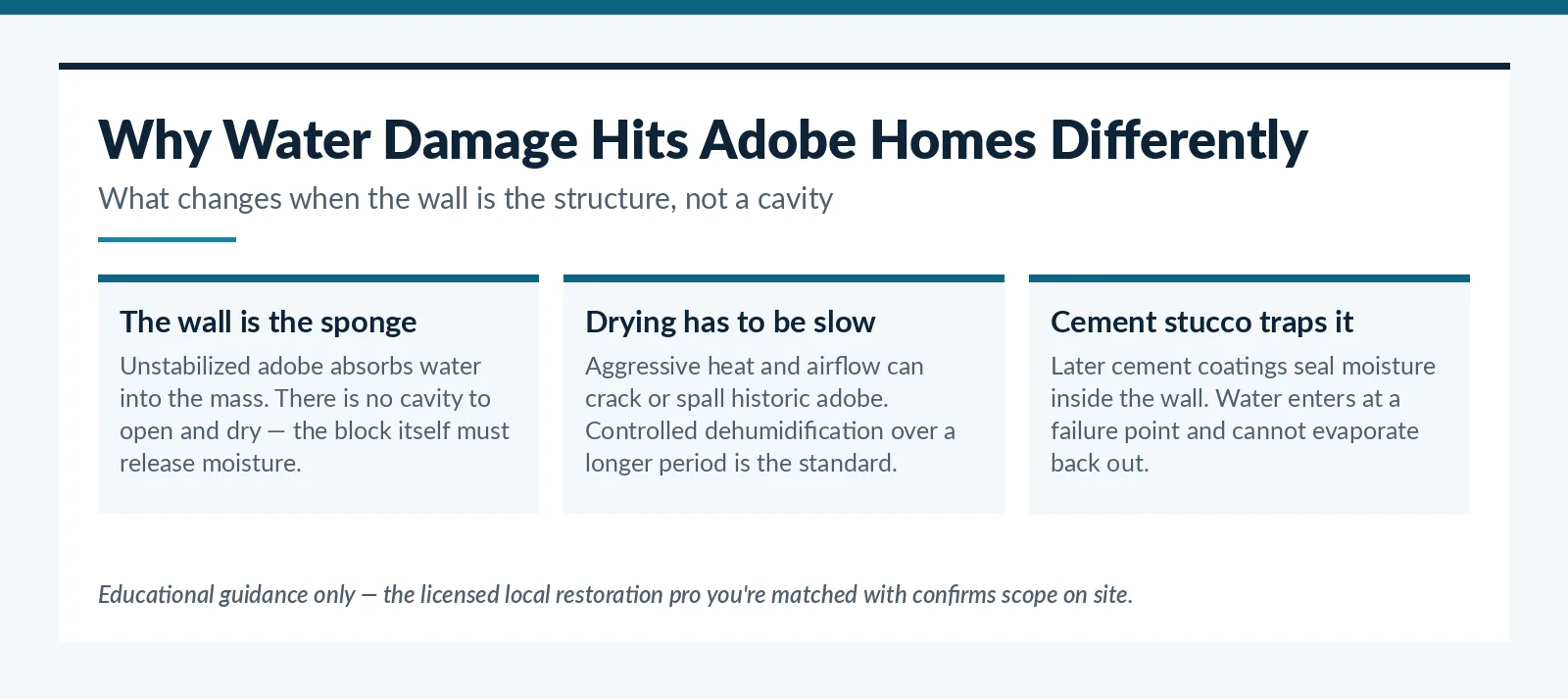
Traditional adobe is essentially unfired mud brick — sun-dried earth, straw, and water formed into blocks. It’s a genuinely effective building material in Tucson’s dry climate, with excellent thermal mass for the desert’s heat swings. But its structural strength depends on staying dry. Sustained water contact — from a roof leak, a burst pipe against an adobe wall, or wicking moisture from flooded ground during monsoon season — can soften and erode the block itself, not just the plaster finish over it. Where a drywall home loses a section of wallboard that gets replaced in a day, a saturated adobe wall can lose structural integrity that takes specialized masonry and adobe-repair expertise to correctly restore.
Where the risk concentrates in historic Tucson
Downtown Tucson, Barrio Viejo, Armory Park, West University, and El Presidio have the heaviest concentrations of pre-1940s adobe and burnt-adobe construction, though older adobe and territorial-style homes exist scattered throughout the older parts of the metro. These homes often also carry other water-vulnerable historic features: original lime plaster (softer and more moisture-sensitive than modern cement stucco), flat or low-slope parapet roofs prone to ponding during monsoon downpours, and canales (traditional roof drainage scuppers) that can back up or overflow if not kept clear ahead of storm season.
What to do differently if you have adobe or historic construction
Act faster on active water than you would in a standard home
Adobe doesn’t need to be standing in water for days to be at risk — sustained dampness against an untreated or damaged wall surface can begin softening the block well before it looks obviously wet from the interior finish side. If a pipe bursts against an exterior or bearing adobe wall, or monsoon water is pooling against the foundation, treat it as more urgent than the same event would be in frame construction.
Don’t assume standard drying equipment and timelines apply
Structural drying protocols developed for drywall, wood framing, and modern insulation don’t map directly onto solid masonry walls several feet thick. Adobe can hold moisture deep inside the wall mass long after the visible surface feels dry, which is exactly the same principle behind why Tucson restoration crews caution that a wall “looking dry” doesn’t mean it actually is — it just matters more, and takes longer to resolve, in solid masonry than in a stud wall with a cavity.
Get a crew with actual historic-material experience
Not every water damage restoration company routinely works on adobe, lime plaster, or historic masonry. Ask directly whether the crew you’re matched with has handled adobe or historic Tucson properties before an assessment begins, particularly if the home is in a designated historic district where repair materials and methods may also need to meet preservation guidelines.
Check canales and parapet drainage before monsoon season, not after
Because flat parapet roofs and canale drainage are common on these older homes, a pre-monsoon check that canales are clear and parapet drains aren’t blocked by debris is a cheap step that prevents a much larger adobe-saturation problem in July or August.
This is still true even for later additions
Many historic Tucson properties have later additions built in standard wood-frame or block construction attached to an original adobe core. Water damage in the newer section can still be handled with standard methods and typical drying timelines — it’s specifically the original adobe or masonry portion that needs the different approach. A capable crew will treat the two parts of the same house differently rather than applying one protocol to the whole structure.
Frequently asked questions
Can adobe walls be dried out and saved, or do they have to be rebuilt?
It depends on the extent and duration of saturation and how much structural softening occurred. Limited surface moisture caught early can often be dried and repaired. Prolonged saturation that has softened the block itself is a more involved masonry repair, which is why fast response matters more here than in standard construction.
Does homeowners insurance treat adobe home water damage differently?
Coverage depends on your specific policy and the source of the water, the same as any home — but repair costs and methods for historic adobe and masonry can differ from standard construction, which is worth discussing with your adjuster and documenting carefully with photos before any drying or repair begins.
Are lime-plastered walls as vulnerable as unfinished adobe?
Lime plaster is more breathable and generally more moisture-tolerant than modern cement stucco, but it’s still more sensitive than typical modern wall finishes, and it protects the adobe underneath only as long as it stays intact.
Get connected with a Tucson crew experienced in historic construction
If you have water intrusion in an adobe, burnt-adobe, or historic masonry home anywhere in central or downtown Tucson, call now and we’ll connect you with a qualified local restoration crew, 24/7.
Tucson Restoration Pros is a referral service connecting Tucson-area homeowners with independent, licensed local water and mold damage restoration companies. We are not a restoration contractor and do not perform repair or restoration work ourselves.
Leave a Reply