Smoke Smell Keeps Coming Back? Here’s What Was Missed
The walls were washed and the house smelled fine in March. Then the cooler came on in April, or the monsoon arrived in July, and the smell walked straight back in.
Short answer: Odor is a materials problem, not an air problem. If smoke compounds are still held in duct interiors, attic insulation, wall cavities, carpet pad, textiles or unsealed wood, no amount of air treatment ends it — and Tucson’s dry air makes surfaces smell clean fast, which is exactly why the job gets called done too early.
Odor came back after cleaning?
Call now to reach a licensed local company.
📞 Call Now — (612) 886-9863No obligation. We connect you with independent, qualified, licensed local restoration companies — we are a referral service, not a contractor.
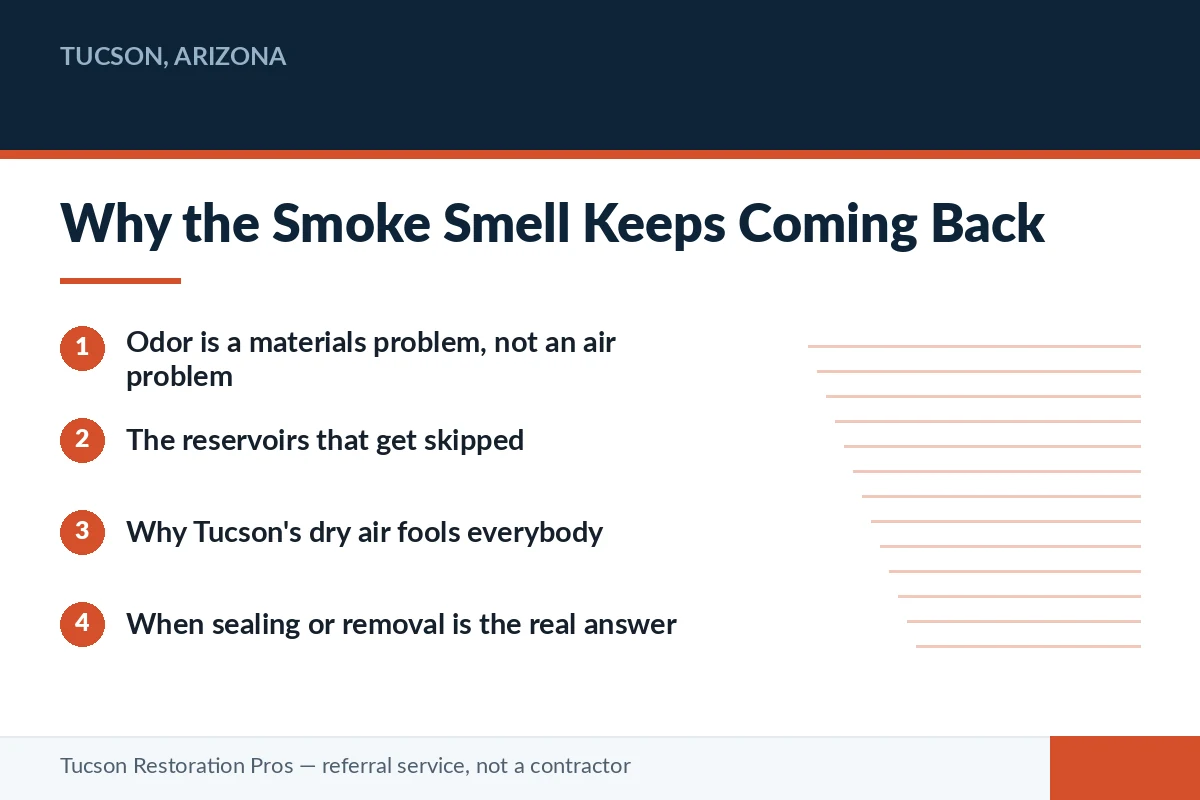
The walls were washed. The house smelled fine through March. Then the cooler came on in April, or the first real monsoon humidity arrived in July, and the smell walked straight back in. That is not bad luck and it is rarely a new event. It is a reservoir that was cleaned around instead of cleaned out.
Odor is a materials problem, not an air problem
Smoke odor is caused by volatile and semi-volatile compounds that were absorbed into porous materials while the smoke was moving, and that continue to release slowly afterward. What you smell in the air at any moment is downstream of what is still held in the building. Treating the air — scrubbing it, masking it, filtering it — lowers the concentration temporarily. It does not empty the reservoir. This is why source removal comes first in every credible deodorization sequence and why everything else is a finishing step.
The reservoirs that get skipped
Odor complaints after a completed job almost always trace back to one of these, and they share a common feature: they are all out of sight.
Why Tucson’s dry air fools everybody
In most of the country a lingering smoke smell announces itself continuously. Here it does not. For much of the year Tucson relative humidity sits very low, and dry air plus high air exchange strips the surface layer of odor compounds quickly and disperses them. Within a few days the house genuinely smells acceptable at nose level — and human olfactory adaptation finishes the job, because occupants stop noticing what visitors notice immediately.
Meanwhile the compounds bound deeper inside porous materials have not gone anywhere. Release rate rises with two things: temperature and moisture. Both arrive on a schedule in Southern Arizona, which is why recurrence here is seasonal rather than random.
| Trigger | When | Why it releases odor |
|---|---|---|
| Evaporative cooler start-up | April–May | Warm, humid air pushed across pads and duct interiors that held residue all winter |
| Extreme attic heat | May–September | High temperatures accelerate off-gassing from insulation, framing and stored contents |
| Monsoon humidity | July–September | Moisture displaces bound compounds in porous materials, so walls and carpet smell again |
| First heating run | November–December | Air pushed across a dormant heat exchanger and duct residue after months of disuse |
| Any deep clean or extraction | Any time | Added moisture re-mobilises odor that had gone quiet on the surface |
Deodorization methods, and their honest limits
Each of these has a legitimate role and none of them is a substitute for removing the source. The safety notes are not decoration.
| Method | What it does | Limits and safety |
|---|---|---|
| Source removal | Physically removes the material holding the compounds — insulation, pad, flex duct, charred framing | Always first. Nothing downstream compensates for skipping it |
| HEPA vacuuming and detail cleaning | Removes the particulate carrying much of the odor | Only reaches accessible surfaces; cavities and ducts need separate attention |
| Thermal fogging | Heats a deodorizer into a fine vapour that follows the same paths the original smoke took | Structure must be vacated during treatment and ventilated afterward; it treats what it can reach, not what is sealed behind finishes |
| Hydroxyl generation | Produces hydroxyl radicals that oxidise odor compounds in air and on exposed surfaces | Slower than ozone and generally usable in occupied spaces per manufacturer instructions; needs time and air movement; not a cleaning substitute |
| Ozone | Strong oxidiser used in vacated structures or off-site chambers for contents | Ozone is a lung irritant and is not for use in occupied spaces. The structure must be empty during treatment and fully off-gassed before re-entry, and ozone degrades rubber and some finishes |
| Sealing | Pigmented shellac or purpose-made odor-blocking coating on framing, decking and subfloor | A legitimate final step on cleaned material only; sealing a dirty surface traps the problem and has to be undone |
When sealing or removal is the real answer
The decision is not about how strong the smell is. It is about whether the material can be cleaned to a sound surface.
- Remove anything porous that cannot be cleaned through: attic insulation, carpet pad, flex duct, most acoustic ceiling tile, charred sheathing.
- Clean, then seal structural material that is sound but odorous — framing, roof decking, subfloor — after it has been cleaned and is dry.
- Clean only non-porous and sealed surfaces, which release readily once the residue is gone.
- Treat off site contents that need a chamber process rather than in-place treatment.
Sometimes the smell is not smoke at all
If a fire was suppressed with water, some of that water went into wall cavities, insulation and subfloor. A musty note layered under the smoky one, appearing on exactly the humid days when smoke odor also spikes, is worth taking seriously rather than assuming it is more of the same. The two smells overlap, and monsoon season brings both out together — see mold remediation in Tucson if the musty note is present, and water damage restoration if materials are still damp.
How to work out whether the last job missed something
Run the bag test
Seal a sample of a suspect material — a piece of pad, a scrap of insulation, a cushion cover — in a clean bag, leave it somewhere warm for a few hours, then open it and smell the headspace. A loaded material is obvious immediately.
Smell at the registers
Hold the system in fan-only for a minute and smell a supply register. If the odor is strongest there, the duct system is the reservoir.
Check the closed spaces
Closets, the attic hatch, under-sink cabinets and the garage. Enclosed volumes that are rarely aired concentrate what the open rooms have already dispersed.
Ask what was actually done
Request the scope in writing and read it for three words: removed, cleaned, sealed. If insulation, pad and duct were only ever cleaned, you have found the gap.
If the answer is that a reservoir was left untreated, the remedy is a targeted re-scope rather than another round of air treatment. Call now and we route the address to an independent, licensed and insured local restoration company; same-day dispatch is common but not guaranteed.
Related: smoke damage restoration in Tucson, how swamp coolers pull wildfire smoke indoors, and smoke residue types compared.
Smoke Odor Back Again in Tucson?
A returning smell usually means a reservoir was cleaned around rather than cleaned out. Call now and we route the address to an independent, licensed and insured local restoration company. Same-day dispatch is common but not guaranteed.
Recurring smoke odor questions
Why does the smoke smell come back in the summer?
Does ozone remove smoke odor from a house?
Does returning odor mean the cleaning was done badly?
Is thermal fogging safe to be in the house during?
Do I need to replace attic insulation after a fire?
Why does my house smell musty and smoky at the same time?
More on smoke, odor & moisture
About this guide
Researched and reviewed for local accuracy by the Tucson Restoration Pros team, drawing on ANSI/IICRC S700, EPA guidance on ozone generators sold as air cleaners and the EPA mold guide. See how we research. We are a referral service, not a licensed restoration contractor.
Connect with a Tucson fire restoration company
Call now and we’ll connect you with a qualified, licensed local restoration company near you — 24/7.
📞 Call Now — (612) 886-9863Free, no obligation. We’re a referral service, not a contractor.
Leave a Reply