Window Leaks During Tucson Monsoon Storms: Why Wind-Driven Rain Gets Past Stucco and Frames
Tucson rain doesn’t fall — it arrives sideways. A monsoon outflow boundary can push 40–60 mph gusts ahead of the rain core, and for the next half hour the east- and south-facing walls of your house are being pressure-washed. That’s when water shows up where it “shouldn’t”: beading along the top of a window frame, pooling on the sill, streaking down the drywall below the corner of a window. Roof intact, no plumbing involved — and yet the wall is wet. Here’s why stucco homes leak at windows during wind-driven rain, how to tell a window-wall leak from a roof leak, and what the water is doing inside the wall after the storm moves on.
Why Stucco Homes Leak at the Windows
Stucco is not a raincoat — it’s a sponge with a drainage system behind it. The cement coat absorbs and passes some moisture by design; the real waterproofing is the layered paper or wrap behind it, plus flashing that directs water back out. Wind-driven rain finds the failure points in that system:
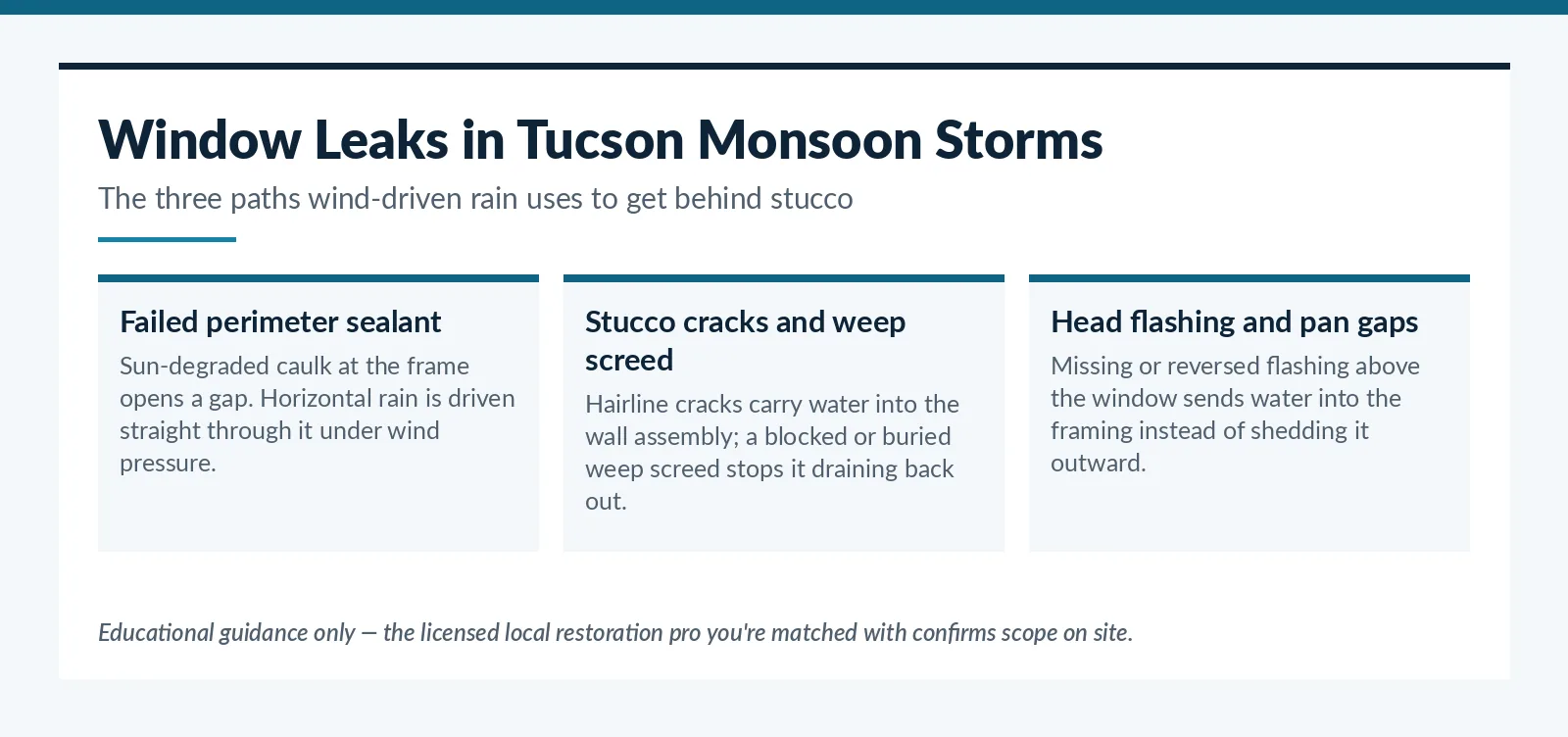
Hairline cracks at window corners. Windows are the stress concentrators of a stucco wall. Tucson’s extreme daily temperature swings work the material year after year, and diagonal cracks radiating from window corners are the classic result. In a gentle rain they don’t matter; under 50 mph of wind pressure, water is driven straight into them.
Failed sealant joints. The caulk line between the window frame and the stucco has a hard life in the desert — UV bakes it brittle, and by year ten many homes are running on sealant that has visibly pulled away. That gap is a direct channel to the wall cavity.
Aged or missing flashing and weep paths. Water that gets behind stucco is supposed to exit at the bottom through the weep screed — the perforated strip near the foundation line. Painted-over, stuccoed-over, or soil-buried weep screeds trap that water in the wall instead. On older homes, window head flashing may be minimal or absent entirely.
The window unit itself. Weep holes at the bottom of aluminum frames clog with dust and debris — this is Tucson, dust is a given — so the frame’s built-in drainage fills, overtops, and spills inward across the sill.
Window Leak or Roof Leak? How to Tell
The stain pattern and the timing carry most of the diagnosis. Water appearing at or below the window — wet sill, damp drywall under the corners, bubbling paint beneath the opening — points to the window-wall system. Water appearing on the ceiling or at the top of the wall points to the roof or a parapet scupper, a Tucson flat-roof pattern with its own failure modes — see our guide to monsoon roof leaks on Tucson flat roofs. Direction and wind matter too: a leak that only happens when the storm blows from the southeast, and never in a calm soaking rain, is wind-driven-rain intrusion almost by definition. Note which storms produce it — that detail is genuinely useful to whoever assesses the wall.
What the Water Is Doing Inside the Wall
The visible streak on the drywall is usually the smallest part of the event. Behind the stucco, water that got past the sealant is wetting the sheathing, the insulation, and the framing around the window opening — and a wall cavity has almost no airflow, so “it’ll dry out” is mostly wishful thinking, even in the desert. Repeated wetting through a monsoon season is how window openings develop hidden rot, rusted fasteners, and the musty smell that shows up in August. The same principle applies here as everywhere else in water damage: surfaces dry fast, assemblies don’t — our guide to why “it looks dry” doesn’t mean it’s actually dry covers what proper moisture verification looks like.
During the Storm, and Right After
While it’s raining: towels at the sill, move furniture and electronics away from the wall, and photograph the water while it’s actively coming in — active-leak photos are the strongest documentation you can hand an insurer or an assessor. After the storm: mark the stain edges with painter’s tape and date it, so growth after the next cell is obvious; check the exterior for cracked corners, gapped caulk, and clogged frame weeps; and if drywall is soft, paint is bubbling, or the same window has now leaked in multiple storms, have the wall moisture-mapped rather than repainted. Repainting over a wet assembly is how a cosmetic problem becomes a demolition problem — and how timelines and scope escalate, as laid out in our Tucson monsoon damage timeline.
Before the Next Cell
The preventive list is short and unglamorous: re-caulk the frame-to-stucco joint with a quality elastomeric sealant, clear the window frame weep holes with a wire, seal hairline corner cracks with elastomeric patch, keep soil and gravel off the weep screed at the foundation line, and confirm sprinklers aren’t hitting the wall daily (chronic irrigation wetting mimics storm intrusion). None of it requires scaffolding — and all of it is cheaper than opening a wall.
If a window wall in your home has already taken on water this season, call now and we’ll connect you with a licensed local restoration contractor who can moisture-map the wall and dry or open it properly. Availability varies with provider schedule and monsoon-season demand.
→ Call now to connect with a local restoration crew
Frequently asked questions
Why does my window only leak in some storms?
Wind direction and pressure. Wind-driven rain intrusion needs both water and wind pressure on that specific wall, so a southeast-facing window leaks in outflow-driven storms from that direction and stays dry in calm rain. That pattern is itself diagnostic.
Is a leaking window the window’s fault or the wall’s fault?
Either, and often both: clogged frame weeps and failed glazing seals are window-side; cracked stucco corners, failed caulk joints, and missing flashing are wall-side. The stain location and an exterior inspection usually sort out which system failed.
Will the wall dry out on its own in Tucson’s heat?
Exterior surfaces will; the wall cavity often won’t. Sheathing and insulation behind stucco have minimal airflow, and repeated monsoon wettings can keep the assembly damp for weeks — which is why moisture readings, not appearance, should make the call.
Does homeowners insurance cover wind-driven rain damage?
It varies. Sudden storm-driven intrusion is treated differently from long-term seepage and maintenance issues, and carriers draw that line case by case. Active-leak photos, dated stain documentation, and a prompt professional assessment all strengthen your position — confirm specifics with your carrier.
Can I just repaint the water stain?
Once the assembly is verified dry and the entry point is sealed, yes — stain-blocking primer first. Repainting before verification hides the evidence while the framing stays wet, and the stain returns with the next storm anyway.
What are the weep holes at the bottom of my window frame for?
They drain water that gets into the frame track back to the outside. Clogged with desert dust, they let the track fill and overflow inward — clearing them with a wire or compressed air is a two-minute maintenance task worth doing before every monsoon season.
Tucson Restoration Pros is a dispatch and matching service connecting homeowners with independent, licensed water damage restoration professionals. We do not perform restoration work ourselves. We are not affiliated with any government agency. In a life-threatening emergency, call 911.
Leave a Reply