How to Spot Hidden Mold After a Tucson Roof Leak
Roof Leaks in Tucson Hide Mold Better Than You’d Think
A roof leak in Tucson rarely shows up where the water actually enters. Flat and low-slope roofs, common across the city, let water travel sideways along framing and insulation before it ever stains a ceiling — and monsoon downpours can push a surprising amount of water through a small failure point in a short burst. By the time you see a brown ring on the drywall, moisture has often been sitting behind it for days or longer, which is exactly the window mold needs to get started.
The Clock Starts the Moment Water Gets In
Per EPA guidance, damp materials that don’t get dried within roughly 24 to 48 hours are at meaningfully higher risk of mold growth. A roof leak that shows a visible stain has usually already been wet for longer than that behind the surface, since the visible sign is often the last thing to appear, not the first. That’s the core problem with roof leaks specifically: the ceiling stain that finally gets your attention is a lagging indicator, not an early one.
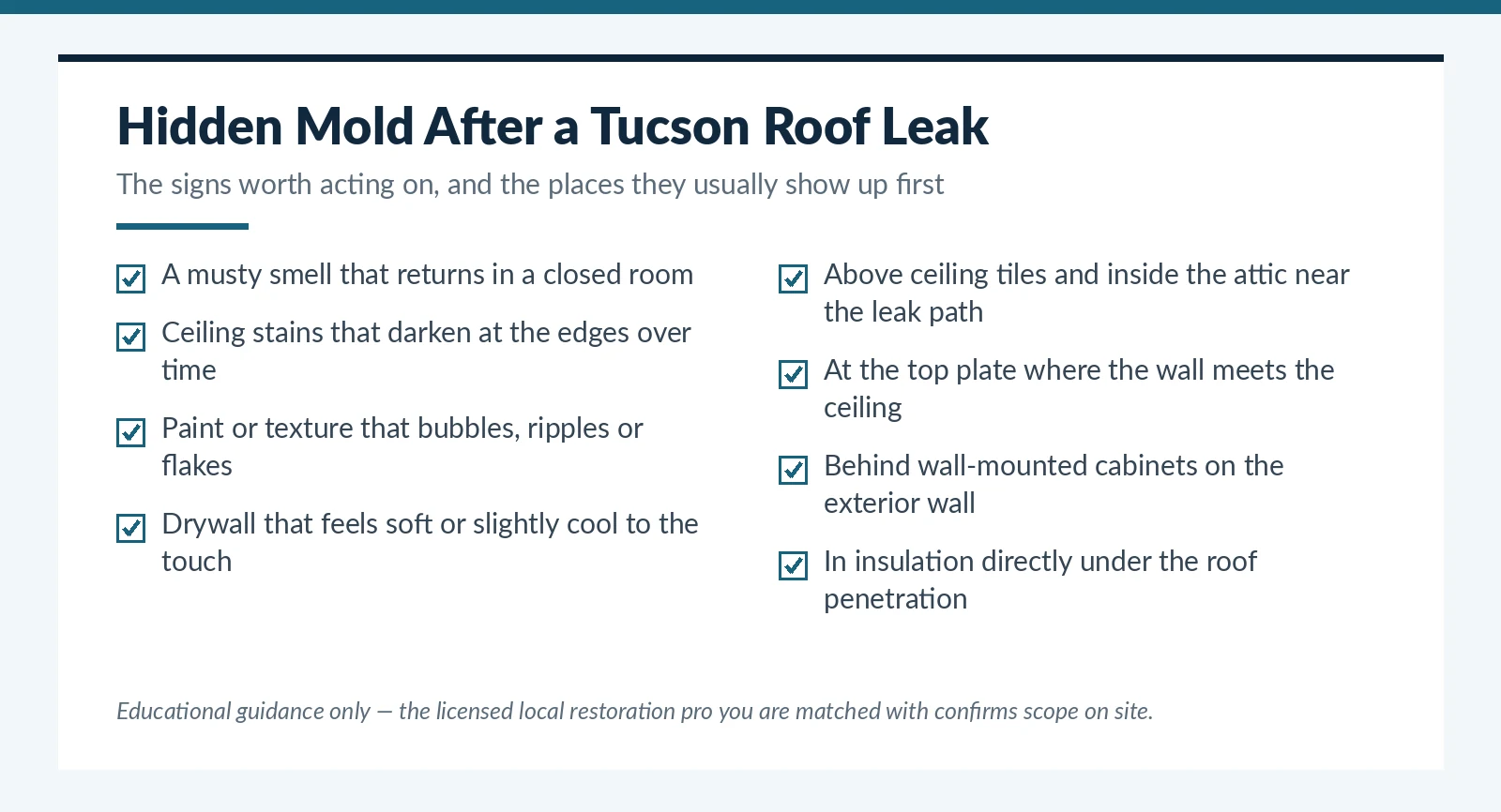
Signs of Hidden Mold to Check For
- A musty smell that comes and goes, especially after the swamp cooler or AC runs. Airflow can push spore-laden air out of a wall cavity or attic space intermittently, so the smell isn’t always constant.
- Discolored or bubbling ceiling texture near a known leak point. Even a small bubble or soft spot in stucco ceiling texture usually means moisture is trapped just behind it.
- Peeling paint or a slightly soft patch of drywall. Paint that’s lifting in a bathroom or hallway ceiling, away from any obvious source, is a common early tell.
- Allergy or respiratory symptoms that spike indoors and ease outside. If someone in the household has been sneezing more at home than usual, especially in one particular room, it’s worth investigating.
- Visible spotting in an attic access panel. Dark speckling on the underside of roof decking or on insulation paper is often the clearest confirmation, if you’re able to safely check.
Where to Actually Look
Start at the attic access panel nearest the suspected leak — look at the underside of the roof decking and the top of the insulation for staining or dark speckling. Check around any roof penetrations: swamp cooler ducting, plumbing vents, and skylights are the most common failure points on Tucson roofs. Inside the house, check closets and cabinets that share a wall with the affected ceiling; hidden mold often shows up first in an out-of-the-way spot nobody checks daily, not the room with the obvious stain.
Why This Matters More in Older and Adobe-Style Homes
Tucson’s historic districts and adobe-style construction handle water very differently than a standard stick-built home. Adobe and older masonry walls can absorb and hold moisture for a long time without an obvious surface sign, and that slow saturation is a different problem than a stain on drywall — it can mean the moisture has been present far longer than any visible symptom suggests. If your home is older or adobe construction and you’ve had any roof leak, even a small one, it’s worth having it checked rather than assuming it dried out on its own.
Why “It Looks Dry” Doesn’t Mean It’s Actually Dry
This is one of the most common mistakes after a Tucson roof leak: the surface dries in the desert heat within a day or two, so it looks handled. But insulation, the underside of decking, and framing members can stay damp well after the visible surface feels dry to the touch. Surface-dry and structurally dry are two different conditions, and only the second one actually stops mold risk.
How Monsoon Season Raises the Stakes
A roof that held up fine through a dry winter can still develop a small failure point that only shows itself under monsoon-intensity rain. A short, heavy downpour can push more water through a pinhole gap than months of light rain would, which is why so many Tucson roof-leak calls cluster in July and August. If a leak shows up mid-storm, the moisture behind the ceiling is arriving fast, not slowly — which shortens the window before mold becomes a real concern rather than a theoretical one.
What Not to Do
Don’t scrub or dry-brush visible mold yourself — disturbing it releases spores into the air and can spread the problem to areas that weren’t affected. Don’t run the HVAC or swamp cooler through the affected zone until it’s been assessed, since airflow can carry spores through the rest of the house. And don’t assume a patched roof means the moisture underneath is gone — a roof repair stops new water from coming in, it doesn’t dry out what’s already trapped.
What a Licensed Mold Remediation Crew Actually Does
A licensed pro doesn’t guess. Moisture mapping tools locate exactly how far the water traveled, containment keeps spores from spreading to unaffected rooms during removal, and the work follows the IICRC S520 mold remediation standard. For anything beyond a small, fresh, surface-level spot, that level of containment is the difference between solving the problem once and chasing it around the house for a year.
Get Connected to a Licensed Tucson Crew
If you’ve had a roof leak — recent or from earlier this monsoon season — and you’re seeing any of the signs above, don’t wait for a bigger stain to confirm it. Get connected with a licensed local crew for roof leak water damage, or if mold is the primary concern, get connected with a licensed local mold remediation crew. Both routes start from the same place: call now on the Tucson Restoration Pros dispatch line and you’ll be matched with a vetted, licensed local pro, 24/7.
Leave a Reply