The First 24 Hours After Monsoon Flooding Hits Your Tucson Home
The storm cell moves through in 45 minutes. What it leaves behind — water under a door, a wet carpet edge, a damp patch spreading across the ceiling — is what you’re dealing with for the next 24 hours, and what you do in that window matters more than almost anything that happens after. Here’s the order of operations for the first day after monsoon water gets into a Tucson home.
Hour Zero: Safety Before Anything Else
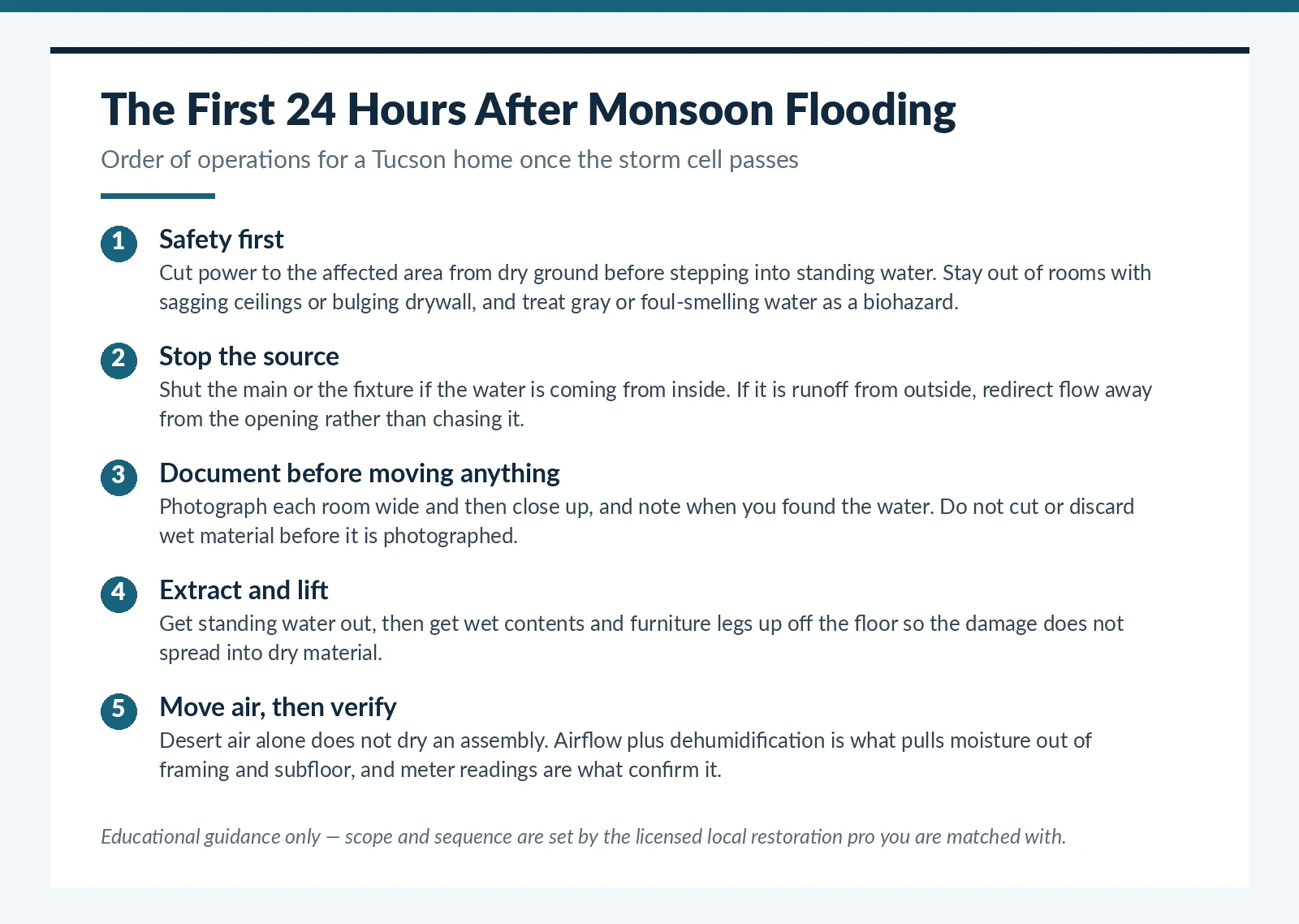
Don’t wade into standing water if it’s anywhere near an outlet, a power strip, or the electrical panel — cut power to that area at the breaker from dry ground first. If water is coming in fast enough that door frames or drywall look like they’re bulging or a section of ceiling is sagging, treat that as a structural concern and stay out of the room until it’s checked. And if the water has any sewage smell or gray/black color to it, that’s a biohazard situation, not a simple cleanup — monsoon storm drains backing up into a home is more common in Tucson than people expect.
Stop What You Can Stop
If the water is coming from inside — a supply line, a water heater, a washing machine hose — shut off the water at the main or the fixture. If it’s monsoon runoff coming in from outside through a door, a low window, or a foundation gap, you can’t shut that off; the move is to slow the entry point (towels, sandbags, anything to redirect flow away from the opening) and focus your energy on getting water out once the storm passes rather than fighting the storm itself.
Start Extraction as Soon as It’s Safe — the Clock Is Real
This is the part that surprises people in a desert climate: water damage doesn’t wait for dry air outside. Clean rainwater sitting on a floor starts absorbing into drywall, baseboards, and subflooring within hours, and the longer it sits, the more it can shift from a straightforward cleanup into a contaminated one — our guide to water categories and why the type changes everything about your cleanup covers how that shift happens. Pull out what water you can with a wet-shop vac, mop, or towels the moment it’s safe to do so. Every hour genuinely counts here.
Document Before You Move Anything
Photos and a short video of the standing water, the affected area, and anything it touched — flooring, furniture, drywall, belongings — before cleanup starts. This is the documentation an insurance adjuster or a restoration assessment will reference later, and it’s nearly impossible to recreate once things have been moved or dried.
Get Wet Materials Up and Off the Floor
Furniture, rugs, boxes, and anything electronic should come off wet flooring immediately — even a short delay lets moisture wick upward into legs, cushions, and cardboard. Prop up wet furniture on foil or wood blocks so air can move underneath it too.
Get Air Moving — But Don’t Assume Desert Air Fixes It
Here’s the counterintuitive part: during an active monsoon, the outside air is often more humid than usual, so opening every window doesn’t necessarily help and can slow drying instead. Point box fans across wet surfaces rather than just into the room, and if you have a dehumidifier, run it with doors closed to concentrate the effect. Avoid running a swamp cooler in the affected room during this window — evaporative cooling adds humidity, which is the opposite of what a wet room needs.
What Not to Do in the First 24 Hours
Don’t paint, seal, or cover a wet or stained surface — it traps moisture underneath and hides the problem instead of solving it. Don’t assume a surface that feels dry to the touch means the material underneath is dry; drywall and subfloor can hold moisture well after the surface feels fine. And don’t ignore a musty smell that shows up a day or two later — that’s usually the first sign the drying wasn’t complete.
When to Get a Professional Assessment
Any water that touched drywall, insulation, subflooring, or ran for more than an hour before it was caught is worth having moisture-mapped by someone with the right equipment — a moisture meter reads what’s actually happening inside the wall or floor, which eyes alone can’t. That’s especially true before any sewage-contaminated water, since that category of water damage carries its own handling requirements.
Water in your home from this storm?
Call now and we’ll connect you with a licensed local restoration contractor who can start extraction and drying properly. Availability varies with provider schedule and monsoon-season demand.
Frequently asked questions
Should I open windows to dry out my house after a monsoon flood?
Not automatically. If outside humidity is high during or right after the storm, open windows can slow drying rather than help it. Fans directed at wet surfaces and a dehumidifier in a closed room usually work better in that window.
How fast does water damage actually get worse in Tucson?
Faster than the dry climate suggests. Materials like drywall and subflooring absorb standing water within hours regardless of outside air, and untreated water can shift categories the longer it sits.
Is it safe to walk through standing water in my house?
Only if you’ve confirmed power is off to any area the water reaches and the water isn’t sewage-contaminated. When in doubt on either point, stay out until it’s checked.
Do I need to document damage before I start cleaning up?
Yes — photos and video of the original scene are what insurance and any professional assessment will rely on, and that documentation is very hard to recreate after cleanup begins.
Can I just run my swamp cooler to help dry the house?
No — evaporative cooling adds moisture to the air, which works against drying a wet room. Box fans and a dehumidifier are the better tools in that specific window.
How do I know if my house actually dried out or just looks dry?
A surface can feel dry while the material underneath — drywall, subfloor, insulation — is still holding moisture. A moisture meter reading is the only reliable way to confirm, which is part of what a professional assessment checks for.
Tucson Restoration Pros is a dispatch and matching service connecting homeowners with independent, licensed water damage and mold restoration professionals. We do not perform restoration work ourselves. We are not affiliated with any government agency. In a life-threatening emergency, call 911.
Leave a Reply