What to Do When Wash and Arroyo Flooding Backs Water Into a Tucson Garage or Casita
Tucson does not flood the way cities built around rivers and storm sewers do. It floods through washes – the normally dry desert channels that carry flash runoff during and after a monsoon downpour – and homes built near or below grade to one can take on water fast, especially in a detached garage or a casita sitting closer to grade than the main house.
Tucson Restoration Pros is a free dispatch and referral service. We connect homeowners with independent, licensed local water damage restoration companies – we do not perform the cleanup ourselves. This guide covers why wash and arroyo flooding behaves differently than a typical roof or plumbing leak, and what to do if it reaches a garage or casita.
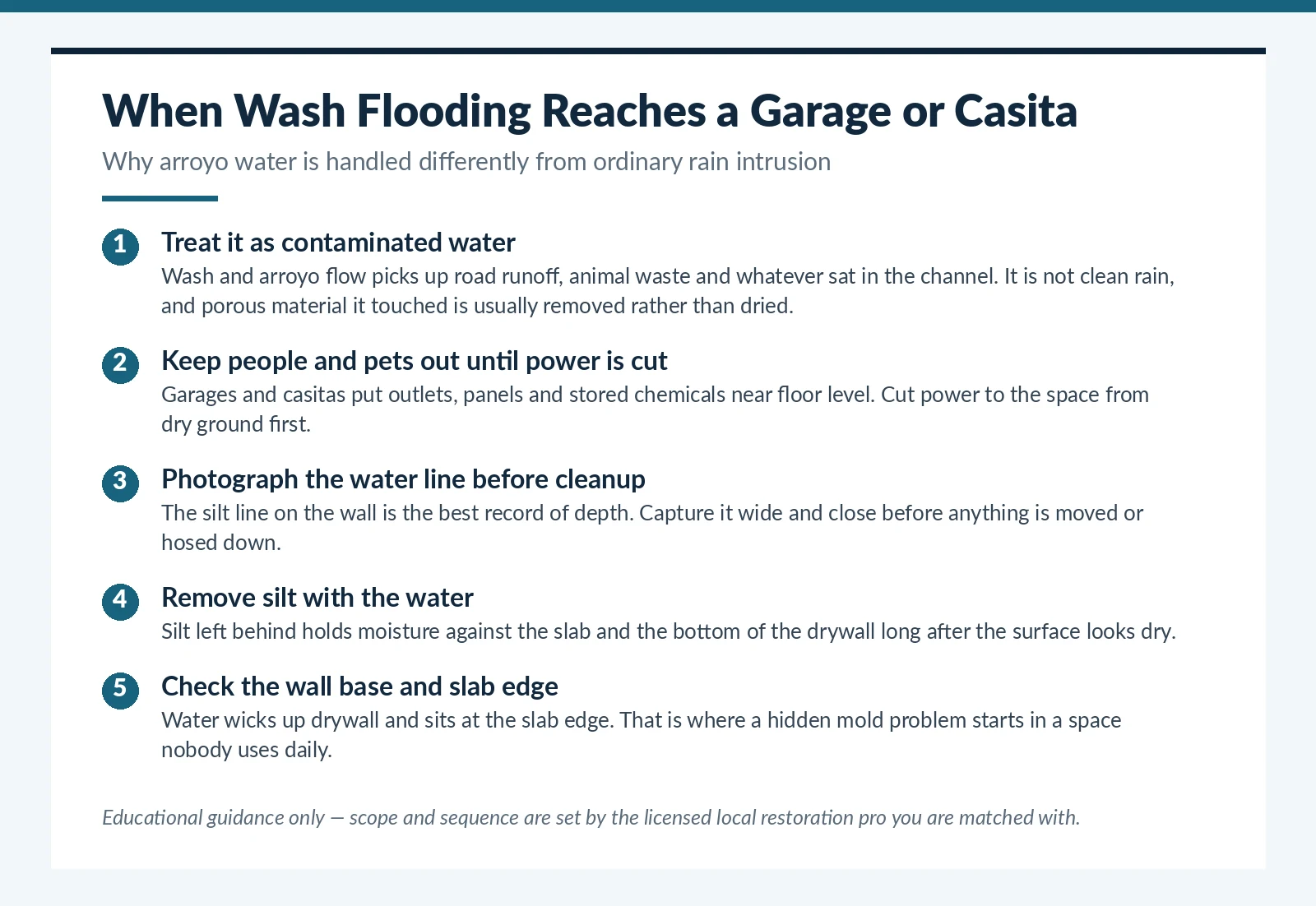
Why Wash Flooding Is a Different Kind of Water Event
A wash can run completely dry for months and then carry a genuine volume of fast-moving water within minutes of a heavy monsoon cell passing overhead – runoff from a much larger drainage area arrives all at once rather than building gradually. Homes and detached structures built near a wash, at a low point in a lot’s grading, or below the street grade can see water intrusion that has nothing to do with the condition of the roof or plumbing at all.
Why Garages and Casitas Take the Hit First
Lower slab elevation
Detached garages and casitas are frequently built at a slightly lower finished floor elevation than the main house, especially on older Tucson properties, which means floodwater finds them before it reaches the primary living space.
Direct grading toward the structure
Older lots graded before modern drainage standards sometimes slope toward a garage or casita rather than away from it, particularly if landscaping or hardscape changes over the years altered the original grading.
Contents sitting directly on the floor
Garages and casitas often store items directly on the slab rather than elevated the way a main house typically is, so even a modest depth of water reaching the floor can cause real content loss beyond the structural water damage itself.
What to Do If Wash Water Reaches a Garage or Casita
- Do not enter moving floodwater. Fast-moving wash water, even at a shallow depth, can carry debris and knock a person off their feet – wait until the water has fully receded.
- Photograph the water line and any visible debris once it is safe to do so, before moving anything, for both insurance documentation and to help a restoration crew understand what occurred.
- Move salvageable items off the wet floor once it is safe, since prolonged contact with a saturated slab continues to wick moisture into porous materials.
- Do not run a plugged-in space heater, generator, or any electrical equipment in a space that took on floodwater until it has been checked.
- Get the structure assessed even if it looks like it is drying on its own. Wash floodwater can carry silt, debris, and contaminants that behave differently than clean rainwater, and drywall or slab-adjacent framing can hold moisture well past when the surface looks dry.
Why This Isn’t the Same as a Simple Rain Puddle
Wash and arroyo runoff picks up silt, desert debris, and whatever contaminants sit in its path upstream before it ever reaches a property, which is a meaningfully different cleanup situation than clean rainwater pooling against a foundation. That distinction matters for how a restoration crew approaches drying and sanitizing the space, not just extracting the water.
Reducing Future Risk
If a garage or casita has taken on wash water before, it is worth having the property’s grading and any nearby drainage features looked at ahead of the next monsoon season rather than after the next flood. A licensed restoration company can also advise on flood-resistant storage practices for a garage or casita that sits in a known lower-lying spot on the property.
Get Connected to a Tucson Water Damage Crew
If wash or arroyo flooding has reached a garage, casita, or any part of your property, call now and we will connect you with a licensed local restoration company that can assess the water damage properly.
→ Call now to connect with a local restoration crew
Frequently Asked Questions
Is wash flooding covered by homeowners insurance the same as other water damage?
It depends on your specific policy – flood damage from a wash or arroyo is sometimes treated differently than water damage from an internal plumbing failure, so confirming your coverage with your insurer is worth doing ahead of monsoon season, not during an active event.
How long does wash floodwater usually take to recede?
It varies by storm intensity and the specific wash, but flash flooding in a dry wash can rise and fall within a matter of hours in many cases. Never assume it is safe to cross or enter until water has fully receded.
Can wash flooding cause mold even after everything looks dry?
Yes. Moisture can remain in slab-adjacent framing and porous materials well after the visible surface looks dry, which is why a professional assessment matters even when a space appears to have dried on its own.
Should I store items on shelving in a garage or casita prone to wash flooding?
Elevated storage reduces the risk of content loss during a flood event, and is a reasonable precaution for any structure with a known history of taking on water or sitting at a lower grade.
Do you perform the water damage cleanup yourselves?
No. Tucson Restoration Pros is a referral service. We connect homeowners with independent, licensed local restoration companies that carry their own insurance and perform the actual work.
Tucson Restoration Pros is a lead-generation and referral service. We are not a restoration contractor, are not affiliated with any government agency, and do not perform restoration, mitigation, or repair work. When you reach out, we connect you with one or more independent, licensed local restoration companies that handle the work, licensing, and insurance. In a life-threatening emergency, call 911. Never attempt to cross moving floodwater.
Leave a Reply