Water Damage Restoration in Chandler
Chandler grew out of cotton fields, and the clay soils never left. Slab movement stresses under-slab plumbing while engineered basins handle the monsoon — until they don’t. We match you with a licensed local pro, 24/7.
Get connected to a Chandler restoration pro
Call now — we route your request to a qualified, licensed local restoration company.
📞 Call Now — (612) 886-9863Free to request. No obligation. We connect you with independent, qualified, licensed local restoration companies — we are a referral service, not a contractor.
Chandler sits on former farmland, and that origin drives its water-damage profile. The silty clay soils left over from the cotton era are expansive: they swell when wet and shrink when dry, flexing slab-on-grade foundations with every wet-dry cycle. That movement is a leading reason Chandler sees more than its share of slab leaks — hot-water lines under the slab fatigued to failure. Above ground, the city has almost no natural washes; its monsoon defense is a network of engineered retention basins and storm drains.
How does water damage start in Chandler homes?
The signature Chandler failure is the slab leak: a warm spot on the floor, an unexplained jump in the water bill, or the sound of running water with everything off. Under-slab copper fatigued by expansive-soil movement pinholes, and water wicks up through the slab into flooring. Laminate and wood floors cup and swell first, then baseboards, then drywall — and the moisture keeps coming until the line is rerouted or repaired.
The rest of the mix is familiar valley fare with a Chandler skew: water heaters aging out across the huge 1990s–2000s tracts around Ocotillo and south Chandler, dishwasher and washing-machine failures, and the occasional monsoon overwhelm. When a storm outruns basin capacity, streets flood by design — they are the emergency channel — but grading in older neighborhoods near downtown’s 1920s core can push that street water toward doorsills. Downtown Chandler’s historic bungalows also carry old galvanized and cast-iron plumbing with the same end-of-life risks as any mid-century stock.
Chandler at a glance
| ZIP codes | 85224–85286 |
|---|---|
| Jurisdiction | City of Chandler · Maricopa County |
| Elevation | 1,215 ft |
| Terrain | Flat former farmland; expansive silty clay soils |
| Key drainage | Engineered retention basins & storm drains; no natural washes |
| Housing stock | 1920s downtown core; 1980s–2010s slab-on-grade tracts |
From Chandler we can also connect you for storm & flood cleanup, sewage backup cleanup, and Arizona restoration cost guidance.
What should you do in the first hour?
Stop the source & stay safe
Shut off the water at the fixture or the main (and the power, if it’s safe). Keep people clear of sagging ceilings, contaminated water, and anything electrical that got wet.
Document it
Photograph and video everything before cleanup begins — your insurance claim is built on what you capture in these first minutes.
Get a local crew moving
We connect you with a qualified, licensed Chandler-area restoration company — fast. The EPA’s 24–48 hour window to limit mold starts now, not when the adjuster calls back.
Water, fire or mold damage in Chandler?
Get connected with a qualified, licensed local restoration crew — 24/7 across Chandler and statewide Arizona.
Why does Chandler get so many slab leaks?
Blame the soil. Chandler’s expansive clays change volume dramatically with moisture content — geotechnical engineers design around it, but millions of feet of soft copper were buried beneath slabs before modern practices like sleeved lines and PEX manifolds became standard. Each monsoon-to-drought cycle flexes the slab slightly; the copper work-hardens at contact points and eventually pinholes. Hot-water lines fail first because heat accelerates both corrosion and soil movement directly beneath them.
Restoration for a slab leak is a sequence: locate (electronic leak detection), stop (reroute or repair), extract and dry (the part our matched crews handle), then rebuild flooring and drywall. Insurance usually covers the water damage and access, though not always the plumbing repair itself — the details live in our Arizona claim-filing guide. If the leak ran for weeks before discovery, ask the crew to check for mold behind baseboards; Chandler’s sealed, air-conditioned homes hold humidity exactly where mold wants it.
One more Chandler-specific note: the Price Road tech corridor means a lot of relocations and rentals. If you’re a landlord or a tenant, Arizona’s landlord-tenant act puts mitigation urgency on both parties — report and act on leaks immediately, in writing.
What restoration help is available in Chandler?
Emergency Water Removal
Standing water extracted same-day before it climbs walls and cabinets. 24/7 emergency dispatch to homes across Chandler.
Storm & Flood Cleanup
Monsoon and flash-flood water is contaminated Category 3 — proper cleanup means extraction, tear-out, disinfection, and verified drying.
Burst Pipe & Plumbing Leaks
Supply-line bursts, slab leaks, and hidden in-wall failures — located, extracted, and dried to IICRC standards by a licensed crew near you in Chandler.
Sewage Backup Cleanup
Backed-up drains and failed laterals cleaned under containment with disinfection and safe disposal — keep people and pets clear until help arrives.
Structural Drying & Mold Control
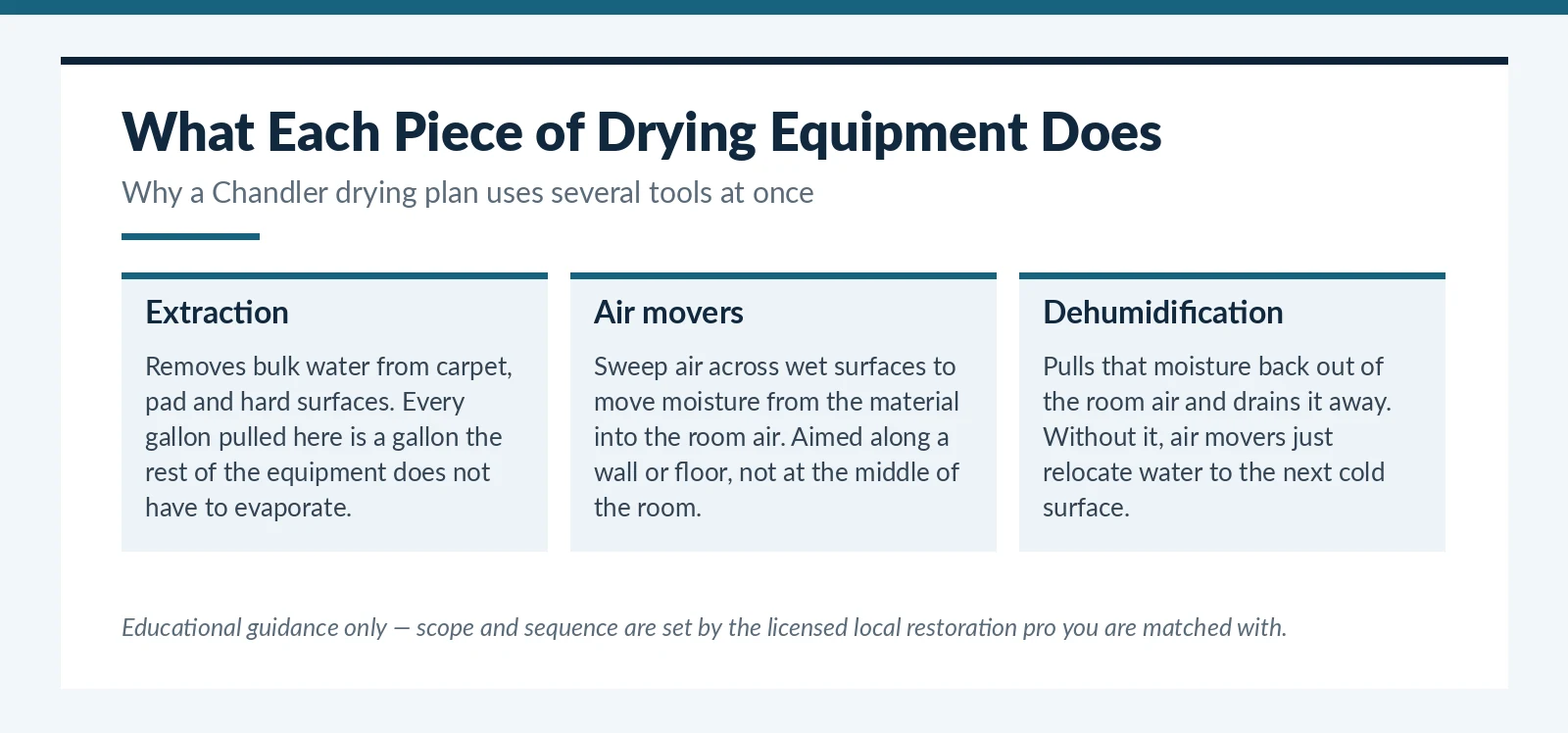
Air movers, dehumidifiers, and daily moisture readings until the structure verifies dry — the step that keeps a Chandler water loss from becoming a mold loss.
Insurance Claim Help
What to photograph, when to notify, and how Arizona claims actually move — plus documentation from the crew your adjuster will want.
Chandler restoration FAQs
Which Chandler areas do you cover?
How do I know if I have a slab leak?
Are Chandler’s retention basins supposed to flood?
Does homeowners insurance cover slab-leak damage in Chandler?
About this guide
This page is researched, written, and reviewed for local accuracy by the Tucson Restoration Pros team. It draws on primary and scientific sources — including the IICRC S500/S700 restoration standards, the U.S. EPA and CDC on mold, the WHO guidelines on dampness and mould, NWS Phoenix forecasts and monsoon climatology, University of Arizona CLIMAS research, FEMA flood maps, and Flood Control District of Maricopa County resources. See how we research. Tucson Restoration Pros is a referral service that connects Arizona homeowners with independent, qualified restoration companies; we are not a licensed restoration contractor and do not perform the work ourselves.
Connect with a Chandler restoration crew
Call now and we’ll connect you with a qualified, licensed local restoration company near you — 24/7.
📞 Call Now — (612) 886-9863Free, no obligation. We’re a referral service, not a contractor.