Frozen and Burst Pipes in a Tucson Home: Why Desert Plumbing Isn’t Built for a Hard Freeze
Tucson Rarely Freezes Hard — Which Is Exactly Why Pipes Aren’t Protected
Builders in cold climates bury supply lines deep and insulate every exposed run because freezing is a near-certainty every winter. Tucson doesn’t get that treatment. A hard freeze here is rare enough that most homes were never built to handle one, which means when temperatures do drop below freezing for a stretch of hours, exposed pipe that would never be a problem in a colder city becomes a real risk here.
What Actually Happens When a Pipe Freezes
Water expands as it turns to ice, and that expansion puts pressure on the inside of a pipe. The pipe doesn’t necessarily split at the frozen section itself — often it fails at whatever point downstream is weakest, once the ice blockage stops flow and pressure builds up behind it. That’s why a burst can show up somewhere unexpected, not just at the exact spot that froze.
Where Tucson Homes Are Most Exposed
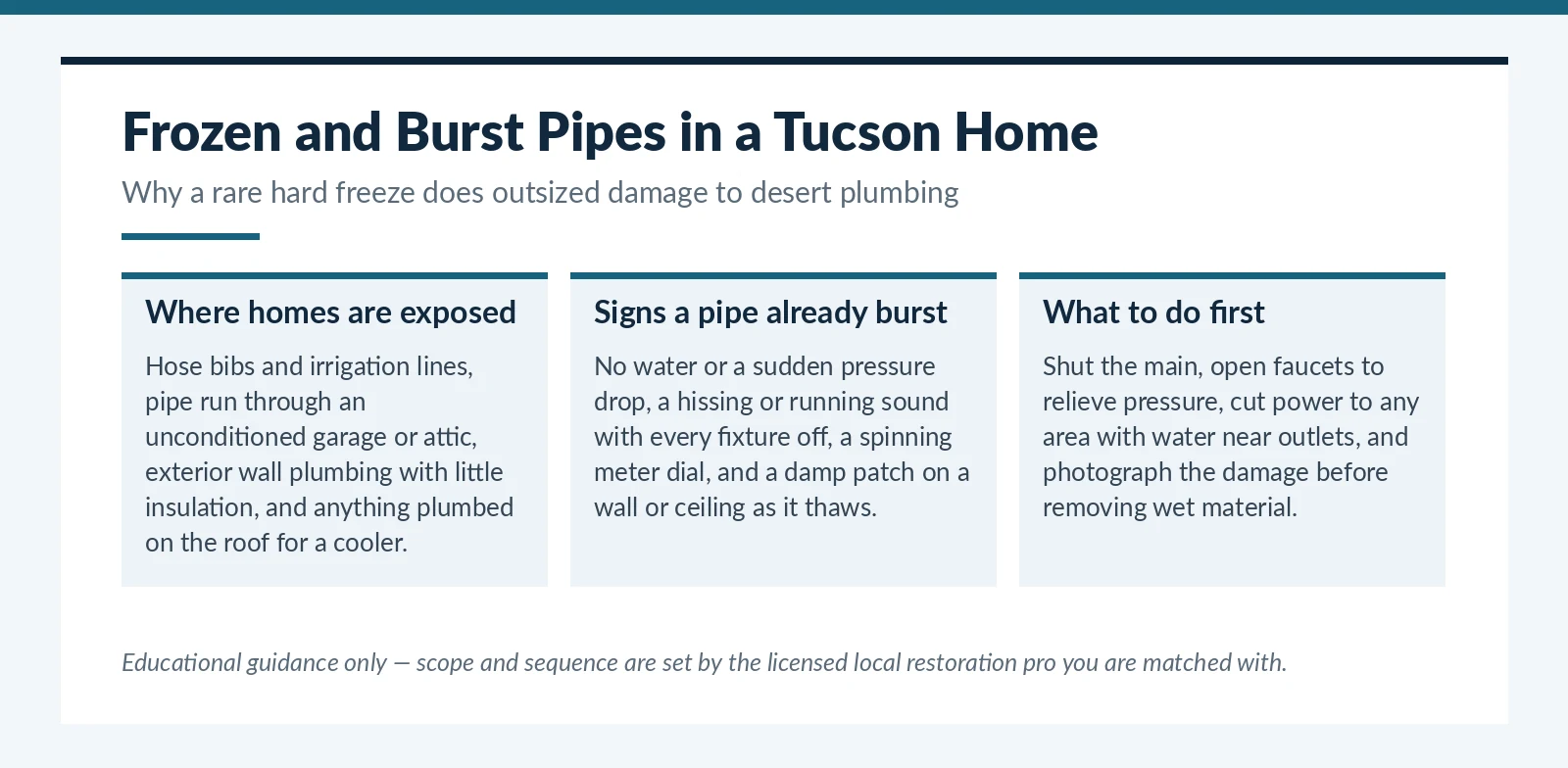
- Exterior hose bibs and irrigation backflow devices. These sit outside with minimal or no insulation because they’re rarely needed in freezing conditions, which makes them the most common failure point in a Tucson cold snap.
- Pipe runs in exterior walls or block construction. Homes built with plumbing routed through exterior masonry walls, common in older Tucson construction, offer very little thermal protection compared to interior wall runs.
- Attic and crawl space supply lines. Uninsulated runs in an attic can drop close to outdoor temperature overnight during a hard freeze, especially in homes where insulation was sized for cooling load, not cold protection.
- Manufactured and mobile homes. Common across outlying Tucson-area communities, these often have supply lines running through unconditioned underbelly space with limited insulation.
- Swamp cooler water lines left connected through winter. A supply line to an evaporative cooler that wasn’t drained or disconnected for the season is sitting exposed on the roof through any cold snap.
Signs a Pipe Has Already Burst
Watch for no water pressure at a fixture that worked fine the day before, a hissing or running sound inside a wall, water stains spreading on a ceiling or wall, or an active drip or spray once the ice inside the pipe thaws and the break opens up. Sometimes the first sign isn’t visible at all until temperatures rise and the thawed water starts moving through the break.
What to Do the Moment You Notice
- Shut off the main water valve. This is the single most effective step to limit how much water damage happens before help arrives.
- Turn off the water heater if the break is anywhere near it, to avoid it running dry or overheating.
- Move belongings away from any wet or dripping area if it’s safe to do so.
- Photograph the damage before cleanup starts, for insurance purposes.
Why the Water Damage Often Outlasts the Cold Snap
The freeze itself might only last a night or two, but water that’s already soaked into drywall, flooring, or insulation doesn’t dry on its own just because temperatures warm back up. Per EPA guidance, materials that stay damp past roughly 24 to 48 hours carry meaningfully higher mold risk, and a burst pipe that ran unnoticed overnight can put a room well past that window before anyone’s even back from the hardware store with a bucket.
What Not to Do
Don’t use an open flame to thaw a suspected frozen section — it’s a fire risk and it won’t tell you whether the pipe has already cracked. Don’t assume a pipe is fine just because water’s flowing again; a hairline crack can open into a full split once full pressure returns. And don’t wait to see if a wet spot dries on its own before calling anyone — the drying window is shorter than it feels.
Get Connected to a Licensed Local Crew
If a pipe has burst or you’re seeing water damage after a cold snap, the plumbing fix and the water cleanup are two separate calls, and both matter for how much damage you end up with. Get connected with a licensed local crew for frozen and burst pipe water damage. For active flooding right now, see the 24/7 emergency water damage dispatch line. Either way, you can start from the Tucson Restoration Pros dispatch line — call now and you’ll be matched with a licensed local crew.
Leave a Reply