Slab Leak Warning Signs in a Tucson Home: What Caliche Soil Does to Pipes
Why Slab Leaks in Tucson Aren’t Quite Like the Ones You’ll Read About Elsewhere
Most slab leak articles online are written for cities with expansive clay soil, where the ground swells and shrinks with the seasons and stresses pipe joints that way. Tucson’s slab-on-grade homes sit on something different: caliche, a hardened layer of calcium carbonate that can be nearly as unforgiving as concrete itself once you’re below the topsoil. That changes how slab leaks develop here, and it’s worth understanding before you assume the standard advice applies.
What a Slab Leak Actually Is
A slab leak is a break in a water or drain line running underneath a home’s concrete foundation. Slab-on-grade construction is standard across most of the Tucson metro, which means the plumbing runs beneath a poured slab rather than under a raised floor. When a supply or drain line under that slab cracks or separates at a joint, water has nowhere to go but up through the concrete into flooring, or sideways under the slab where it can affect the soil supporting the foundation itself.
Six Warning Signs to Watch For
- A water bill that jumps with no change in household usage. This is usually the first thing homeowners notice, and it’s one of the most reliable early signals of an active slab leak.
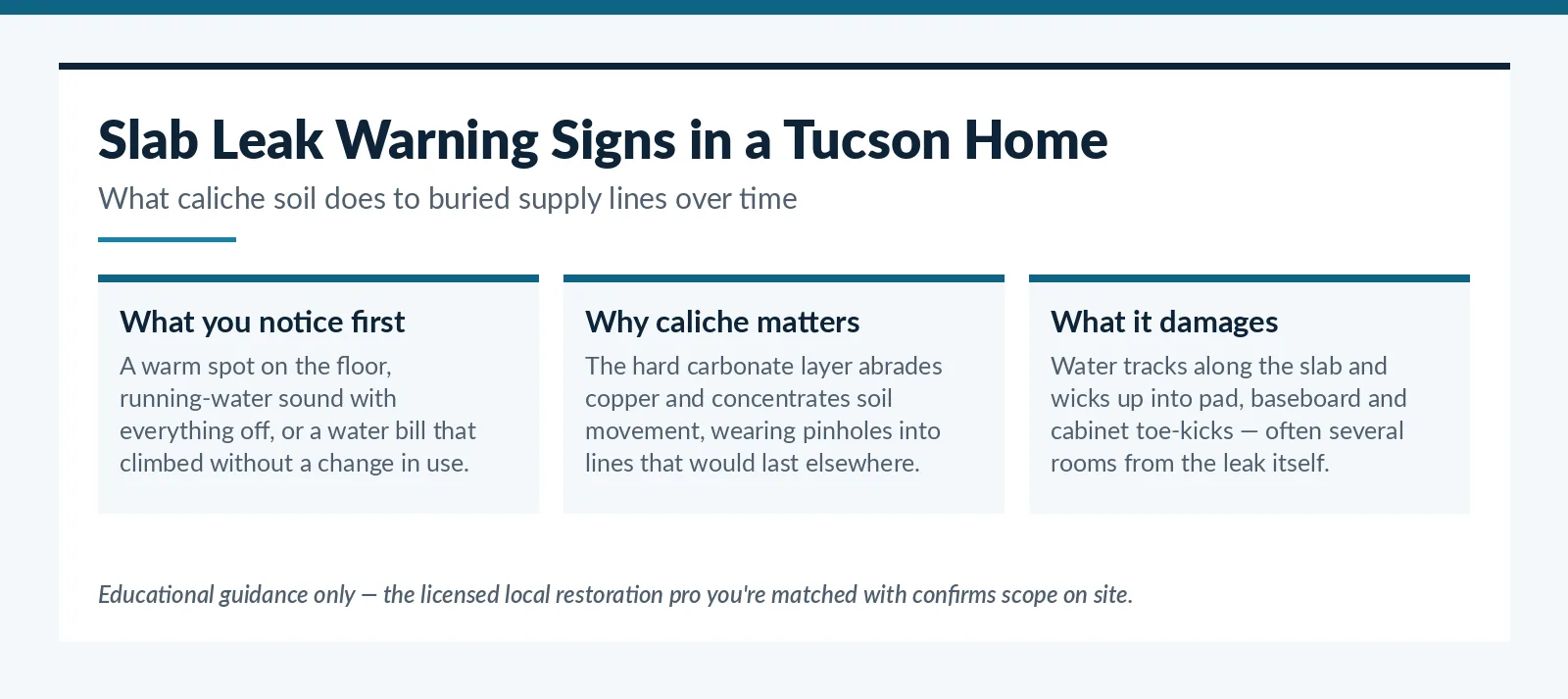
- Warm or damp spots on the floor. A section of tile or flooring that feels warmer than the rest of the house, especially near a hallway or bathroom, often points to a hot-water line leaking beneath the slab.
- A hissing or running-water sound near a wall or floor with every fixture off. Turn everything off and listen in a quiet room. A continuous sound that shouldn’t be there is one of the clearest signs of an active leak.
- Low water pressure at fixtures that used to run fine. A house-wide pressure drop, rather than just one faucet, can mean water is being diverted underground before it ever reaches the tap.
- New cracks in flooring, tile grout, or nearby drywall corners. Water affecting the soil beneath a slab can cause slight shifting, which shows up as small cracks that weren’t there before.
- A musty smell or unexplained dampness, especially near an exterior wall. Moisture wicking up through concrete over time creates a damp, earthy smell that doesn’t have another obvious source.
What Caliche Does That Clay Doesn’t
In cities with expansive clay soil, slab leaks are usually driven by seasonal ground movement — the soil swells and contracts and stresses pipe joints along the way. Tucson’s caliche layer behaves almost the opposite way: it’s dense and rigid, which means pipes bedded against or near it get very little give when there’s any settling elsewhere in the surrounding soil. Instead of gradual seasonal stress, caliche-area slab leaks often trace back to a pipe that was under stress from the moment it was installed, plus monsoon-season saturation that softens the soil layers above the caliche just enough to shift things at a joint that had no flexibility to begin with. It’s a different mechanism, but the result on your floor looks the same.
Why You Shouldn’t Wait to Get It Checked
A slab leak doesn’t resolve on its own, and the longer water runs beneath a foundation, the more it can affect the soil stability around footings, which turns a plumbing problem into a structural one. Acting on the early signs, before there’s visible flooring damage, is almost always the more manageable path.
What Not to Do
Don’t start pulling up tile or flooring on a guess — without acoustic or thermal leak detection equipment, it’s easy to open the wrong spot and still not find the actual break. And don’t ignore a warm spot or a hissing sound because the water bill “isn’t that bad yet.” Slab leaks tend to get worse, not better, over time.
What Happens Next: Two Separate Calls, Not One
A slab leak is really two problems in sequence. First, a licensed plumber needs to locate and repair or reroute the actual leak — that’s plumbing work, not restoration work. Second, if water has already soaked flooring, drywall, or insulation, that damage needs water mitigation and drying separate from the pipe fix, ideally started as soon as possible given how quickly moisture can turn into a mold problem in an enclosed space. Handling both promptly keeps the second problem from outgrowing the first.
Get Connected to a Licensed Local Crew
If you’re seeing any of these signs and there’s already visible water damage — a soaked floor, a damp wall, a musty smell that’s set in — get connected with a licensed local crew for slab leak water damage cleanup. For the leak itself, a licensed plumber will need to locate and fix or reroute the line. Either way, you can also start from the Tucson Restoration Pros dispatch line and call now to be matched with a licensed local crew, 24/7.
Leave a Reply