Free live match · ROC-licensed pros 📞 (866) 695-5058
Dealing with AC Condensate Overflow: ‘s Summer in Tucson, AZ in metro Tucson or Pima County, AZ (ZIPs 85701–85755)? Whether your loss involves a roof-mounted evaporative cooler leak, a slab-on-grade pipe burst over caliche clay, or post-monsoon mold behind drywall, wet materials cross the U.S. EPA’s 24–48 hour mold threshold rapidly. Call (866) 695-5058 24/7 to get matched live with an independent, licensed local Tucson restoration company.
Need a Licensed Crew in Tucson & Pima County, AZ?
Before you call — have ready: (1) Your 5-digit ZIP code, (2) What got wet or damaged, and (3) When it started.
Free live match · ROC-licensed pros 📞 (866) 695-5058
AC Condensate Overflow: 's Summer in Tucson, AZ
Not every water damage call in Tucson starts with a monsoon storm. Through the peak of summer, when air conditioners run nearly around the clock to keep up with 105- to 110-degree afternoons, one of the most common — and most overlooked — sources of indoor water damage has nothing to do with rain at all: a clogged or overflowing AC condensate line. It’s a slow, quiet failure that can soak an attic, a closet ceiling, or a hallway for days before anyone notices, and it peaks in exactly the weeks when the monsoon isn’t the only thing putting water where it doesn’t belong. We cover this in more detail in how to tell if water damage is an emergency.
Tucson Restoration Pros is a free dispatch and referral service — we connect homeowners with independent, licensed local restoration companies that handle water damage assessment and drying; we don’t perform that work ourselves. This guide explains how condensate overflow happens, why it’s worse in extreme summer heat, and what to watch for in your home.
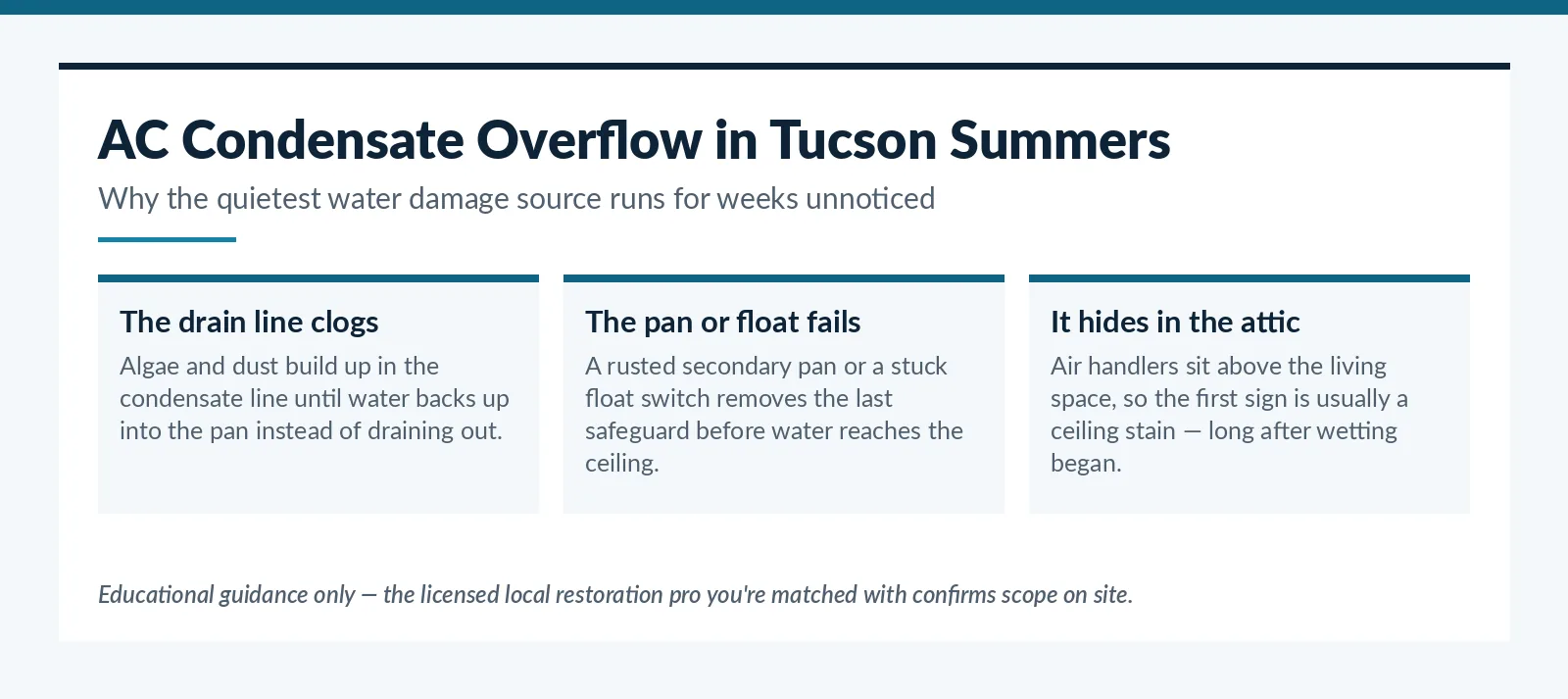
Where the water actually comes from
Central air conditioners pull moisture out of the air as they cool it, and that moisture collects on the evaporator coil and drips into a condensate drain pan, then out through a condensate line — usually a PVC pipe that runs to the exterior of the house or ties into a floor drain. In Tucson’s dry climate people assume there isn’t much condensate to worry about, but the math doesn’t work that way: the harder and longer a system runs, the more moisture it pulls out of the air regardless of how dry it is outside, and a system running 16+ hours a day through a July heat wave produces a steady, ongoing stream of condensate that has to go somewhere.
When that drain line clogs — with algae, dust, or debris, which builds up faster in a system that runs constantly — the water has nowhere to go but backward. Most systems have a secondary drain pan or a float switch meant to catch this and shut the system down before it overflows, but older units, poorly maintained systems, or units where the safety switch has failed won’t catch it. The pan overflows, and water starts finding its way into the attic, a closet, or straight through a ceiling below.
Why this is a bigger risk in extreme heat
Three things line up during Tucson’s hottest weeks that make condensate overflow more likely and more damaging than it would be the rest of the year:
- Run time goes way up. A system cycling nearly continuously produces far more condensate, and moves far more air past a coil that can grow biofilm and algae, than a system that only kicks on occasionally.
- Attic AC units sit above living space. Many Tucson homes have the air handler in the attic, meaning an overflow doesn’t just wet a utility closet — it drips through insulation and drywall into a bedroom or hallway ceiling below, often for hours before it’s noticed.
- Systems are already under stress. Extreme heat pushes AC systems to their performance limits, and a system running flat-out is more likely to have a marginal part — a float switch, a drain trap, a pump — finally fail during the exact stretch when it’s producing the most water.
How it’s different from a monsoon leak
A monsoon roof leak or flash-flood intrusion is usually tied to a specific storm event you can point to. Condensate overflow is different — it’s mechanical, gradual, and can happen on a bone-dry, cloudless 108-degree afternoon with no storm anywhere near the forecast. That makes it easy to miss, because homeowners are conditioned to watch for water damage during monsoon season and can overlook a slow ceiling stain that shows up on a clear week in June or August. The underlying moisture risk, though, is the same one covered in our mold after monsoon flooding guide — trapped moisture in insulation or drywall doesn’t care what caused it, and the same 24-to-48-hour window applies whether the source was a storm or a clogged drain line.
Signs of condensate overflow to watch for
- A ceiling stain that appears with no recent rain, often below an attic air handler or near a utility closet.
- A musty smell near a closet that houses an air handler or near attic access, even without visible staining yet.
- Visible water or staining on the floor of a utility closet where an indoor AC unit sits.
- Reduced cooling performance alongside any of the above — a system fighting a clogged drain or failed float switch sometimes short-cycles or underperforms before it fully backs up.
- Standing water in a secondary drain pan, visible if the unit has an accessible catch pan underneath.
Any of these are worth a look from an HVAC technician for the mechanical fix — clearing the line, checking the float switch — and, if there’s already staining, ceiling damage, or a musty smell, a water damage assessment for whatever moisture already got into the structure, since the two problems don’t resolve together on their own.
Why “it stopped dripping” doesn’t mean the damage stopped
Once an HVAC tech clears the clog, the active leak stops — but whatever insulation, drywall, or subflooring already absorbed water during the overflow doesn’t dry out just because the source is fixed. This is the same structural drying issue covered in our guide on why “it looks dry” doesn’t mean it’s actually dry — a ceiling that’s no longer actively dripping can still be sitting on wet insulation that needs proper drying, not just a repair to the AC unit that caused it.
Get connected to a Tucson water damage crew
If you’ve noticed a ceiling stain, a musty smell near your air handler, or any sign of condensate overflow, don’t wait for it to dry on its own. Call now and we’ll connect you with a licensed local restoration contractor who can assess the moisture and structural damage properly. Availability for same-day dispatch can vary with provider schedule and seasonal demand, so response times may shift during peak summer weeks.
→ Call now to connect with a local restoration crew
Frequently asked questions
Can my AC really cause water damage without any rain involved?
Yes. Central air conditioners pull significant moisture out of the air as they cool it, especially when running long hours during extreme heat, and that condensate has to drain properly. A clogged line or failed safety switch can cause an overflow with no storm anywhere nearby.
Why does this happen more in summer than other times of year?
AC systems run far longer and harder during Tucson’s hottest weeks, which both increases condensate volume and puts more stress on parts like float switches and drain traps — the same parts that are supposed to prevent an overflow.
How is this different from a monsoon-related water leak?
Monsoon leaks are tied to a storm event you can usually identify. Condensate overflow is mechanical and can happen on a clear, dry day with no rain at all, which makes it easy for homeowners to overlook as a possible cause of a ceiling stain.
What should I check if I suspect condensate overflow?
Look for ceiling stains near an attic air handler or utility closet, a musty smell, visible water in a secondary drain pan, or reduced cooling performance. Any of these are worth having both an HVAC technician and a water damage assessment look at.
If my HVAC tech clears the clog, is the water damage automatically fixed too?
No. Clearing the clog stops new water from coming in, but any insulation, drywall, or subfloor that already absorbed water needs to be properly dried out separately — fixing the AC doesn’t dry the structure.
Is AC condensate overflow damage covered by homeowners insurance?
It depends on the carrier and the circumstances — sudden mechanical failures are sometimes covered, while damage from a long-neglected, poorly maintained system may be treated differently. Document when you noticed it and confirm coverage specifics with your insurance company.
Where in the house does condensate overflow usually cause the most damage?
In homes with an attic-mounted air handler, the ceiling and insulation directly below the unit take the brunt of it. In homes with a closet-mounted unit, the closet floor and any adjoining wall are the most common damage points.
Tucson Restoration Pros is a dispatch and matching service connecting homeowners with independent, licensed water damage restoration professionals. We do not perform restoration work ourselves. We are not affiliated with any government agency. In a life-threatening emergency, call 911.
Frequently Asked Questions About Tucson, AZ Water & Mold Restoration
Does homeowners insurance cover water damage from a swamp cooler or pipe leak in Tucson, AZ?
Yes, standard Arizona HO-3 homeowners insurance policies typically cover sudden and accidental water damage in Tucson—including burst supply pipes, water heater ruptures, and sudden evaporative (swamp) cooler line breaks. You generally pay only your policy deductible ($500–$1,000) when professional IICRC S500 extraction starts within 24–48 hours.
How much does water damage restoration cost in Tucson, AZ (85701–85755)?
In Tucson, AZ (85701–85755), professional water mitigation and structural drying typically range from $1,200 to $3,800 for a single-room Category 1 clean-water leak, and $4,000 to $9,500+ for multi-room Category 2 or Category 3 sewage or monsoon flood losses built in Xactimate.
How fast does mold grow after a water leak in a Tucson home?
Per the U.S. EPA, mold can begin colonizing damp drywall, baseboards, and insulation within 24 to 48 hours of water exposure in a Tucson home. Because desert air dries only the surface while wall cavities stay humid, professional dehumidification and moisture mapping are essential.
How do I verify a restoration contractor's license in Tucson and Pima County?
Every restoration contractor performing structural work in Tucson and Pima County must hold an active license with the Arizona Registrar of Contractors (ROC). Before signing a work authorization, verify the company's license number online at roc.az.gov and confirm active general liability insurance.
Have an active leak or mold question in Tucson? Call (866) 695-5058 24/7 for a free live connection to a licensed local restoration specialist.
Local Hydrological, Psychrometric & Restoration Benchmarks: Tucson, AZ
| Local Engineering / Restoration Factor | Tucson, AZ (Metro Pima County) Field Specification |
|---|---|
| Primary Watershed & Wash Corridor | Rillito River, Pantano Wash, Santa Cruz River & Canada del Oro Corridors |
| Dominant Wall & Foundation Assembly | Sonoran slab-on-grade over caliche, burnt/mud adobe, slump block & 2-story stucco over dense Sonoran caliche hardpan |
| Leading Local Water / Mold Triggers | Rooftop swamp cooler overflows, under-slab copper pinhole leaks & monsoon flash runoff |
| Local Water Hardness & Pipe Scale Factor | 210–350 ppm CaCO₃ (12–20 gpg) — accelerates water heater tank & copper valve failure |
| IICRC S500 / S520 Target Dry Standard | < 16% Wood Moisture Equivalent (WME) & < 35 GPP indoor humidity within 24–48 hrs |
| Typical Pima County Xactimate Range | $1,400–$3,800 (Cat 1 Clean Extraction) | $3,500–$8,500+ (Cat 2/3 Flood, Sewage or Mold) — Call (866) 695-5058 |
How much does water damage restoration cost in Tucson?
Professional water damage restoration in Tucson, AZ typically costs between $1,400 and $3,800 for Category 1 clean pipe or supply leaks, while Category 2 appliance overflows and Category 3 monsoon flood or sewage cleanups range from $3,500 to $8,500+. Most sudden water losses are covered by Arizona homeowners insurance minus your policy deductible.
Does insurance cover swamp cooler leaks in Tucson?
Yes, standard Arizona HO-3 homeowners insurance policies generally cover sudden and accidental water damage from a ruptured rooftop swamp cooler supply line or float valve failure in Tucson, AZ. Policies exclude gradual rust neglect, so documenting the sudden overflow with immediate thermal moisture logs and Xactimate photos within 24 hours protects your claim.
How fast does mold grow after a water leak in Tucson, AZ?
Per U.S. EPA and IICRC S520 standards, mold spores begin colonizing damp drywall, baseboards, and insulation within 24 to 48 hours after a leak in Tucson, AZ. Because warm desert temperatures accelerate microbial amplification inside closed wall cavities, starting commercial LGR dehumidification on day one prevents costly mold demolition.
Priority Tucson Water Damage & Mold Remediation Dispatch Hubs
Need immediate on-site extraction, thermal moisture mapping, or containment? Connect directly with our two main service hubs for water damage restoration in Tucson, AZ and mold remediation in Tucson, AZ, or compare coverage in our Tucson State Farm, USAA & Allstate insurance claim hub.
Our 60-minute response trucks cover all nearby communities, including water damage restoration in Catalina Foothills, water damage restoration in Oro Valley, water damage restoration in Sam Hughes, and water damage restoration in Marana.
Frequently Asked Questions: AC Condensate Overflow: 's Summer in Tucson, AZ
Does homeowners insurance cover ac condensate overflow: 's summer from a swamp cooler or burst pipe in Tucson, AZ?
Most Arizona homeowners insurance policies cover sudden and accidental water damage in Tucson, AZ, including ruptured supply lines, water heater bursts, under-slab copper leaks, and sudden rooftop swamp cooler overflows. Gradual seepage or overland surface wash flooding typically requires separate flood coverage. Our technicians provide Xactimate estimates and infrared moisture photos directly to your adjuster.
What should I do in the first 30 minutes after discovering water damage in Tucson, AZ?
First, shut off your main residential water valve at the street meter or exterior hose bib to stop active flooding. Second, turn off circuit breakers serving wet rooms and elevate wood furniture onto foil pads. Third, call our 24/7 dispatch line at (866) 695-5058 with your Tucson, AZ address ready for immediate crew routing.
How fast can an emergency restoration crew arrive in Tucson, AZ?
Our live operator routes the nearest available IICRC-certified extraction truck in Tucson, AZ within minutes of your call. Typical on-site arrival near Rillito River and Pantano Wash and surrounding Pima County neighborhoods is 45 to 60 minutes, 24 hours a day, including weekends, holidays, and severe summer monsoon thunderstorm surges.
How much does professional ac condensate overflow: 's summer cost in Tucson, AZ?
In Tucson, standard Category 1 clean-water extraction and structural drying typically ranges between $1,400 and $3,800 depending on affected square footage. Category 2 greywater or Category 3 sewage and monsoon silt remediation ranges from $3,500 to $8,500+. When covered by homeowners insurance, you generally pay only your standard policy deductible.
Why is the 24 to 48 hour drying window critical for homes in Tucson, AZ?
According to EPA and IICRC S500 guidelines, indoor mold spores begin colonizing damp drywall, baseboards, and adobe or wood framing within 24 to 48 hours. In Tucson's warm climate, hidden moisture trapped under tile or inside stucco walls rapidly triggers microbial growth and odors unless commercial LGR dehumidifiers extract it immediately.