💡 Insurance vs. Out-of-Pocket Check: Why Most Tucson Homeowners Pay Only Their Deductible
While full Xactimate mitigation in Tucson typically ranges from $1,400 to $4,500+, sudden burst pipes, water heater ruptures, under-slab copper leaks, and sudden swamp-cooler line breaks are generally covered under standard Arizona HO-3 policies—meaning your true out-of-pocket cost is often just your deductible ($500–$1,000), provided extraction starts within the 24–48 hour EPA window.
Free live match · ROC-licensed pros 📞 (866) 695-5058
Dealing with Does Homeowners Insurance Cover a Slab Leak in Arizona? in Tucson, AZ in metro Tucson or Pima County, AZ (ZIPs 85701–85755)? Whether your loss involves a roof-mounted evaporative cooler leak, a slab-on-grade pipe burst over caliche clay, or post-monsoon mold behind drywall, wet materials cross the U.S. EPA’s 24–48 hour mold threshold rapidly. Call (866) 695-5058 24/7 to get matched live with an independent, licensed local Tucson restoration company.
Need a Licensed Crew in Tucson & Pima County, AZ?
Before you call — have ready: (1) Your 5-digit ZIP code, (2) What got wet or damaged, and (3) When it started.
Free live match · ROC-licensed pros 📞 (866) 695-5058
Does Homeowners Insurance Cover a Slab Leak in Arizona? in Tucson, AZ
Often, partly. In many Arizona homeowners policies, the water damage from a sudden slab leak is covered, and some policies also pay to break out and replace the floor to reach the broken pipe. The repair of the pipe itself is frequently not covered, and a leak that has been seeping for weeks or months may be excluded entirely. Every policy is different, so the language in yours and your adjuster’s findings decide the outcome. Here’s how slab leak claims usually break down in Tucson and what you can do to protect yours.
Why slab leaks are common in Tucson
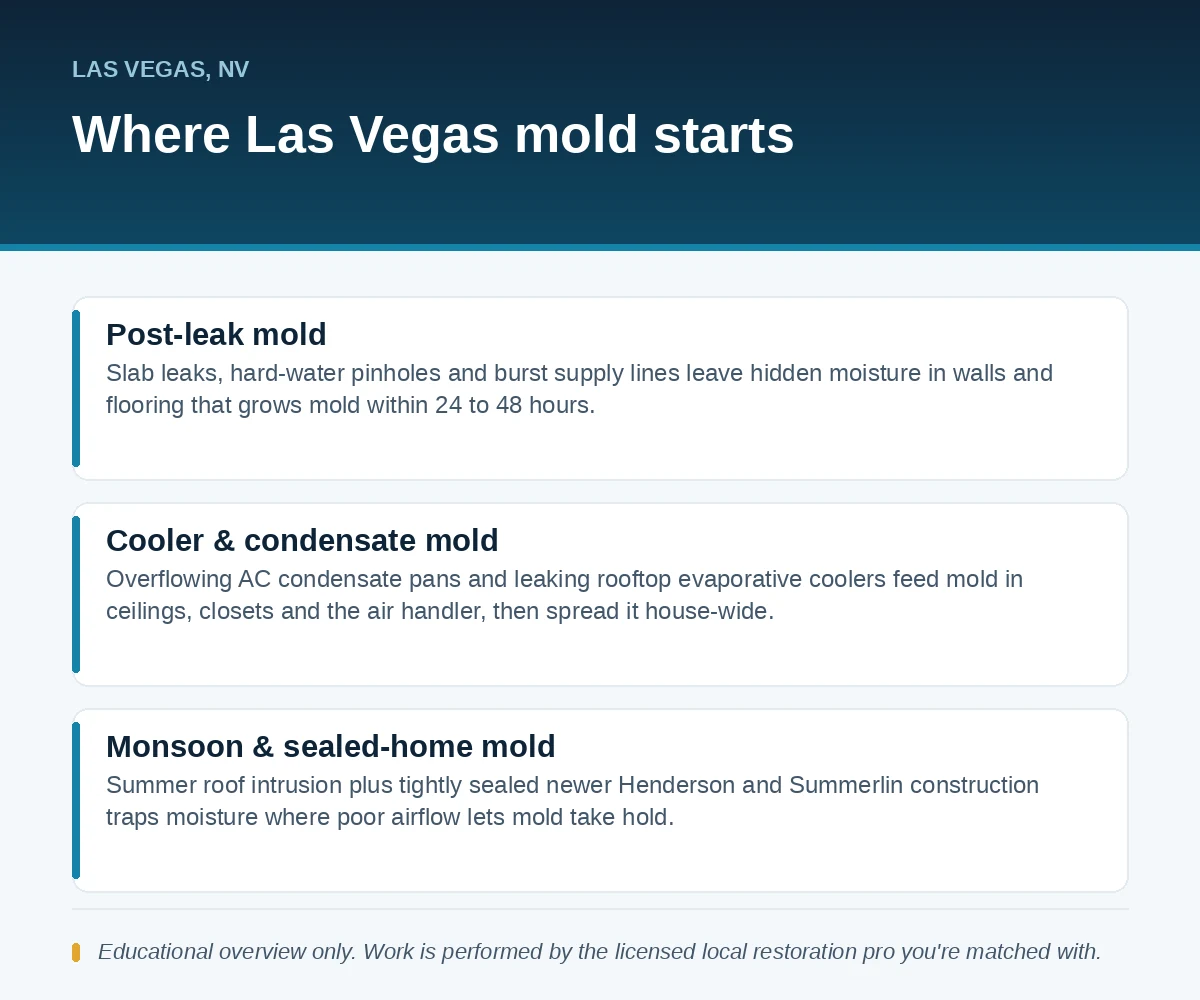
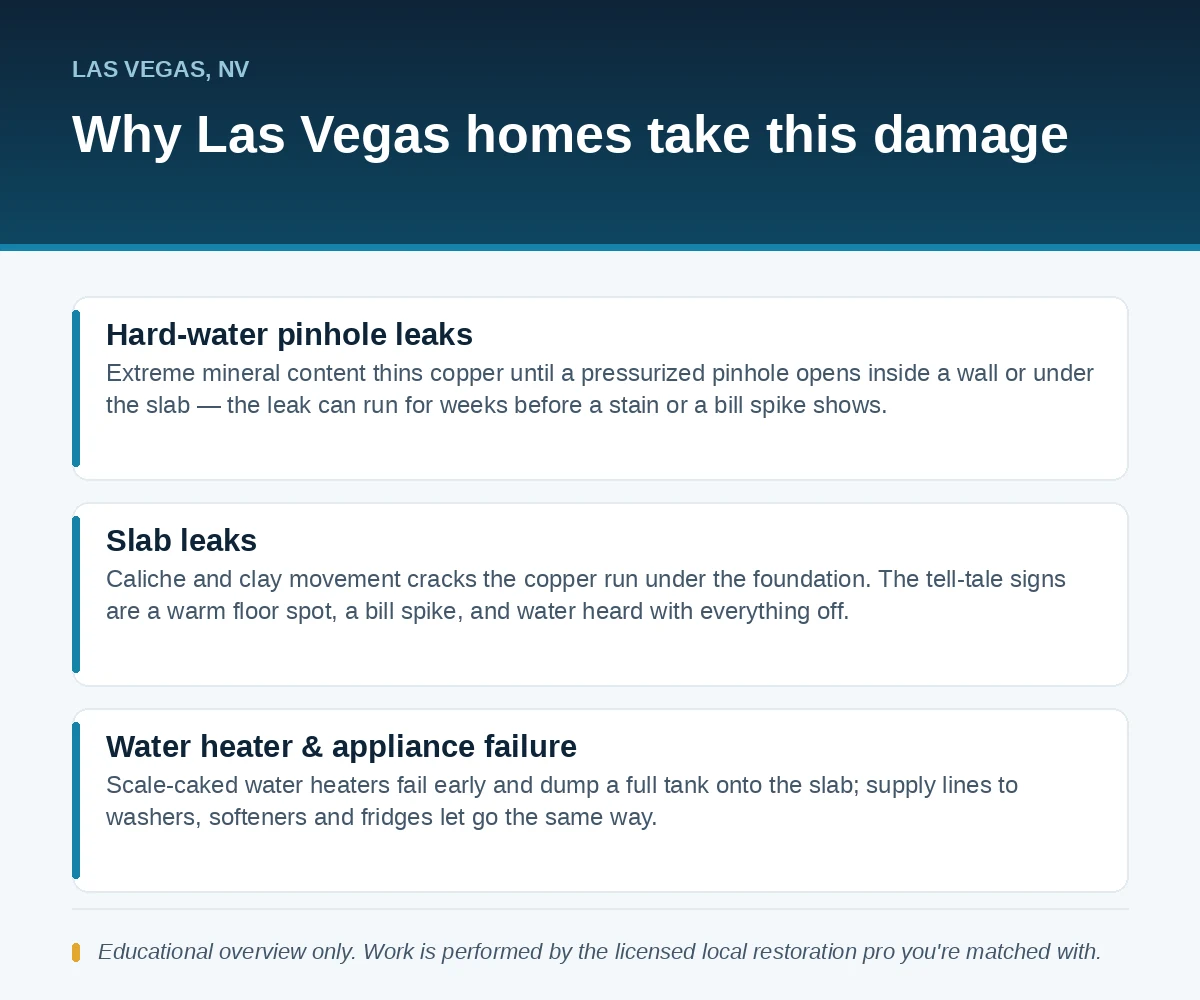
Most Tucson homes are built on concrete slabs, with water lines running under or inside the slab. In many homes built from the 1970s through the 1990s, those lines are copper. Over time, several local factors work against them:
- Caliche and rocky soil. Hard, cemented soil layers and gravel can rub against pipes as the ground shifts, wearing through them.
- Soil movement. Heavy monsoon rain followed by long dry stretches makes some soils swell and shrink, stressing pipes and fittings.
- Hard water and pressure. Mineral-heavy water and high pressure add wear from the inside.
- Hot water lines. Hot lines expand and contract every day, which is why many slab leaks show up as a warm spot on the floor.
Warning signs include a warm spot on tile or concrete, the sound of running water with every fixture off, a water bill that jumps for no reason, damp carpet or swelling baseboards, and cracks in the floor. The slab leak warning signs guide covers these in detail.
The three parts of a slab leak claim
Insurers usually look at a slab leak as three separate pieces, and they’re often treated differently.
1. The resulting water damage
This is the wet flooring, baseboards, drywall, cabinets and contents. If the leak was sudden and accidental, many standard homeowners policies cover this part, subject to your deductible.
2. Access: tearing out and replacing the slab and floor
To fix the pipe, a plumber may need to jackhammer through tile and concrete, or tunnel under the slab. Some policies cover the cost of breaking out and restoring the floor to reach the leak, often called tear-out or access coverage. Others limit it or exclude it. This is one of the most important lines to find in your policy.
3. The pipe repair itself
Many policies don’t pay to repair or replace the failed pipe, because the pipe wore out. Some insurers offer endorsements, such as service line or equipment coverage, that can change that. Rerouting a line overhead instead of breaking into the slab is a plumbing decision, and coverage for it varies.
Water under the floor or a warm spot on the tile? Talk to a real Tucson water damage pro about drying and documentation.
Tap to call (866) 695-5058Tap to reach the 24/7 dispatch line. The call costs nothing and there is no obligation to book.
What usually gets a slab leak claim denied
- Long-term seepage. Many policies exclude damage from water that leaked continuously or repeatedly over a period of time. Mold under flooring, rotted baseboards and long-standing stains suggest a slow leak to an adjuster.
- Wear and tear, and settling. Corrosion, deterioration and foundation settling or cracking are commonly excluded.
- Delay. Waiting to report the leak, or letting water keep running after you knew about it, can hurt the claim. Policies generally require you to take reasonable steps to prevent further damage.
- Mold limits. Mold that results from a covered leak may be covered only up to a limit, or excluded.
Steps that protect your claim
- Stop the water. Shut off the main valve if you hear water running under the floor or see it surfacing.
- Document right away. Take photos and video of wet areas, the water meter and any warm spots before anything is moved or removed. Note the date you first noticed signs.
- Get a written leak detection report. A licensed plumber’s report showing where the leak is and what failed is often the key document for the adjuster.
- Report the claim promptly and ask the adjuster which parts of the work, including access and floor restoration, are being considered.
- Start drying. Water under flooring and in wall bottoms keeps spreading. Mitigation, including drying and removing materials that can’t be saved, is usually expected and is documented with moisture readings.
- Keep receipts and copies of every estimate, invoice and report.
The step-by-step guide to filing a water damage claim in Arizona walks through the process, and the broader guide on what insurance covers for water damage in Tucson explains the sudden-versus-gradual line that decides so many claims.
Who does what
A plumber finds and fixes the leak. A water damage restoration company dries the structure, removes damaged materials and documents moisture. A flooring or general contractor rebuilds. In Arizona, contractors doing work beyond small handyman jobs need an ROC license, so check license numbers on the Arizona Registrar of Contractors website. Your insurer decides coverage, and your adjuster is the person to ask about any part of the work before you assume it’s included.
Frequently asked questions
Does homeowners insurance cover slab leaks in Arizona?
Often partly. Many policies cover sudden water damage from a slab leak, and some cover tearing out and restoring the floor to reach the pipe. Repair of the failed pipe itself is frequently excluded, and long-term seepage may not be covered. Your policy and adjuster decide.
Will insurance pay to jackhammer the slab to fix a leak?
Some policies include tear-out or access coverage that pays to break out and restore the floor to reach a covered leak. Others limit or exclude it, so check your policy and ask your adjuster before work starts.
Why do slab leak claims get denied?
Common reasons include damage from slow, long-term seepage, wear and tear or corrosion, foundation settling, waiting too long to report the leak, and mold limits or exclusions.
What are the signs of a slab leak in a Tucson home?
Warm spots on the floor, the sound of running water with fixtures off, a sudden jump in the water bill, damp carpet or swelling baseboards, and new cracks in flooring are common signs.
What documents help a slab leak claim?
Photos and video of the damage, the date you first noticed signs, a licensed plumber’s written leak detection report, moisture readings from drying, and copies of every estimate and invoice.
Slab leak water spreading under your flooring? Get connected with a licensed local water damage pro serving Tucson and Southern Arizona.
Tap to call (866) 695-5058Call to get connected with a licensed local restoration pro. Your quote is between you and the pro.
Tucson Restoration Pros is a dispatch and referral service connecting homeowners with independent, licensed local water and mold restoration companies across Tucson & Southern Arizona. We are not a licensed restoration contractor and do not perform restoration work ourselves. Insurance information here is general; your policy and adjuster decide coverage.
💡 Wait — Will Homeowners Insurance Cover This Instead of Paying Out-of-Pocket?
In Tucson, sudden and accidental water damage (burst pipes, polybutylene ruptures, water heater leaks, sudden swamp-cooler line breaks, and appliance overflows) is typically covered under standard Arizona HO-3 policies. That means even if a multi-room structural drying job costs $3,500+, your actual out-of-pocket cost is often only your policy deductible ($500–$1,000)—provided professional mitigation starts within the 24–48 hour EPA window.
📞 Call (866) 695-5058 — Free 2-Minute Insurance & Scope Triage
Frequently Asked Questions About Tucson, AZ Water & Mold Restoration
Does homeowners insurance cover water damage from a swamp cooler or pipe leak in Tucson, AZ?
Yes, standard Arizona HO-3 homeowners insurance policies typically cover sudden and accidental water damage in Tucson—including burst supply pipes, water heater ruptures, and sudden evaporative (swamp) cooler line breaks. You generally pay only your policy deductible ($500–$1,000) when professional IICRC S500 extraction starts within 24–48 hours.
How much does water damage restoration cost in Tucson, AZ (85701–85755)?
In Tucson, AZ (85701–85755), professional water mitigation and structural drying typically range from $1,200 to $3,800 for a single-room Category 1 clean-water leak, and $4,000 to $9,500+ for multi-room Category 2 or Category 3 sewage or monsoon flood losses built in Xactimate.
How fast does mold grow after a water leak in a Tucson home?
Per the U.S. EPA, mold can begin colonizing damp drywall, baseboards, and insulation within 24 to 48 hours of water exposure in a Tucson home. Because desert air dries only the surface while wall cavities stay humid, professional dehumidification and moisture mapping are essential.
How do I verify a restoration contractor's license in Tucson and Pima County?
Every restoration contractor performing structural work in Tucson and Pima County must hold an active license with the Arizona Registrar of Contractors (ROC). Before signing a work authorization, verify the company's license number online at roc.az.gov and confirm active general liability insurance.
Have an active leak or mold question in Tucson? Call (866) 695-5058 24/7 for a free live connection to a licensed local restoration specialist.
Local Hydrological, Psychrometric & Restoration Benchmarks: Tucson, AZ
| Local Engineering / Restoration Factor | Tucson, AZ (Metro Pima County) Field Specification |
|---|---|
| Primary Watershed & Wash Corridor | Rillito River, Pantano Wash, Santa Cruz River & Canada del Oro Corridors |
| Dominant Wall & Foundation Assembly | Sonoran slab-on-grade over caliche, burnt/mud adobe, slump block & 2-story stucco over dense Sonoran caliche hardpan |
| Leading Local Water / Mold Triggers | Rooftop swamp cooler overflows, under-slab copper pinhole leaks & monsoon flash runoff |
| Local Water Hardness & Pipe Scale Factor | 210–350 ppm CaCO₃ (12–20 gpg) — accelerates water heater tank & copper valve failure |
| IICRC S500 / S520 Target Dry Standard | < 16% Wood Moisture Equivalent (WME) & < 35 GPP indoor humidity within 24–48 hrs |
| Typical Pima County Xactimate Range | $1,400–$3,800 (Cat 1 Clean Extraction) | $3,500–$8,500+ (Cat 2/3 Flood, Sewage or Mold) — Call (866) 695-5058 |
How much does water damage restoration cost in Tucson?
Professional water damage restoration in Tucson, AZ typically costs between $1,400 and $3,800 for Category 1 clean pipe or supply leaks, while Category 2 appliance overflows and Category 3 monsoon flood or sewage cleanups range from $3,500 to $8,500+. Most sudden water losses are covered by Arizona homeowners insurance minus your policy deductible.
Does insurance cover swamp cooler leaks in Tucson?
Yes, standard Arizona HO-3 homeowners insurance policies generally cover sudden and accidental water damage from a ruptured rooftop swamp cooler supply line or float valve failure in Tucson, AZ. Policies exclude gradual rust neglect, so documenting the sudden overflow with immediate thermal moisture logs and Xactimate photos within 24 hours protects your claim.
How fast does mold grow after a water leak in Tucson, AZ?
Per U.S. EPA and IICRC S520 standards, mold spores begin colonizing damp drywall, baseboards, and insulation within 24 to 48 hours after a leak in Tucson, AZ. Because warm desert temperatures accelerate microbial amplification inside closed wall cavities, starting commercial LGR dehumidification on day one prevents costly mold demolition.
Priority Tucson Water Damage & Mold Remediation Dispatch Hubs
Need immediate on-site extraction, thermal moisture mapping, or containment? Connect directly with our two main service hubs for water damage restoration in Tucson, AZ and mold remediation in Tucson, AZ, or compare coverage in our Tucson State Farm, USAA & Allstate insurance claim hub.
Our 60-minute response trucks cover all nearby communities, including water damage restoration in Catalina Foothills, water damage restoration in Oro Valley, water damage restoration in Sam Hughes, and water damage restoration in Marana.
Frequently Asked Questions: Does Homeowners Insurance Cover a Slab Leak in Arizona? in Tucson, AZ
Does homeowners insurance cover does homeowners insurance cover a slab leak in arizona? from a swamp cooler or burst pipe in Tucson, AZ?
Most Arizona homeowners insurance policies cover sudden and accidental water damage in Tucson, AZ, including ruptured supply lines, water heater bursts, under-slab copper leaks, and sudden rooftop swamp cooler overflows. Gradual seepage or overland surface wash flooding typically requires separate flood coverage. Our technicians provide Xactimate estimates and infrared moisture photos directly to your adjuster.
What should I do in the first 30 minutes after discovering water damage in Tucson, AZ?
First, shut off your main residential water valve at the street meter or exterior hose bib to stop active flooding. Second, turn off circuit breakers serving wet rooms and elevate wood furniture onto foil pads. Third, call our 24/7 dispatch line at (866) 695-5058 with your Tucson, AZ address ready for immediate crew routing.
How fast can an emergency restoration crew arrive in Tucson, AZ?
Our live operator routes the nearest available IICRC-certified extraction truck in Tucson, AZ within minutes of your call. Typical on-site arrival near Rillito River and Pantano Wash and surrounding Pima County neighborhoods is 45 to 60 minutes, 24 hours a day, including weekends, holidays, and severe summer monsoon thunderstorm surges.
How much does professional does homeowners insurance cover a slab leak in arizona? cost in Tucson, AZ?
In Tucson, standard Category 1 clean-water extraction and structural drying typically ranges between $1,400 and $3,800 depending on affected square footage. Category 2 greywater or Category 3 sewage and monsoon silt remediation ranges from $3,500 to $8,500+. When covered by homeowners insurance, you generally pay only your standard policy deductible.
Why is the 24 to 48 hour drying window critical for homes in Tucson, AZ?
According to EPA and IICRC S500 guidelines, indoor mold spores begin colonizing damp drywall, baseboards, and adobe or wood framing within 24 to 48 hours. In Tucson's warm climate, hidden moisture trapped under tile or inside stucco walls rapidly triggers microbial growth and odors unless commercial LGR dehumidifiers extract it immediately.