Smoke Damage Restoration in Tucson, AZ
The fire was contained. The smoke was not. A grease flare in a Sam Hughes kitchen, a puffback in Oro Valley, or wildfire smoke pulled in through a swamp cooler leaves residue no intact house shakes off.
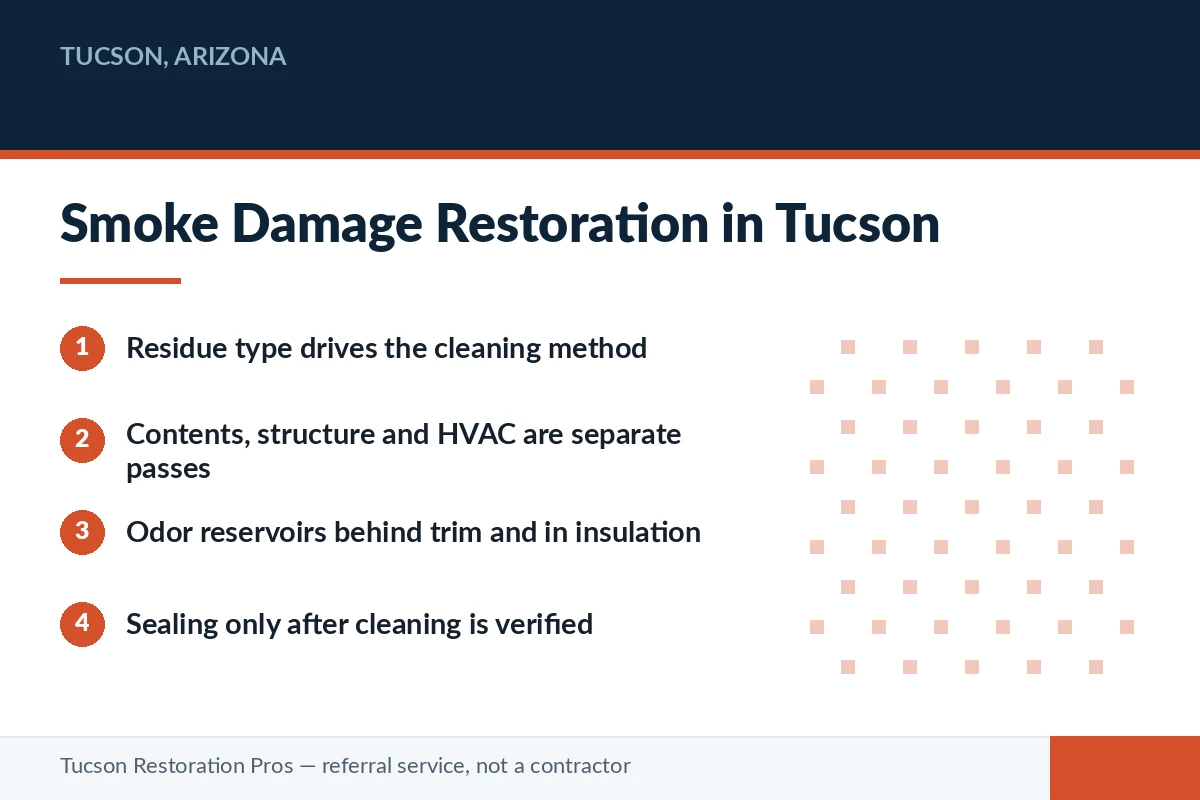
Quick answer: Smoke restoration is residue-specific cleaning, not deodorizing. The licensed local pro you are matched with identifies the residue, isolates the cooler or air handler spreading it, HEPA-filters, dry-cleans, then deodorizes.
Get connected to a smoke & odor pro
Routed to a licensed local company.
📞 Call Now — (612) 886-9863Free, no obligation. You are connected with independent licensed local companies — a referral service, not a contractor.
Most smoke calls here do not come from a house that burned down. They come from oil flashing over on a Midtown range, a furnace puffing back in a January cold snap, a cord smoldering in a Vail garage wall, or a Catalinas range fire while swamp coolers pull the valley’s smoke indoors.
Which page do you need?
Not all smoke leaves the same residue
What burned, how hot, and with how much oxygen decides what is on your surfaces. Each residue needs a different first move.
The four smoke residues
A method that lifts one of these off a wall drives another one into it.
Most Tucson jobs are a blend. A garage fire reaching stored paint leaves dry smoke on the ceiling, wet smoke on plastics, fuel soot through the return.
The instinct is a damp cloth, which grinds dry smoke into the paint — and Tucson raises the stakes with burnt adobe, exposed vigas, and open-beam ceilings in Barrio Viejo and Armory Park.
Why smoke behaves differently in a Tucson house
Wildfire smoke and the swamp cooler problem
Every metro near a fire-prone range deals with wildfire smoke. Tucson deals with it while much of its housing runs a machine whose whole job is pulling outside air inside. An evaporative cooler does not recirculate: it drives exterior air across wet pads and through the house continuously, so a Catalina, Rincon, or Santa Rita fire has a pathway into every room.
The cooler is part of the damage: attic units hold odor in pads, flex duct, and insulation, so a house cleaned wall to wall smells like smoke again in April. Track events on AirNow fire and smoke map and Pima County air quality, against EPA wildfire indoor-air guidance.
Puffbacks during the cold snaps
Tucson gets a handful of cold weeks, which is why puffbacks happen here. Furnaces idle March to December and fall out of tune; the first hard night in Oro Valley, Tanque Verde, or Green Valley is when delayed ignition blows unburned fuel through the ducts, fanning greasy speckle from every register.
Dust, and how desert air hides odor
Haboob dust layers over soot when both land in one week, binding it under a film that is harder to lift. Low humidity plays its own trick: surface odor fades fast, so a house smells better after a week while compounds stay bound in drywall and wood.
Kitchens, garages, and monsoon smolders
Older Midtown, Sam Hughes, and Armory Park kitchens generate most protein-residue calls: original cabinetry, painted plaster, no hood. Tucson garages hold the water heater and the panel, so a garage fire adds stored chemicals, plastics, and paint through the shared wall. Monsoon lightning into a low-slope roof deck smolders for hours with heavy smoke and no fire. If suppression water came too, add water damage restoration and watch for mold.
Neighborhoods and ZIPs served
Catalina Foothills, Oro Valley, Marana, Dove Mountain, Sahuarita, Green Valley, Vail, Rita Ranch, Corona de Tucson, Sam Hughes, Tanque Verde, Casas Adobes, Civano, Midvale Park, Drexel Heights, Flowing Wells, Barrio Viejo, Armory Park, Downtown, Midtown, South Tucson. ZIPs 85701, 85704, 85706, 85710, 85711, 85712, 85713, 85714, 85715, 85716, 85718, 85719, 85737, 85739, 85741, 85743, 85746, 85747, 85749, 85750, 85755, 85756, 85614, 85622, 85629, 85641, 85653, 85658. See service areas.
What smoke restoration actually involves
What the licensed, insured local company works through, per IICRC S700.
Contain the source and the spread
Isolate affected rooms so traffic and airflow stop spreading residue.
Isolate the air-moving system
Cooler, air handler, returns, and ducts inspected first. In Tucson this decides whether odor returns in April.
HEPA air filtration
Air scrubbers pull suspended particulate from the contained zone throughout.
Dry cleaning before wet
HEPA vacuum and chem sponge, single-direction, lift residue instead of driving it in.
Surface-specific wet cleaning
Degreasers for protein film, solvents for wet smoke, gentler methods on adobe and vigas.
Sealing what cleaning cannot finish
Framing, attic decking, and vigas that still hold odor get sealed.
Deodorization, chosen honestly
Thermal fogging reaches the pores smoke did; hydroxyl is slower but safe in occupied homes; ozone needs an empty, later-aired space.
Contents and textiles
Clothing, upholstery, artwork, and electronics are cleaned separately, often off site.
What not to do first
Almost every permanent smoke loss started as a fixable one.
Smoke or Soot in Your Tucson Home?
Get routed to an independent, licensed and insured local smoke and odor restoration company, 24/7 across Tucson & Southern Arizona. Same-day dispatch is common but not guaranteed.
Smoke damage and Arizona homeowners insurance
Coverage turns on one question: was there a covered fire loss at your property? Soot from a sudden, accidental fire — including one at a neighboring home — is typically addressed under the same Arizona homeowners claim as the fire itself, extending to cleaning, deodorization, and contents. Wildfire smoke with no covered fire loss there is often treated differently.
Documentation decides the outcome. Photograph residue on walls, ceilings, and inside registers before cleaning; note when the odor started; inventory contents instead of discarding them; ask whether loss of use applies. See claim help and the Arizona filing guide.
Tucson smoke damage FAQs
How fast does smoke and soot damage need to be addressed?
My house did not burn but smells like smoke after a wildfire. Is that a restoration job?
Should I run my swamp cooler or air conditioner after a smoke event?
Why can I not just wipe the soot off the walls?
Does smoke odor go away on its own in a dry climate?
Is smoke damage covered by homeowners insurance in Arizona?
Related guides
About this guide
Reviewed for local accuracy by the Tucson Restoration Pros team, drawing on IICRC S700, EPA wildfire indoor-air guidance, AirNow, and Pima County air quality. See how we research.
Related reading
- Smoke Damage From a Neighbor’s Fire: What to Do — How smoke and soot travel through shared walls, attic space and HVAC systems when your own home never caught fire.
Connect with a Tucson restoration crew
Call now and we’ll connect you with a qualified, licensed local restoration company near you — 24/7.
📞 Call Now — (612) 886-9863Free, no obligation. We’re a referral service, not a contractor.