Swamp Cooler Leaking Through the Ceiling? Do This
Swamp Cooler Leaking Through the Ceiling: What Tucson Homeowners Should Do First
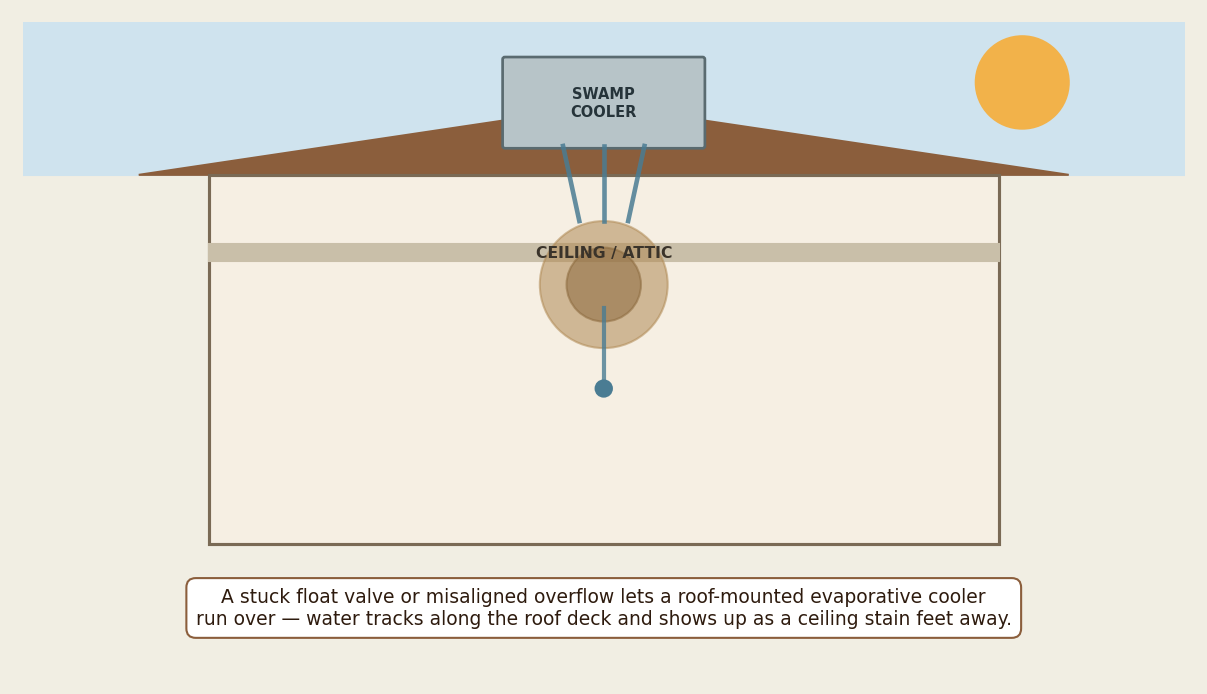
Quick answer: A ceiling stain under a roof-mounted swamp cooler almost always means the unit is overflowing or its drain line has failed, not that the roof itself is leaking. Evaporative coolers constantly feed water to a wet pad, and a stuck float valve, clogged bleed line, or misaligned drain lets that water run over the pan and track along the roof deck — sometimes showing up as a stain feet away from the unit itself. Turn the cooler off, and don’t assume the stain marks the actual leak point.
Cooler leaking through the ceiling right now? Talk to a local restoration pro.
📞 (866) 695-5058 · Tap to callFree call · we connect you with a local restoration pro · referral service, not a contractor
Why Swamp Coolers Are Such a Common Source of Ceiling Leaks in Tucson
Evaporative cooling has been a fixture in Tucson and the broader Sonoran Desert for decades, and University of Arizona Cooperative Extension resources have long covered its upkeep as standard homeowner maintenance in this climate — it works by pulling dry desert air through a water-soaked pad, which cools the air through evaporation. That means, unlike a standard AC condenser, a swamp cooler is constantly cycling water while it runs, and most units in older Tucson homes sit directly on the roof, right above living space.
That combination — constant water flow, mounted directly over the ceiling — is exactly why a swamp cooler malfunction shows up as a ceiling problem instead of just a mechanical one. There’s no buffer between a leak at the unit and the drywall below it.
The Usual Culprits
- A stuck float valve. The float that regulates water level in the pan can get stuck open from mineral buildup or debris, letting water keep filling the pan well past its normal level until it overflows the sides.
- A clogged or disconnected bleed/drain line. Swamp coolers use a bleed line to flush out water and dissolved minerals; if that line clogs or comes loose, water backs up rather than draining off the roof as intended.
- A cracked or rusted pan. Older metal pans corrode over years of constant moisture exposure, and a hairline crack can leak slowly enough that it goes unnoticed until a ceiling stain appears.
- A failed roof jack or curb seal. The seal where the cooler’s ductwork penetrates the roof deck can degrade over time, letting overflow water — or even wind-driven monsoon rain — find its way into the roof cavity.
Why the Stain Isn’t Always Right Under the Leak
This is the detail that trips up most homeowners. Water doesn’t drop straight down through a roof deck and ceiling — it follows the path of least resistance, running along roof sheathing, rafters, or ductwork before finally soaking through drywall at a low point. That’s why a stain can appear several feet from the actual swamp cooler location, and why guessing at the source based on stain position alone often leads to the wrong repair.
What to Do the Moment You Spot a Ceiling Stain
- Turn the cooler off at the switch or breaker so it stops feeding more water into the problem while you sort out the cause.
- Place a container to catch active dripping if water is actively coming through, and move anything valuable out from underneath.
- Don’t push or poke at a sagging ceiling. A water-saturated section of drywall can hold weight until it suddenly doesn’t — a controlled release by someone who knows what they’re doing is safer than an accidental collapse.
- Photograph the stain and its spread before doing anything else, for your own records and for any insurance conversation.
Getting the Actual Source Found and Fixed
Because the failure point is rarely directly above the visible stain, tracing a swamp cooler leak usually means inspecting the unit itself — float, pan, bleed line, and roof seal — rather than starting with the ceiling. Requesting swamp cooler water damage cleanup in Tucson connects you with the licensed local restoration pro you’re matched with, who can identify how far the water traveled, dry out the roof cavity and ceiling cavity before mold has a chance to start, and document the damage path for insurance purposes. For repair work on the ceiling material itself once the source is resolved, see the site’s ceiling water damage repair guide. If you’re wondering whether your policy responds to this kind of loss, this breakdown of insurance coverage for swamp cooler leaks walks through what’s typically covered.
Ceiling wet from a cooler leak? Call to get connected with a Tucson restoration pro to dry it out.
📞 (866) 695-5058 · Tap to callFree call · we connect you with a local restoration pro · referral service, not a contractor
Swamp Cooler Ceiling Leak FAQs
Is a swamp cooler leak the same as a roof leak?
Not usually. Most swamp cooler leaks originate at the unit — the pan, float valve, or drain line — rather than from a failure in the roofing material itself, though a long-neglected overflow can eventually damage the roof deck around the unit too.
Can I keep running my swamp cooler while I figure out the leak?
It’s best to shut it off first. Running the unit keeps feeding water into whatever is already failing, which extends the area of ceiling and roof-deck saturation before the actual cause gets addressed.
Why does the ceiling stain keep spreading even after I turned the cooler off?
Water already inside the roof cavity or ceiling material continues moving along the same paths it was already following, so a stain can keep growing for a while even after the source is shut off — that trapped moisture is also what creates mold risk if it isn’t dried out.
Do all Tucson homes still use swamp coolers, or is this an older-home issue?
Evaporative cooling remains common across Tucson because of the region’s low humidity, so this isn’t limited to older homes — any roof-mounted unit, regardless of the home’s age, can develop these same float, drain, or seal issues over time.
Need help now? Dealing with this in your home right now? See water damage restoration in Tucson, 24/7 emergency water removal or mold remediation in Tucson — free 24/7 dispatch to a licensed local company, or call (866) 695-5058.
Leave a Reply