Tucson Monsoon Season Prep Checklist: What to Do Before June 15
The National Weather Service defines Arizona’s monsoon season as running June 15 through September 30 — a fixed calendar window, not a rainfall trigger, precisely because storm timing varies so much year to year. What doesn’t vary is how fast a first monsoon cell can turn a dry wash into a torrent, or push water through a roof, doorway, or swamp cooler line that was already marginal. A few hours of prep before the season starts is cheap. A flooded living room in July is not.
Tucson Restoration Pros is a free dispatch and referral service — we connect homeowners with independent, licensed local restoration companies, we don’t perform restoration ourselves. This checklist is general seasonal guidance, not a substitute for a professional roof, HVAC, or drainage inspection.
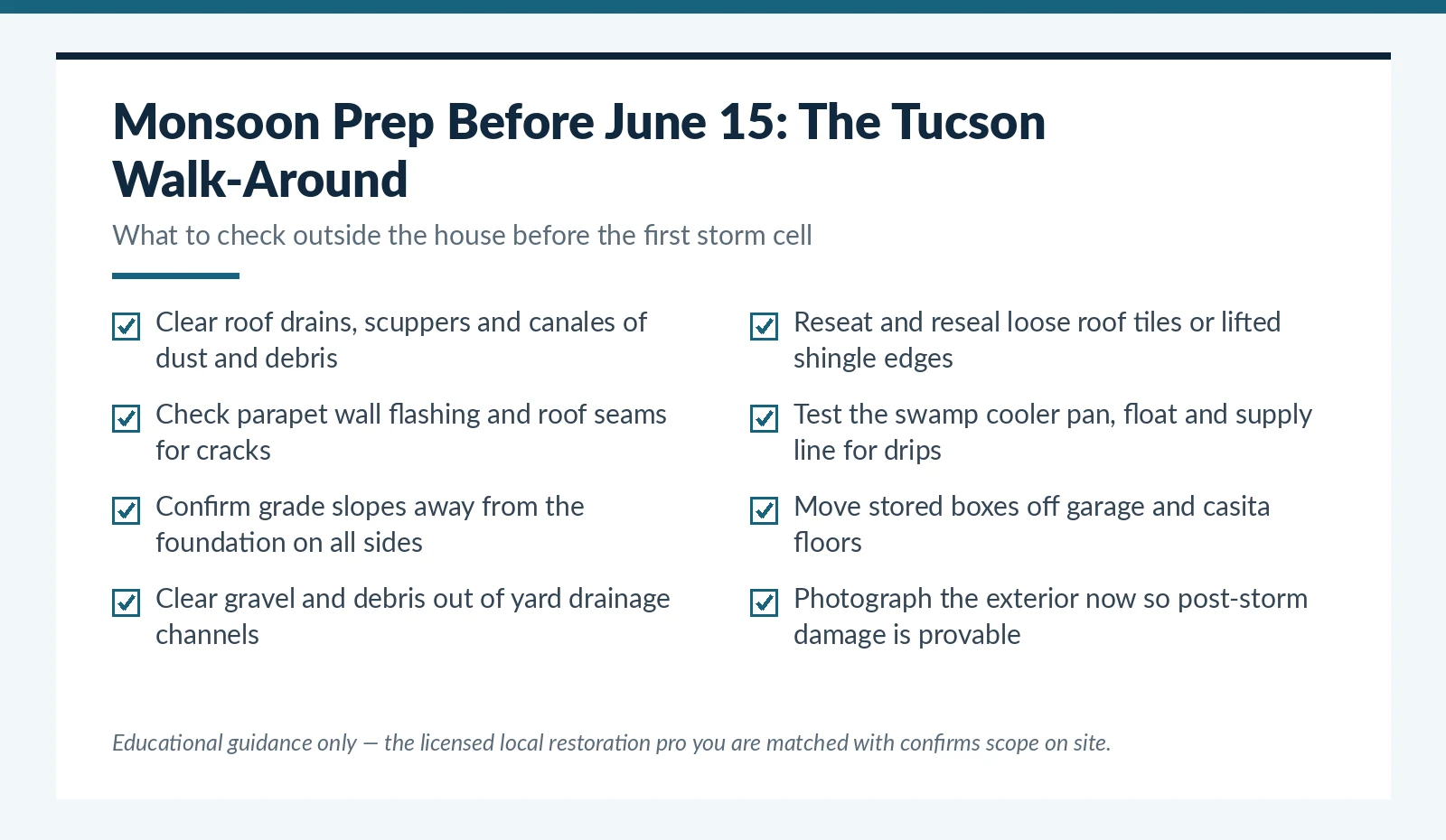
Before June 15: the walk-around checklist
1. Roof and parapet check (especially flat/low-slope roofs)
Many Tucson homes have flat or low-slope roofs with parapet walls — both are common failure points once monsoon rain starts pooling instead of running off. Look for ponding water stains, cracked roof coating, or debris blocking scuppers and drains from a full year of dust accumulation. A cracked parapet cap or clogged drain that’s fine in dry weather can flood a ceiling the first time a real storm hits. See roof & ceiling leak water damage for what happens when this goes wrong.
2. Swamp cooler shutdown or service check
If your evaporative cooler is still running into monsoon season, check the roof jack, distribution tubing, float valve, and pan for the six common failure points before storms start — a marginal seal or a cracked pan that’s been fine all spring can give way the moment monsoon humidity and wind stress hit the unit. If you’re switching to A/C for the humid months, make sure the cooler is properly shut down and drained, not just switched off at the thermostat. See swamp cooler leak water damage for the full failure-point breakdown.
3. Grading and drainage around the foundation
Walk the perimeter of the house. Ground should slope away from the foundation, not toward it. Check that downspouts extend water away from the slab rather than dumping it against the wall. In neighborhoods near washes or with a history of street flooding, sandbags or door barriers are worth having on hand before the season starts, not after the first flash-flood watch.
4. Clear gutters, scuppers, and yard drains
A full year of dust, leaves, and debris collects in gutters and drains during Tucson’s dry months — and monsoon storms arrive suddenly enough that a clogged drain has no time to be discovered gradually. Clear them before the season, not during the first storm.
5. Document your home’s baseline condition
Photograph your roof, ceiling, foundation, and any prior repair areas before the season starts. If a claim does become necessary later, “before” photos make the “after” comparison — and the adjuster’s job — considerably easier.
6. Confirm your insurance coverage — before you need it
Standard homeowners policies typically cover sudden, accidental water damage (a burst pipe, a roof failure during a storm) but often exclude or limit coverage for flood water entering from outside — which is exactly the mechanism behind most monsoon flooding. If you’re in a wash-adjacent area, check now whether a separate flood policy makes sense; asking after a flood already happened is too late for that policy year. See does insurance cover monsoon flood damage in Arizona for the coverage breakdown.
During the season: what to watch
- Track NWS Tucson alerts — flash flood watches and warnings for your specific area, not just a general forecast.
- Never drive or walk into moving water — six to twelve inches of moving water can sweep a person off their feet or float a vehicle. Follow the NWS Turn Around, Don’t Drown® guidance.
- Check on swamp cooler and roof performance after the first few real storms of the season — early failures are easier to catch and address before they compound.
If water gets in anyway
Even good prep doesn’t guarantee a dry season — Tucson’s flash floods are, per the Pima County Regional Flood Control District, one of the region’s most significant weather hazards precisely because of how fast dry washes fill. If water does get into your home, the same rules apply as any water event: document it, stop the source if it’s safe to do so, and start the connection to a crew quickly — the EPA’s 24–48 hour mold window doesn’t pause for the season. See our full monsoon flood cleanup guide for the complete response process.
Get connected before or during the season
Whether you need help fast during an active monsoon event or want to line up a pre-season roof or drainage referral, call now and we’ll connect you with a qualified local crew.
→ Call now to connect with a local restoration crew
For a full walkthrough of the first 24–48 hours after water gets in — plus flash-flood and wash safety and what to document for insurance — see our Tucson Monsoon Flood & Mold Prevention Guide. For the historical monsoon and flood data behind this checklist, including how fast Pima County washes actually flood, see our sourced Tucson Monsoon Season Data & Home Flood-Risk Reference.
Frequently asked questions
When exactly is Tucson’s monsoon season?
The National Weather Service defines it as June 15 through September 30 — a fixed calendar window rather than a date tied to the first actual storm, since monsoon onset timing varies year to year.
What’s the single most common monsoon failure point in Tucson homes?
Flat and low-slope roofs with parapet walls are a frequent failure point once ponding rain exceeds what scuppers and drains were designed to handle, especially if drains were already partially clogged with a year’s worth of dust and debris.
Does homeowners insurance cover monsoon flooding?
It depends on the source. Sudden, accidental water damage — like a roof failure during a storm — is often covered. Flood water entering from outside the home is frequently excluded or limited on a standard policy and may require separate flood insurance. Check your specific policy before the season starts.
Should I shut down my swamp cooler before monsoon season?
Many Tucson homeowners switch to A/C during the humid monsoon months since evaporative cooling is less effective in high humidity. If you do switch over, make sure the cooler is properly shut down and drained rather than just turned off, since a neglected unit can still fail and leak.
What should I do the moment water gets into my home during a storm?
If it’s safe, stop the source and document the damage with photos before moving anything. Never enter moving floodwater. Then start the connection to a restoration crew — the mold-risk clock starts as soon as materials get wet, regardless of the season.
Tucson Restoration Pros is a lead-generation and referral service. We are not a restoration contractor, are not affiliated with any government agency, and do not perform restoration, mitigation, or repair work. When you reach out, we connect you with one or more independent, licensed local restoration companies that handle the work, licensing, and insurance. In a life-threatening emergency, call 911; for active flooding, follow the NWS Turn Around, Don’t Drown guidance.
Leave a Reply