Category 1, 2, or 3? Why the Water Type Changes Everything About Your Tucson Cleanup
Not every flooded room is the same job. A clean supply-line break and a sewage backup both leave “water damage,” but a restoration crew treats them completely differently — different PPE, different containment, different disposal rules, and a different price. The dividing line is the IICRC’s water category classification, and knowing which one you’re dealing with helps you understand what a crew is actually doing (and why it costs what it costs).
Tucson Restoration Pros is a free dispatch and referral service. We connect homeowners with independent, licensed local restoration companies that carry their own insurance and classify and clean the water — we are not a contractor and don’t perform the work ourselves. This guide explains the classification system so you can describe your situation accurately when you call.
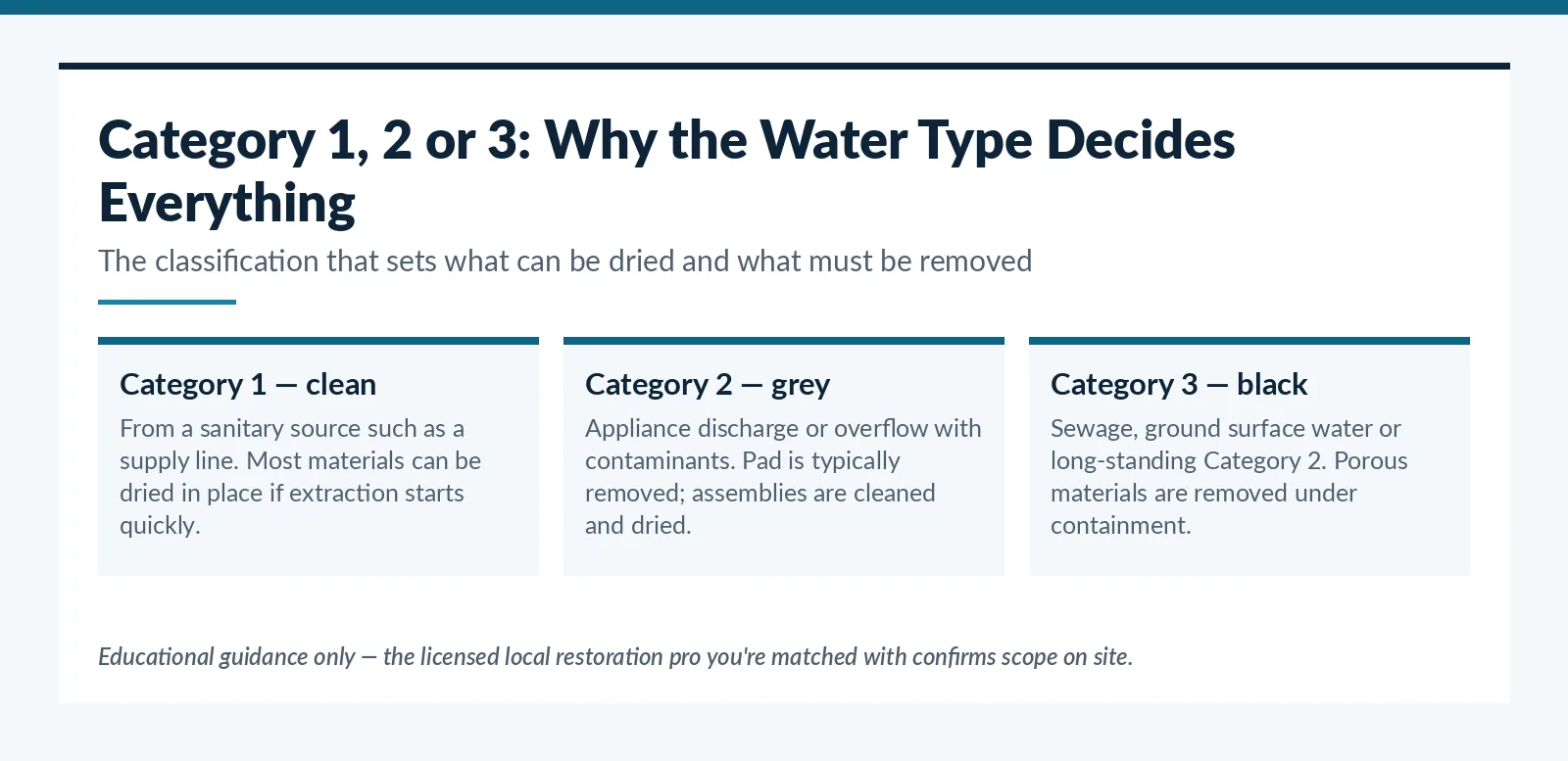
The three categories, in plain terms
Category 1 — clean water
Water from a clean source with no contamination risk: a broken supply line, a water heater failure, an overflowing sink from clean tap water. Category 1 water poses no immediate health risk, and if it’s addressed quickly, cleanup is typically straightforward extraction and drying. Left untreated for too long, though, Category 1 water can degrade into Category 2 as it sits and picks up contaminants from the materials it’s touching.
Category 2 — gray water
Water that carries a significant contamination level and could cause illness if ingested — think dishwasher or washing machine overflow, a toilet overflow with urine but no feces, or a Category 1 loss that’s been sitting long enough to degrade. Category 2 requires more caution and different cleaning protocols than Category 1, though it’s not the full biohazard containment level of Category 3.
Category 3 — black water
Grossly contaminated water that can contain harmful bacteria, viruses, and other pathogens — sewage backups, water from a toilet overflow with feces, and (in Tucson specifically) most monsoon floodwater that’s traveled overland through washes and streets, picking up whatever it crossed on the way. Category 3 requires full containment, protective equipment, and disinfection — and in most cases, porous materials that were saturated (carpet, pad, some drywall) can’t be cleaned to a safe standard and need to be removed rather than dried and reused.
Why monsoon floodwater is treated as Category 3
This surprises a lot of homeowners: water that “looks clean” coming in during a monsoon storm is still classified Category 3 in almost every case, because it’s traveled across streets, washes, and yards before reaching your home — picking up bacteria, chemicals, and debris along the way, regardless of how clear it looks. This is exactly why a crew responding to monsoon flooding suits up in full PPE even when the water in your living room doesn’t look visibly dirty. See our monsoon flood cleanup guide for the full response process.
Why classification changes the entire job
The category isn’t just a label — it drives every decision a crew makes:
- PPE and containment. Category 1 might need minimal protective gear; Category 3 requires full suits, respirators, and physical containment barriers to keep contamination from spreading to unaffected areas.
- What gets saved vs. removed. Category 1 water on carpet might be extracted and the carpet dried and kept. The same carpet soaked in Category 3 water typically has to be removed and disposed of — it can’t be cleaned to a safe standard.
- Disinfection requirements. Category 2 and 3 losses require antimicrobial treatment of affected surfaces after extraction; Category 1 generally does not.
- Cost. All of the above means Category 3 jobs cost meaningfully more than Category 1 jobs of a similar size — not because of markup, but because of the actual additional materials, disposal, and labor required.
Category can change over time — speed matters
A Category 1 loss doesn’t stay Category 1 forever. The longer clean water sits — especially in Tucson’s heat, which accelerates bacterial growth — the more likely it degrades toward Category 2. This is one more reason the EPA’s 24–48 hour drying guidance matters beyond just mold: acting fast can keep a cleaner, cheaper classification from turning into a more involved one.
What to tell the crew when you call
Describe the water source as specifically as you can: “supply line under the sink” reads very differently than “backed-up toilet” or “water that came in from the street during the storm.” That description helps determine what equipment and protective gear the crew brings on the first visit, rather than having to reassess and potentially return.
Get connected to a Tucson restoration crew
Whatever category you’re dealing with, the response needs to match it. Call now and we’ll connect you with a qualified, licensed local restoration company equipped for the specific water type you’re facing. For contaminated water specifically, see our sewage backup cleanup guide. You can also try our free water damage category checker tool for a quick self-assessment before you call.
→ Call now to connect with a local restoration crew
Frequently asked questions
What’s the difference between Category 1, 2, and 3 water damage?
Category 1 is clean water with no contamination (a broken supply line). Category 2 is gray water with significant contamination risk (appliance overflow, toilet overflow without feces). Category 3 is black water, grossly contaminated and requiring full containment and disinfection (sewage backups, most monsoon floodwater, toilet overflow with feces).
Why is monsoon floodwater considered Category 3 even if it looks clean?
Because it has traveled across streets, washes, and yards before reaching your home, picking up bacteria, chemicals, and debris along the way regardless of visual clarity. Restoration crews treat overland floodwater as Category 3 as a standard practice.
Can Category 1 water become Category 2 or 3 if I wait too long?
Yes. Clean water that sits, especially in Tucson’s heat, can degrade as bacteria develop, effectively becoming a higher category the longer it’s left untreated. This is part of why fast response matters beyond just preventing mold.
Does the water category affect whether my carpet can be saved?
Often, yes. Category 1 water on carpet may allow the carpet to be extracted, dried, and kept. Carpet and pad saturated with Category 3 water typically can’t be cleaned to a safe standard and are usually removed and disposed of.
Do you classify the water or perform the cleanup?
No. Tucson Restoration Pros is a referral service. We connect homeowners with independent, licensed local restoration companies that assess the water category and perform the actual extraction, containment, and cleanup.
Tucson Restoration Pros is a lead-generation and referral service. We are not a restoration contractor, are not affiliated with any government agency, and do not perform restoration, mitigation, or repair work. When you reach out, we connect you with one or more independent, licensed local restoration companies that handle the work, licensing, and insurance. In a life-threatening emergency, call 911.
Leave a Reply