Structural Drying in Tucson: Why “It Looks Dry” Doesn’t Mean It’s Actually Dry
A carpet can feel dry to the touch within hours of a water event and still be sitting on a soaked pad. Drywall can look fine from the front and be wicking moisture six inches up inside the wall cavity. This is the gap between “looks dry” and “structurally dry,” and it’s the single most common reason mold shows up two or three weeks after a water damage event that everyone thought was handled.
Tucson Restoration Pros is a free dispatch and referral service. We connect homeowners with independent, licensed local restoration companies that carry their own insurance and do the actual drying work — we are not a contractor and don’t perform restoration ourselves. This guide explains what “dry” actually means in a professional sense, so you know what to ask the crew you’re connected with.
Why Tucson homes hide moisture differently
Tucson’s dry climate cuts both ways. Low ambient humidity does help materials evaporate faster than they would in a humid climate — but it also means a homeowner can be badly misled by surface appearances. A tile floor over a slab can look completely dry within a day while the concrete underneath is still saturated. Drywall painted with a non-porous finish can hide a wet cavity behind it for weeks. And with most homes here built slab-on-grade, moisture that gets under the slab has nowhere obvious to show itself until it starts wicking up through grout lines or baseboards.
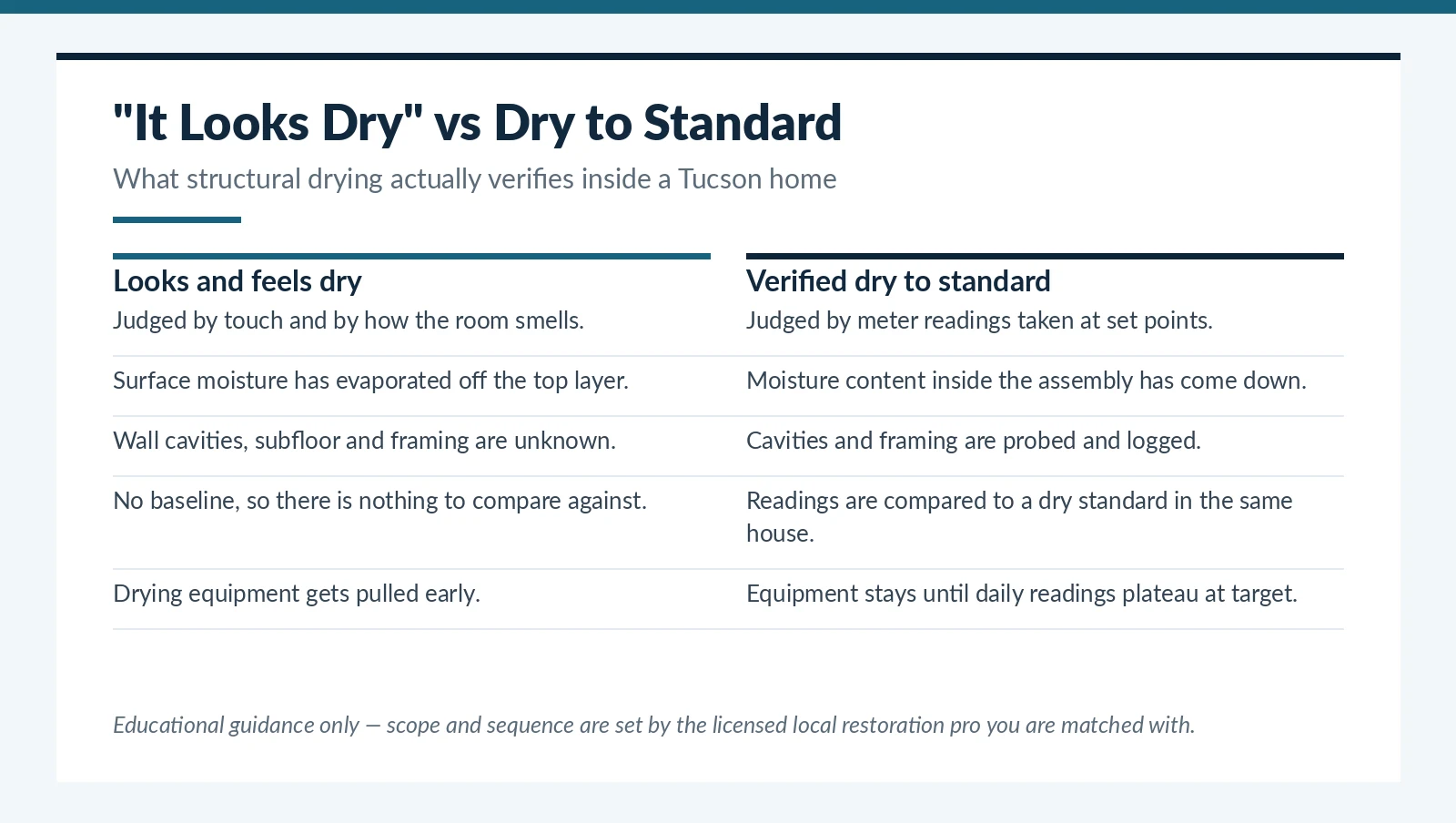
What “dry to standard” actually means
Restoration crews working to the IICRC S500 water-damage restoration standard don’t declare a job finished because a surface feels dry. They document a specific numeric drying goal for each affected material — based on that material’s normal (unaffected) moisture content elsewhere in the same house — and they don’t stop monitoring until instruments confirm the wet material has reached that target.
The instruments that do the actual verifying
- Moisture meters (pin and pinless) — measure moisture content inside a material, not just on its surface. A pinless meter can scan a wall or floor without puncturing it; a pin meter gives a more precise reading at a specific depth.
- Thermal (infrared) imaging — doesn’t measure moisture directly, but reveals temperature differences that often indicate wet areas behind a finished surface, letting a technician know where to take a moisture reading.
- Hygrometers — measure ambient humidity in the air of the affected space, tracked daily against a target (the EPA recommends keeping indoor humidity under 60% to help prevent mold growth).
A crew working a real drying job takes these readings daily, not once. The drying equipment gets adjusted based on what the numbers show, not left running blind on a timer.
Air movers and dehumidifiers: why both, and why placement matters
Air movers (commercial-grade, high-velocity fans) don’t dry a room by blowing air around generally — they’re positioned and angled to accelerate evaporation off specific wet surfaces, feeding moisture into the air. Dehumidifiers then pull that moisture back out of the air so it doesn’t just resettle somewhere else in the house or spike ambient humidity. Run air movers without adequate dehumidification and you can actually push humidity higher in adjoining rooms — one of the more common mistakes in an under-equipped DIY drying attempt.
Why the mold clock keeps running even after “it feels dry”
The U.S. EPA’s guidance to dry water-damaged materials within 24–48 hours is about starting drying quickly — it isn’t a guarantee that a material declared “dry” after 48 hours by feel alone is actually safe from mold. Mold can establish behind a surface that looks and feels dry if the material underneath never hit true dry standard. This is exactly why professional verification matters more than the calendar: a documented, instrument-confirmed dry reading is the only reliable signal that the mold risk has actually passed for that material. See our first-24-hours timeline for what should happen well before a crew ever gets to the drying-verification stage.
What to ask the crew you’re connected with
- “What’s the drying goal for this material, and how are you measuring it?”
- “Will you document daily moisture readings, and can I see them?”
- “How do you decide when equipment comes out — a timer, or a moisture reading?”
A crew working to IICRC S500 should have straightforward answers to all three. If the answer is essentially “we run the fans for a few days and then pull them,” that’s a surface-dry approach, not a structural-drying approach.
Get connected to a Tucson water damage crew
Whether it’s a fresh water event or a “looks dry but I’m not sure” situation from a few weeks back, call now and we’ll connect you with a qualified, licensed local restoration company that documents drying to standard — not just by feel. See the full water mitigation service or the water damage restoration hub for more.
→ Call now to connect with a local restoration crew
Frequently asked questions
How do I know if my house is actually dry after water damage?
Feel alone isn’t reliable. A restoration crew working to the IICRC S500 standard uses moisture meters and sometimes thermal imaging to take numeric readings and compares them to the unaffected moisture level elsewhere in your home, tracking daily until the wet material reaches that target.
Can drying equipment make things worse?
Yes, if it’s not balanced. Air movers accelerate evaporation, pushing moisture into the air — without enough dehumidification running alongside them, that moisture can raise humidity in adjoining rooms rather than actually leaving the structure.
How long does structural drying typically take?
It depends on how much water, what materials were affected, and how quickly drying started — but most standard residential water losses take a few days to about a week of monitored drying, verified by moisture readings rather than a fixed calendar date.
Is Tucson’s dry climate an advantage for drying?
It can help evaporation happen faster on exposed surfaces, but it can also mask deeper moisture — a dry-feeling surface over a slab or behind drywall doesn’t guarantee the material underneath has actually reached dry standard.
Do you provide the drying equipment and technicians?
No. Tucson Restoration Pros is a referral service. We connect homeowners with independent, licensed local restoration companies that supply their own equipment, technicians, and insurance and perform the actual drying and monitoring.
Tucson Restoration Pros is a lead-generation and referral service. We are not a restoration contractor, are not affiliated with any government agency, and do not perform restoration, mitigation, or repair work. When you reach out, we connect you with one or more independent, licensed local restoration companies that handle the work, licensing, and insurance. In a life-threatening emergency, call 911.
Leave a Reply